


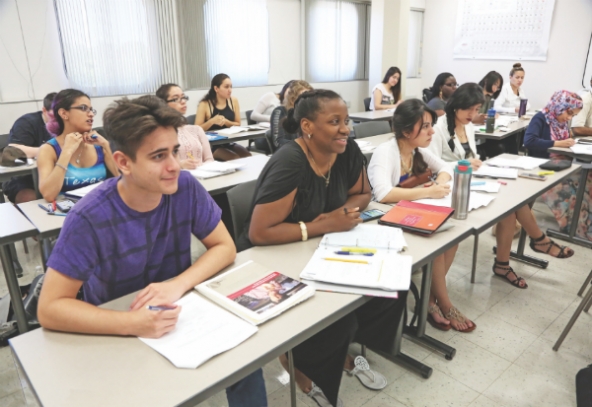
 Students at Wilbur Wright College, located in the Dunning neighborhood of Chicago, attend a chemistry lecture. (Photo courtesy of the City Colleges of Chicago)
During the last two decades of the 20th century, the City Colleges of Chicago (CCC) went into a kind of death spiral. CCC, a city-operated system that encompasses seven campuses, lost one-quarter of its students between 1985 and 2000, as enrollment dropped from 210,000 to 157,000. Over the next decade, enrollment declined another 30 percent. Chicagoans had good reason to turn away from CCC. According to a 1991 study by researchers from Harvard University, fewer than 1 in 10 CCC students ended up finishing either a one-year certificate or a twoyear degree. The researchers also estimated that among students who hoped to transfer to a four-year college, only 1 in 50 would earn a bachelor’s degree within six years.
Although CCC leaders had good intentions, they also had low expectations of students who entered the system. “They have so much confronting them, … it’s a wonder that they’re able to complete a course, let alone a degree,” said Zerrie Campbell, who was then president of Malcolm X College, in 2000. The system’s leaders also lacked a compelling vision for improving the situation. Wayne Watson, who was chancellor of the system from 1998 to 2009, once called CCC the “best-kept secret” in Chicago and suggested that its main problem was inadequate marketing. Other Chicagoans—especially those a liated with local employers—had a rather different outlook on the system. Jim Tyree, a businessman who served as chair of the CCC board of directors for 10 years, made his view of the institution’s academic quality vividly clear: “We teach irrelevant things poorly,” he says.
Today, though, CCC is in the midst of an ambitious turnaround effort—a systemwide reform initiative called Reinvention. The initiative began in 2010, and since then CCC has registered some impressive results. Between 2010 and 2015, enrollment in for-credit courses at community colleges declined sharply nationwide and in other parts of Illinois, but enrollment at CCC campuses rose by 10 percent. More important, the system began to produce better outcomes. The federally reported three-year completion rate for CCC climbed dramatically, from 7 percent in 2009 to 17 percent in 2015. (It still falls short of the national average for public community colleges, which stands at 22 percent.) The percentage of CCC graduates from eligible programs who transfer to four-year schools within two years of earning an associate’s degree increased modestly as well, reaching a new high of 49 percent.
Progress is also evident at individual CCC campuses. Consider Kennedy-King College, located in the Englewood neighborhood (where the poverty rate is roughly twice the city average). Its threeyear graduation rate jumped from 8 percent in 2009 to 26 percent in 2013. Among underrepresented minority students on that campus, 42 percent now graduate or transfer to a four-year college; the national average for other community colleges is 24 percent. In 2015, Kennedy-King was 1 of 10 finalists for the Aspen Prize for Community College Excellence. (Every other year, the College Excellence Program of the Aspen Institute gives the prize to institutions that demonstrate exceptional outcomes, particularly for minority and low-income students.) As part of that competition, Kennedy-King received Aspen’s Rising Star award for its record of “rapid student improvement.”
CCC exemplifies the pitfalls and the promise of public community colleges throughout the United States. For that reason, its performance matters a great deal. The system serves a student body that faces significant obstacles to success: About two-thirds of its students are African-American or Hispanic; 36 percent of its students (compared with 22 percent of Chicago residents as a whole) live below the poverty line; and 90 percent of its incoming students require one or more remedial courses. And because it serves those populations, CCC has the potential to function both as an engine of economic growth for its host city and as a gateway to opportunity for the city’s low-income residents—including not only recent high school graduates, but also minority and immigrant adults.
A turnaround on the scale of Reinvention isn’t supposed to happen in a broken big-city institution like CCC. But it has happened, and it’s still under way. Civic leaders in Chicago are rewriting the playbook for how urban community colleges operate. At the center of the effort is Cheryl Hyman, who has served as chancellor of CCC since 2010 and who played a lead role in developing the Reinvention effort.
Hyman attributes the early successes of Reinvention to a pair of factors. First, she and her team have built an institutional culture that is data-driven and goal-oriented from top to bottom. And second, they have developed a clear strategy and worked diligently to execute it. “You need a set of quantifiable goals that everyone can agree on, clear metrics for improvement that are tracked and reported publicly, and operational efficiency,” says Hyman. “If you have a culture that embraces change, it’s easier to absorb bumps in the road. I can’t stress that enough. But what keeps me up at night is how well we implement, how well it sticks.”
Failing To Connect
Before Reinvention, CCC suffered from deeply engrained problems. These problems were not unique to CCC. In fact, they remain common to community college systems across the United States. But by the late 1990s, politicians and community leaders—mindful of CCC’s role as a source of opportunity for low-income Chicagoans—were becoming impatient with the high costs of low performance.
Like other community colleges, CCC had a core strength that was also the source of its core weakness. The institution, which traces its roots to the founding of Crane Junior College in 1911, had long been known colloquially as “the people’s college”: CCC campuses were open to any student who had earned a high school diploma or its equivalent. Indeed, the expansion of access to millions of Americans who would otherwise have no route to postsecondary credentials represents a historic achievement for US community colleges. By the 1960s, a new community college was opening almost every week in the United States, and college had become accessible to anyone who was willing to enroll and work hard.
Yet open access had a dark side: Getting into college is not the same thing as graduating from college with a degree. For CCC, as for other community college systems, a commitment to access often took precedence over helping students to succeed. State and city policies rewarded increased enrollment rather than higher completion rates. Open access meant that CCC institutions were often the next stop for students who graduated from Chicago Public Schools (CPS). In many cases, those students were simply not ready for college. By the 1980s, this problem had grown particularly acute. “I don’t think there is a [K-12] system as bad as the Chicago system,” US Secretary of Education William Bennett told The New York Times in 1987. That same year, half of Chicago’s public high schools ranked in the lowest- performing 1 percent of schools nationwide that administered the ACT exam (a widely used college admissions test). During this era, as many as 95 percent of CPS graduates who enrolled at a CCC campus had to take at least one remedial course—and half of those students dropped out before earning a semester’s worth of credits.
Not surprisingly, few CCC students were able to complete a degree and then transfer to a four-year college. As a result, working relationships between those institutions and CCC were weak. Equally important, relationships between CCC and Chicago companies that sought well-trained employees were also tenuous. Vocational studies in Chicago’s community colleges had languished for decades. In the 1990s, a tightening job market drove employers to look anywhere and everywhere for skilled workers. CCC was of little assistance. The system had operated a single, stand-alone vocational campus, but it closed that facility in 1993.
The persistent inability of CCC to support employers and their hiring needs catalyzed two politically sophisticated groups: community-based workforce organizations, which seek to develop job opportunities for residents; and members of the city’s business elite, who focus their attention on drivers of economic growth—including, in particular, the supply of workers who can fill middle-skill jobs. From the bottom up and from the top down, these advocates set in motion a campaign to bring new leadership and a new vision to CCC.
Setting The Stage
In 1996, a public policy researcher named Davis Jenkins moved to Chicago to take a job at the University of Illinois-Chicago that focused on helping to accelerate the transfer of industrial technology to small firms. An activist as much as an academic, Jenkins soon connected with people from several employment and training organizations in Pilsen, a largely immigrant neighborhood. Over the next several years, he collaborated with those groups—which included the Mexican Community Center and Instituto del Progreso Latino—on various projects. The Mexican Community Center, for example, was working with Morrison-Knudsen, a large civil engineering company that was having a hard time finding qualified workers to fill jobs that involved refurbishing train cars. Jenkins joined with people from the center to develop “bridge” programs to help people master both the technical skills and the English-language skills they would need to do those jobs.
In the early 2000s, the training groups turned to CCC for help, assuming that the community college system would be a natural ally in their efforts. CCC had buildings and equipment in underused training centers; the community groups had people and programs that could put the facilities to good use. But CCC leaders had no interest in the offer. “We saw the potential for community-based partnerships with community colleges and employers,” says Juan Salgado, CEO of Instituto (and a 2015 MacArthur Foundation genius grant winner). “But we had no cooperation from the college system.” Jenkins is still angry about it. “Here were the City Colleges, doing so little. Everybody hated the community colleges,” he says.
Other players joined the cause. In 2005, Brian Fabes, a former McKinsey & Co. consultant with a background in higher education, became director of the Civic Consulting Alliance (CCA), a nonprofit group that focuses on supporting public-private collaboration in the Chicago area. Before long, Fabes was deeply engaged with issues related to employment and training—and he soon became aware of CCC’s inadequacies. Arne Duncan, who was then head of CPS (and who later served as US Secretary of Education), asked Fabes to help CPS improve career and technical education so that more young people could work for local firms. Fabes remembers telling Greg Darneider, a CPS official, that high school vocational programs should be “articulated to”—aligned with, in other words—community college offerings. Unable to check his frustration with CCC, Darneider shot back: “Articulated to what, exactly?”
Fabes and his team decided to bring the issue of CCC’s deficiencies to the attention of Mayor Richard M. Daley. (In Chicago, the mayor plays a pivotal role in overseeing CCC.) Daley had regular monthly meetings with Chancellor Watson, and in advance of those meetings, Fabes found ways to provide Daley with devastating data on CCC student outcomes. He also kept up a steady drumbeat of messages about wasted opportunity: Why, Fabes asked, was the community college system absent from citywide partnerships to improve economic growth and educational attainment? At the time, however, Daley was focusing his attention on K-12 reform and had no inclination to undertake reform at CCC.
Eventually, Fabes got lucky. He found a receptive audience for his message in Michael Macpherson, president of the Spencer Foundation. To gauge the appetite for reform, Macpherson offered to host a meeting that would bring together national community college experts and leaders from CCC, Chicago city government, and various civic and business organizations. In October 2006, 40 people convened for what turned out to be a pivotal event. “Employers acknowledged that most of them had prospered without relying on City Colleges and did not envision relying on them in the future,” Fabes recalls. Communitybased groups reiterated their frustration with the underutilization of CCC training centers. National experts offered a harsh assessment of CCC’s performance. Chancellor Watson tried to deflect blame for the system’s shortcomings onto the business community. “This all went south pretty fast for the City Colleges’ leadership,” says Fabes.
After the meeting, CCA developed a proposal to engage the Boston Consulting Group and the Federal Reserve Bank of Chicago to form a team that would define a new vision for CCC. Daley approved the proposal. The team was heavy with leaders from the corporate world, but it also included heads of nonprofit, foundation, and civic organizations. Following a series of meetings, the team arrived at a set of recommendations. CCC’s top priority, according to a report issued by the team, should be to “find ways to help thousands more to better employment and then demonstrate that success to prospective students and supporters.”
Building A Vision
By 2008, pressure from community and business leaders had made an impact on Daley. He began to signal publicly that it was time for a change at CCC. That year, Watson announced that he would resign his position as chancellor in 2009. Daley decided that he didn’t want to nominate an educator to fill the open position, and he asked his associates to suggest candidates. Frank Clark, CEO of the electric utility Commonwealth Edison (and a close friend of Daley), recommended Cheryl Hyman, who was a vice president at the utility.
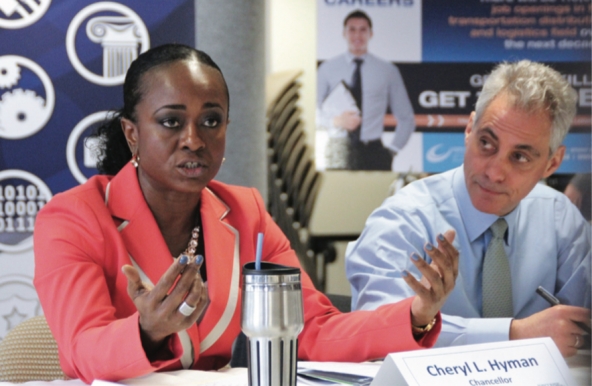 Cheryl Hyman,
chancellor of the City Colleges of
Chicago (joined by Chicago mayor
Rahm Emanuel), speaks to a
delegation
from the World Bank. (Photo courtesy of the City Colleges of Chicago)
Cheryl Hyman,
chancellor of the City Colleges of
Chicago (joined by Chicago mayor
Rahm Emanuel), speaks to a
delegation
from the World Bank. (Photo courtesy of the City Colleges of Chicago)
Hyman has a life story that reads like a Hollywood script. She grew up in Chicago public housing facilities, and her parents struggled with addiction. She dropped out of high school and was homeless for a stretch. Yet she got her life back on track, earned her high school diploma, and entered Olive-Harvey College, a CCC campus on the city’s South Side. She then earned a bachelor’s degree in computer science at the Illinois Institute of Technology and went on to land a job at Commonwealth Edison, where she rose through the ranks to vice president. By the end of her tenure there, Hyman was in charge of a team that identified cost efficiencies across the company—a high-visibility, high-stress position that taught her a lot about institutional change. “I wouldn’t have been prepared for this job [chancellor of CCC] if I hadn’t had that one,” Hyman says. “I learned how to play in everyone else’s sandbox and how to figure out solutions that could be implemented.”
When Daley interviewed Hyman, he took to her immediately. Her large personality didn’t fit either the corporate or the higher education mold. She dressed boldly and brightly. She spoke her mind freely. It didn’t hurt that Hyman was a CCC alumna. The day after that interview, on her own initiative, Hyman sent the mayor a PowerPoint deck that set forth her vision for a systemwide “reinvention” (as she called it) of CCC. In the spring of 2010, Daley nominated Hyman to the chancellor post, and the Chicago City Council confirmed her appointment.
A few weeks before her confirmation, Hyman met with a small group of advocates that included Jenkins, Salgado, Fabes, and Anne Ladky, the head of Women Employed, a Chicago-based nonprofit that promotes opportunities for women. (Ladky was also a CCA board member.) The meeting—organized by the Joyce Foundation, a prominent regional funder that focuses on education and workforce issues—lasted five hours. In speaking with the advocates, Hyman emphasized her work to achieve system efficiencies at Commonwealth Edison. Her presentation impressed them, but it also raised questions. “Here was a very appealing person, with a great personal story and lots of guts. She clearly understood what was needed at an operational level,” Ladky says. “But what would she bring to the table on the educational side?” Jenkins (who was now a senior researcher for the Community College Research Center at Teachers College, Columbia University) had similar concerns. He worried that Hyman’s plan would be dead on arrival if it didn’t resonate with CCC educators.
The next day, Jenkins sent an email to participants in the meeting. In the message, he laid out four educational goals for the system: First, increase the number of students who earn degrees of economic value. Second, increase the rate at which students transfer to bachelor’s degree programs after graduating from a CCC institution. Third, improve outcomes for students who require remedial instruction. And fourth, increase the share of poorly prepared students who advance to, and succeed in, college-level courses.
Right away, Hyman saw the power of these goals. For one thing, educators could hardly disagree with them, given that they put students first. For another, they reinforced her conviction that modest, incremental change would not be enough to revitalize CCC. Meeting the first goal, for instance, would require CCC to pay much greater attention to employers’ needs in the design of its curricula. Meeting the second goal, similarly, would not only require CCC to strengthen its relationships with four-year institutions, but also test the rigor of CCC courses.
Hyman adopted these goals, and they became the foundation for Reinvention—a set of touchstones for assessing and reporting progress, and for saying yes or no to new ideas. “There was bound to be a lot of acrimony about the right approach to achieving the goals—and there surely was [acrimony]. But there was never any real questioning of the goals,” says Alvin Bisarya, a former McKinsey consultant whom Hyman tapped to be her first vice chancellor for strategy. (Bisarya left that post after a few years and now works at Kaplan, Inc.)
Making A Bold Start
In November 2010, Daley and Hyman announced the Reinvention initiative. In the months before and after launching Reinvention, Hyman and her team at the Central Office of CCC worked to develop a powerful case for reform. In their first public report on the initiative, they pulled no punches. The report highlighted six data points that together told a bleak story: declining enrollment, completion rates far below those of CCC’s best-in-class peers, weak first-year retention, poor outcomes for students who needed remedial math and English, programs that did not align with employers’ workforce demands, and adult education programs that failed to help students transition to for-credit courses. These data points underscored the core message of Reinvention: CCC could not tweak its way to success.
This commitment to open and honest public reporting caught the attention of people who became important allies of Reinvention. “Cheryl was willing to be transparent about the system’s performance on what [CCC leaders] are least proud of,” says Larry Goodman, CEO of Rush University Medical Center and a member of the CCA board. At the same time, Hyman and her colleagues recognized that transparency would not be enough to help them meet their goals. “We knew that you can hold the moral high ground for a while—but only if you deliver,” says Bisarya.
In particular, Hyman and her team needed to deliver some quick, visible wins. Toward that end, she tapped into her Commonwealth Edison experience and solicited help from the private sector to identify operational efficiencies. Several consulting firms responded to that call: KPMG drilled down on CCC’s procurement policies. Accenture helped upgrade the system’s information technology capabilities. McKinsey worked with Hyman to develop a long-term plan for CCC. As a result of these efforts, the system found $51 million in savings and reallocated those funds to support Reinvention projects.
To engage faculty members and campus administrators, Hyman established a set of Reinvention task forces. She created seven such groups, so that each campus president could oversee one of them. Under this strategy, nearly 100 faculty and staff members left their campuses for a semester and formed what amounted to internal consulting groups. The mandate of the task forces was to identify solutions that would be (in Hyman’s words) “student-centered, data-driven, and research-based.” Hyman also decided to create a space in CCC’s headquarters building where task force members could work together intensively. CCC took one wing of the building’s sixth floor and remodeled it to house the task forces. “It was very high risk,” Bisarya says. “As we built it out, I kept asking myself whether I would have had the courage to do that.”
Substantively, the task force strategy enabled CCC’s Central Office to leverage the expertise and insights of faculty members. Politically, this approach encouraged participants to take ownership of Reinvention: When they returned to their campuses, many faculty members became emissaries of change.
Along with studying community college innovations in other cities, the task forces looked for efforts within CCC that had the potential for systemwide expansion. Three campuses, for example, had installed Wellness Centers, which link students to counseling and other services. Through Reinvention, CCC extended these centers to all campuses. Another innovation, which was initially available only at Truman College, helps non-credit adult education students move into for-credit programs. The system has now replicated that offering at three additional campuses. In a related move, CCC expanded its advising staff and cut its student/advisor ratio drastically. By 2015, the ratio had dropped from 900-to-1 to 250-to-1.
Confronting Opponents
“When people ask me for advice,” says Hyman, “I tell them that the first thing is: You need to have the guts to take on the critics.” Fairly early in the Reinvention effort, Hyman took steps to signal to opponents both inside and outside CCC that she would pursue change vigorously—and, if necessary, aggressively.
For decades, the insularity of the Central Office had left each campus president free to pursue his or her own interests. After having limited success in her attempt to win the support of sitting campus presidents, Hyman took a different tack. She took advantage of a feature that sets CCC apart from most community college systems: The chancellor has the authority to make policy for all seven campuses and to hire and fire campus presidents. In addition, the mayor of Chicago has the authority to appoint members of CCC’s governing board. This unusual governance structure makes it easier than it is in most cities for officials to implement a centralized reform initiative.
In February 2011, Hyman asked the presidents at six campuses to submit their resignations. (Hyman had just appointed Don Laackman, a principal at CCA, to replace an interim president at the seventh campus, Harold Washington College.) She invited them to reapply for their jobs but made it clear that all applicants would have to show a commitment to meeting the four core goals of Reinvention. One of the presidents, Jose Aybar of Daley College, reapplied (and did so successfully).
Hyman sent an equally provocative message to community leaders who liked having high-status programs on their local campus but showed little concern for the quality of those programs. In 2010, she learned that a poorly performing nursing program on one campus lacked proper accreditation, and she moved swiftly to shut it down. Community leaders, including powerful aldermen, protested the move. But Hyman refused to back down and insisted that performance, not patronage, would drive such decisions.
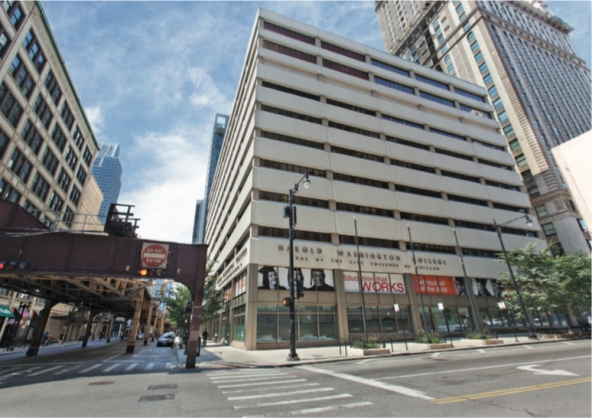 Harold Washington
College occupies part of a city block in
the central business district of Chicago. (Photo courtesy of the City Colleges of Chicago)
Harold Washington
College occupies part of a city block in
the central business district of Chicago. (Photo courtesy of the City Colleges of Chicago)
Local talk shows took aim at Hyman. Websites sprouted up to attack her for a variety of supposed sins: being autocratic, firing good people, manipulating data, ignoring faculty members, overpaying consultants, and so on. Media outlets eagerly reported on Central Office staff and budget increases. Yet opposition to the Reinvention initiative had little staying power, and it eventually faded away.
Several factors account for the ability of Hyman and her team to overcome resistance. She aligned herself with CCC’s customers—with students, employers, and four-year institutions. She also drew an array of effective allies to her side. Goodman challenged the business community to abandon its natural skepticism of public-sector institutions. Ladky and other local advocates used their credibility to blunt community-based complaints. Salgado, for example, joined the chancellor’s Community Advisory Council and thereby sent a signal of support for Reinvention.
In addition, Hyman has a life story that gave her leeway to act boldly. She knew CCC from the inside, and she had left a prestigious job in the private sector in order to make the institution better. So it wasn’t easy for critics to question her motives. At the same time, she worked to avoid being a lightning rod for criticism. At public meetings, she often let others on her team take the lead in speaking for CCC. “Good leaders know that they aren’t the smartest ones in the room and that they need help to make serious change,” she says. Bisarya suggests that Hyman is an atypical change agent: “Most reformers are like me: They think they know best. They come in with a lot of arrogance and ‘saviordom.’ She just doesn’t have that.”
Finding A Focus
In its first year, the Reinvention initiative gained traction but did not always demonstrate a clear sense of direction. CCC leaders layered one ambitious reform atop another. They revamped the system’s registration process. They piloted an automated early-warning system that identifies and contacts students who are at risk of failing a course. At times, it seemed as if they were throwing every available reform idea against a wall, just to see which ideas would stick. A second public report on Reinvention, released in 2012, listed several broad goals—“Boosting Readiness,” “Boosting Retention,” and so forth—and presented an array of new or recommended changes under each goal. “The chancellor faced a real dilemma,” says Ladky. “In most turnaround situations, a new CEO might know that there are four or five big things to fix. But in her case, there were maybe 25 things to fix.”
How could Hyman and her team streamline a wide range of ideas and activities into a coherent reform program? Somewhat unexpectedly, an answer to that question emerged from a change in leadership at City Hall. In February 2011, Chicagoans elected Rahm Emanuel to replace Daley as mayor. Emanuel, who had served as chief of staff for President Barack Obama, was eager to make his mark on the city’s institutions. At the urging of business and civic leaders, he decided to embrace Reinvention. As one observer recalls, the new mayor essentially told Hyman to “double down” on what she was doing.
On his own, meanwhile, Emanuel took steps to raise the stakes for CCC and its turnaround effort. In December 2011, he gave a highly anticipated speech to hundreds of city leaders at the Economic Club of Chicago. In the speech, Emanuel emphasized how important CCC institutions are to economic growth and equity. “The community college is the link our employees and employers need,” he declared. “But it has been missing in action.” He talked about meeting a young man who was working at a Target Corp. warehouse while studying business and computers at Harold Washington College. Emanuel, citing that student, then posed a challenge to the CCC system: “When he puts Harold Washington [College] on his résumé, that should mean something to his employer. It should have economic value to him.”
Emanuel also used the speech to announce the launch of College to Careers, a CCC initiative that Hyman and her team had developed in collaboration with the mayor. College to Careers grew out of a startling observation: The CCC catalog listed more than 200 occupational programs—yet prospective students had no way to discern which programs would set them on an appropriate career path. What students needed was a smart, simple tool that would help them navigate their educational choices. “We went occupation by occupation, looking at the demand and wage projections. Then we looked at the education level that employers expected for new hires,” says Meredith Sparks, associate vice chancellor for workforce and economic development. On the basis of that work, Sparks and her colleagues identified six broad industry clusters that align both with high-growth job categories and with CCC occupational programs: advanced manufacturing; information technology; health care; business and professional services; culinary arts and hospitality; and transportation, distribution, and logistics (TDL). Soon afterward, CCC added a seventh industry cluster: education. These clusters represent 80 percent of the city’s projected job growth over the next several years.
 At the
Washburne Culinary Institute, which is
part of Kennedy-King College, students
learn the fine points of plating food. (Photo courtesy of the City Colleges of Chicago)
At the
Washburne Culinary Institute, which is
part of Kennedy-King College, students
learn the fine points of plating food. (Photo courtesy of the City Colleges of Chicago)
College to Careers became a vehicle for bringing focus to Reinvention: It helped unify the initiative’s multiple moving parts, and it highlighted the role that CCC could play as an engine for economic growth in Chicago. In a significant move, CCC leaders designated each campus as a “center of excellence” in one of the seven occupational clusters. As part of that process, they consolidated duplicate programs at different campuses. Olive-Harvey, for example, became the hub for TDL programs. Malcolm X College, located in the city’s vibrant medical district, became the health career campus. With strong encouragement from Emanuel, Hyman and her team began to ask influential employers to engage with the CCC campus that serves their industry. The CCC team invited companies to review program curricula, to market their industry to students, and to provide internships and other work-based learning opportunities.
Each occupational cluster corresponds to an educational focus area—to a “pathway,” as people in the community college field call it. For each pathway, CCC established a set of clearly defined course requirements, along with a course sequence that students should follow to accelerate their progress toward completion of a degree. As part of this effort, CCC leaders identified industry-recognized credentials that students could gain on their way to earning an associate’s degree: Students on the TDL pathway, for example, could work to receive a commercial driver’s license. The Central Office also developed program maps that gave visual form to each pathway and began using those maps to organize CCC’s course catalog.
Setting A Course
In 2012, Hyman and her team issued a five-year strategic plan for CCC, and Hyman coined a motto for the plan: Reinvention7—in other words, reinvention to the seventh power. With this plan, CCC leaders aim to weave the spirit and practice of Reinvention deeper into the fabric of activity at each of the system’s seven campuses. Equally important, the plan sets forth 24 measurable benchmarks of progress toward the institutional and educational goals of Reinvention. Data on CCC’s performance against those benchmarks now appears in the system’s annual Reinvention report.
CCC leaders are using the benchmarks to support data-driven management at all levels of the system. The Central Office team meets with student services deans and counselors to review trends for particular student groups—those who are failing courses, for example, or those who “stop out” (that is, temporarily withdraw) after enrolling as CCC students. Hyman conducts similar reviews in meetings with her leadership team and with campus presidents.
In 2013, Rasmus Lynnerup replaced Bisarya as vice chancellor for strategy. Lynnerup, a former McKinsey consultant with extensive private sector experience, continued the work of reorganizing CCC course and program offerings into well-defined pathways. About this time, CCC added three academic focus areas (human sciences, natural sciences, and construction technologies) to its seven occupational focus areas. In addition, Lynnerup and other CCC leaders used the concept of structured pathways to inform a dramatic revamping of how new students move through the CCC system. In doing so, they drew on a growing body of research that identifies an excess of choices and a lack of clear guidance as serious obstacles to student success. According to this research, many students—especially first-generation college-goers—easily become overwhelmed by the multitude of options that colleges provide. As a result, they make poor choices, put off critical decisions, and then drift until they eventually drop out.
“Applying to college means making a choice,” says Lynnerup. In the summer of 2014, CCC undertook an intensive effort to train advisors in helping students arrive at choices that work for them. More specifically, the goal of this effort was to encourage and enable students to take two crucial steps: First, they should select and commit to one of CCC’s 10 focus areas. And second, they should develop a customized plan for completing pathway requirements. Progress toward this goal has been rapid. One-third of all CCC students who enrolled in classes for the fall 2014 semester—about 70 percent of full-time students—chose a focus area and created a plan. And as of the fall 2015 semester, all degree-seeking students routinely take those steps.
Reckoning With Challenges
Today, a half decade after the launch of Reinvention, there are signs that a turnaround at CCC is well under way. Since 2010, the number of associate’s degrees earned by CCC students has more than doubled, and the number of certificates earned has risen by 22 percent. As yet, it’s not clear how sustainable these achievements will be. In 2013, CCC met or exceeded 20 of the 24 targets in its five-year plan—but in 2014, the system met only 15 of its 24 targets. Enrollment has also dipped over the past two years (in part because an improving economy has drawn students away from school and into the workforce). Before CCC can meet the core goals of Reinvention, it will need to make further progress on three enduring challenges.
Student preparation for college work | Asked to name the greatest challenge that CCC faces, Hyman offers a ready answer: “Remediation,” she says. “It’s where we have had the least success and where the need is greatest.” Early in the Reinvention effort, she and her team delayed tackling this problem because it’s both inherently difficult and politically complex. But they recognize that progress on student outcomes overall depends on making headway on this challenge. Today CCC is piloting new approaches that will reduce placement into remedial courses, strengthen academic support for first-year students in core courses, and align math and English requirements with the skill and content expectations of employers and four-year institutions. Although the approach is still in development, the guiding principle behind it is clear: “If you are at City Colleges, you understand from the outset that you are on track to go someplace,” Ladky says.
Employer engagement | The second challenge hinges on whether companies will regard CCC as a reliable source of qualified workers. Progress in this area has been solid. Between 2013 and 2015, CCC occupational programs helped place more than 2,300 graduates in jobs, and today about 100 Chicago-area companies are participating in CCC internship programs. Thanks to Emanuel’s “gentle nudging,” Hyman notes, an increasing number of civic-minded companies are engaging with the CCC system. The insurance giant Aon, for example, is hiring CCC students as interns for the first time ever and has hired several of them into full-time jobs upon graduation. Yet big questions loom over the system’s College to Careers initiative: Will employers generate large numbers of middle-skill jobs that align with CCC occupational programs—and will they hire CCC graduates to fill those jobs?
Quality of learning | The third challenge is a byproduct of Reinvention’s early success in raising students’ expectations. As more students see that transferring to a four-year college might be possible, and as more of them commit to careers that require a four-year degree, the quality of CCC learning will become increasingly important. Will universities welcome CCC graduates and give them full credit for CCC courses and programs? On that question, a recent expansion of the city of Chicago’s Star Scholarship program offers an encouraging sign. Under that program, anyone who graduates from a CPS high school with at least a B average can attend a CCC institution free. In August 2015, the city announced that Star Scholarship recipients who complete a degree at a CCC campus and then transfer to a participating four-year college will receive a tuition grant from the city. This year, seven Chicago-area four-year institutions signed on to participate in the program, and about 1,000 first-year students are eligible to benefit from it.
Looking Ahead
It will take time to master the big challenges that CCC faces. But is there enough time, given that Reinvention is already in its sixth year? Hyman, like other leaders of the turnaround effort, expresses cautious optimism. “We’re probably 40 to 50 percent of the way there,” she says. “We are working for culture change from the bottom to the top. Culture and data—that’s the institutional foundation for keeping continuous improvement going.” At the same time, Hyman retains lofty ambitions for CCC. “I’ll know we are successful when a City Colleges degree is regarded as equal in value to any other degree,” she says.
For now, the CCC leadership team remains stable, and external support for the Reinvention initiative remains strong. Hyman and her team appear to have earned an extended grace period—and that asset will be essential if progress on outcomes falters, or if political and fiscal conditions shift. In any event, the work of turning around CCC has reached a point of no return. “We are engaged in transformational change,” says Lynnerup. “[We] can’t go back. Once the butterfly is out of the cocoon, there is no going back in.”
Read more stories by Richard Kazis.