


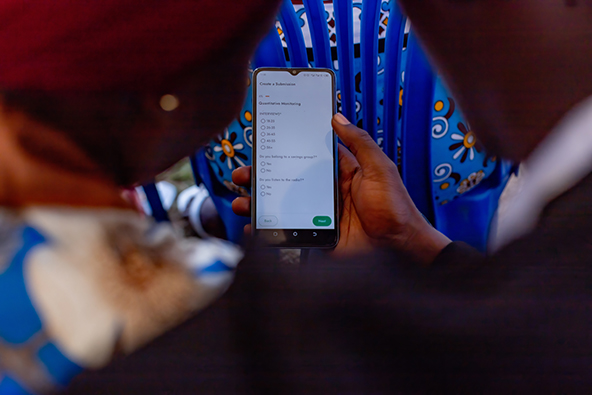
 (Photo courtesy of CARE Uganda)
Eight percent is a number that will not impress anyone. In our work in Uganda, CARE has digitized 500 savings groups, tracked millions of shillings in loans through a digital platform, and kept portfolio-at-risk below 1 percent. These are the kinds of numbers that headline a program report. But when we decided to look at individual women’s actual behavior—not group performance, not repayment rates, but whether a woman was independently using digital savings or loans on her own—the number we came up with was that one, 8 percent.
That number is not scale … at least not yet. But what it is, that’s more important than scale, is real.
The Danger of Scale-Sashing
There has been a lively argument about scale in this publication. Is the social sector’s obsession with scale productive? Is it mostly performative? Does it remain the only honest response to the size of the problems we face? We are not going to settle that argument. But as practitioners who have achieved scale once—with savings groups—and are now trying to do it again in a digital context, we’ve been asking a different question: what does scale actually demand of us before we begin, and who gets left behind when we skip that work?
There is a version of scale that quietly optimizes for whoever is easiest to reach. In digital financial inclusion, that tends to mean men, who are more likely to already own a phone and control how they use it. And it means that the harder, slower work—the kind of change that would actually protect the women furthest from reach—gets left out of this grant cycle.
We call that scale-washing. It isn’t unique to financial inclusion. Any technology that promises to accelerate impact—AI included—moves fastest toward whoever is easiest to reach. But that means it often does the least for the women that it was supposed to matter for the most. Digitizing without making sure she can use the tool herself actually doesn’t close that gap, but widens it.
This is not an argument against ambition. It is an argument for getting scale right.
Real Scale Is Built on Trust
We could frame eight percent as a failure. Many in the sector would, and by the metrics that usually get funded, it looks like one. But that eight percent is eight percent more than we ever had before. These are women who had never held a formal financial record, never had a credit score, never been visible to a bank. We made a difference in their lives. And if the history of savings groups teaches us anything, it is that scale is earned the same way trust is: slowly, and by the people who have to live with it. And trust is not built on shallow change that easily spreads across large numbers, but on the kind of change that sometimes is built slowly, but deeply.
We’ve been here before: a handful of women in a village in Niger in 1991, pooling small amounts, lending to each other, keeping records in a notebook. They were already doing this, but CARE’s role was to watch, adjust, and ask: does this still work for you, what would make it better, what are we getting wrong? That loop, watch, adjust, ask again, is the actual mechanism. Call it women-centered design: not just a CARE scaling strategy, but a way of designing that never stops asking whether it still works for the women it was built for.
It spread the way it did because women ran the groups. They kept the records. They enforced the rules. No CARE staff member needed to be in the room for a savings cycle to function. Today, more than 100 million people across Sub-Saharan Africa participate in VSLAs, and nobody handed them that scale. An innovation can scale in three different ways: It can scale out, reaching more people and places through replication; scale up, as institutions and policy absorb it; or scale deep, as it reshapes the underlying values and relationships in a community. VSLAs did all three. They scaled out, reaching more women, more villages, more countries. They scaled up, as governments began recognizing and funding savings groups as part of their own financial inclusion strategies, and other organizations adopted the model. And they scaled deep, because women trusted the model, ran it themselves, and had no reason to abandon it once we stepped back.
That’s rare. Most efforts manage one of the three. But “scaling deep,” in its usual definition, is a claim about trust, and trust is often difficult to verify from the outside. A program can look like it’s working the whole time it’s actively there and fall apart the moment the support leaves. So the real test is whether a woman keeps using the tool after the support ends, when no one is checking on her anymore.
Normative Change Takes Time
Reach without depth is not just a different version of the kind of success we are seeking. It is a weaker thing wearing the same name. Digital savings groups can follow the same arc, though it hasn’t cleared the bar just yet. Pretending otherwise would repeat exactly the mistake savings groups themselves avoided: designing for what we want to report rather than what women are actually asking for.
What stands between a woman and independent use of a digital tool is often treated as a footnote, a line item funded after the technology budget rather than the foundation the technology sits on. But normative change—whether a woman is allowed to hold a phone, whether her husband trusts what she’s doing on it, whether her community sees a digital record as opportunity or something to be suspicious of—is something that doesn’t move on a grant cycle’s timeline.
Women in low- and middle-income countries are, according to GSMA’s Mobile Gender Gap Report , 36 percent less likely than men to own a mobile money account, and that gap has widened since 2021. In our own Uganda programs, internal survey data has found that over 60 percent of women report hearing of violence linked to phone use in their communities. That’s not a side detail to design around. It’s the actual work: sitting with communities long enough to understand the values and fears already in place and building alongside women and the men in their households.
And so, we go at her pace, not ours. The dominant tech world’s instinct is to move fast and break things, but ours can’t be, since what breaks isn’t a product, but her savings, her standing, and her trust (some of it already worn thin by mobile money scams she’s seen before). If a program moves faster than a woman is actually ready to move, it does not accelerate her progress, it outruns her. A tool that arrives before the trust underneath it does is not a shortcut. It is a program getting ahead of the life it was supposed to change. Going at her pace is the only version of this work that leaves an actual mark on her life instead of just a mark on ours.
We’ve bet on that pace before and had it pay off. We wrote last year in this publication about the decades of advocacy, peer learning, and coalition-building that it took for savings groups themselves to spread organically. None of it was fast. All of it was necessary. Digitization is asking the same patience of us again, for a technology that touches the same fault lines around a woman's autonomy and economic participation.
The barriers aren’t only social. An entry-level smartphone can eat up a month’s income for the poorest 40 percent of households, and a platform that requires a data connection and a touchscreen has been designed for the women who need it least. That’s why USSD, the basic text-menu system available on any phone at any signal strength, should be the default. But USSD has a hidden cost of its own: session fees, small but usually paid behind the scenes by a funder, so the service often ends when the funding does. The more durable fix is to tie that cost to something worth paying for, such as a loan, so a lender or the group has reason to cover it. The same logic tells us when smartphones earn their place: when a lender needs what a text menu can’t capture, such as ID scans, photographs, and signatures. Even then, smartphones, shared or not, suit fewer contexts and need more care to keep each woman’s record her own. And whatever the channel, a tool only works if she can use it. Our fintech partner in Uganda, Ensibuuko, has found that what works is months of coaching from trusted local community members, known as Digital Community Entrepreneurs. That work is slow, unglamorous, and hard to fund, but it produces trust rather than a dashboard number.
We work inside systems of poverty, so entrenched that no single tool is going to solve the problem. A phone in her hand, a credit score attached to her name, a savings account at a local bank: each of these is a real chance for a woman that the formal economy had written off to build something of her own. That’s worth real hope. But hope needs infrastructure. She still needs access to a market that pays a fair price, land and inputs she can control, a government willing to recognize the savings group she already built. That’s work for advocacy, market programs that connect her to real buyers, and partnerships doing the parts of this a phone was never going to do. The tool gives her a real shot at lifting herself and her family out of poverty. Our job, and the job of everyone working alongside her, is to keep chipping away at what’s still stacked against her and clearing the rest of the ground.
Demand-Driven Scale
Most digital financial inclusion is supply-led, starting from what a bank, fintech, or platform needs to reach a target population or hit a profitability threshold, then asking women to adapt to it. The alternative, sometimes called demand-driven design in this sector, means building only what women say they need, on the terms they set, delivered the way they actually want it, and treating her independent use of it, not her enrollment in it, as the real measure of whether it worked.
That independent use is the clearest signal of genuine demand there is. A woman who keeps using a tool on her own, months after a field officer has stopped checking in, is telling us something an enrollment number cannot: that the product actually met her where she was. (It’s why we keep asking rather than assuming we already know).
Demand also depends on how big a problem the tool solves. Digital record-keeping apps can bring real benefits, from accuracy to transparency. But Ensibuuko has found that use holds best when that record unlocks something women already want and will return to unprompted, and access to credit is one of the clearest examples.
Our Digital Data Trails for Credit (DDT4C) pilot in Uganda puts this to the test. It takes six to twelve months of a woman's digital savings history and feeds it into a credit-scoring algorithm, generating a formal credit bureau score a lender can use to extend a loan by USSD. No branch visit, no collateral, no literacy requirement. Early cohorts recorded non-performing loan rates below 2 percent, suggesting that savings-group transaction histories may provide a useful signal of borrower reliability when translated into a form lenders can use. Separately, published research in the World Bank Economic Review has found that behavioral data from digital transactions can predict loan repayment as accurately as, and in some cases better than, traditional credit bureau scores for borrowers with thin credit files.
This also depends on the record being genuinely hers. If a digital record exists because one literate group member or a field officer transacted on someone else’s behalf, the resulting credit score is a proxy, not a signal. Loans built on that proxy default at higher rates, which teaches an entire lending market that savings group women were not a viable population to serve. But if we get it right, we’re making women visible to lenders in a way that benefits both.
So we believe digitization is a great next step, but only when savings groups tell us they want it. We are not in the business of creating dependency. We are in the business of giving women an opportunity they can take for themselves. That is the standard everything else in this piece must be measured against.
Naming the Pattern
Scale-washing is like pinkwashing in that the appearance of progress stands in for the real thing. Here is what we mean by it, and why it is more than a matter of reach versus depth. A grant cycle can fund an enrollment count in months, but it rarely funds the eighteen months of trust-building that produces a woman using a tool on her own, and we understand why: a funder facing competing proposals and a fiscal year has to make a decision with the evidence available at the time, and enrollment is what’s available. That is a structural and funding problem across the whole sector, not a flaw or dishonesty in intention or reporting. It is what happens to good intentions once they pass through a system built to reward the number that is easiest to produce on a deadline, at every organization trying to do work that costs more than any single grant cycle can buy.
But scale-washing is not only counting enrollment as if it were impact. In a more stubborn form, it’s counting the same reach twice: a program, or another INGO or NGO entirely, revisits a community already reported as reached and finds women back where they started, dependent again on a literate neighbor or field officer, the tool set aside, trust lower than it was. Independence is what catches this. A woman’s demand for a tool she actually keeps using isn’t just another metric sitting next to reach and depth. It’s the proof that reach and depth were ever real.
Scale has been defined as an exponential curve, not a line: An enrollment number is a line we draw by hand, but independent use is the curve women draw themselves. She’s the one telling her neighbor, and she’s the one asking her local government for it, without any of our staff in the room. The same distinction has been made in global health, where government partnership isn’t the same as country ownership. The tool has to survive the funding cycle, not just launch inside it. Enrollment is not independence, the same way procurement is not ownership.
Where This Leaves Us
Three things are true at once. Savings groups spread to more than 100 million people because they were built the way women needed them, at whatever pace that took, and were left in women’s own hands once they worked. Digitization can follow that same discipline, even if its own curve looks different, but it will only happen if we measure a woman’s independent use of it as carefully as we measure how many women were reached. And the eight percent of women in our own Uganda program using digital tools on their own is not a disappointing number. It is the honest starting point of a curve we have watched bend upward before, when we did the patient work first instead of skipping to the part we can put in a report.
The question in front of the sector is not whether to digitize savings groups. It is whether we are willing to do the slower work that earns a woman’s independent use before we report the enrollment number, and to say so honestly when we run into hurdles that need solving before we call a model scalable. As practitioners, it means putting that number in our reports even when it’s smaller than the one next to it. Measure the curve, not the line. We want economic independence for a hundred million people, and we’re not going to get there without earning and keeping the trust of one woman, in one household, at a time.
Read more stories by Vidhya Sriram & Maria Liu.