


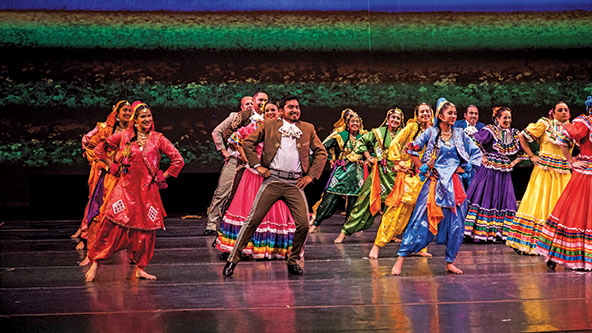
 In BhangraLisco, Mosaic America hosts a collaboration between Indian and Mexican traditional folk artists. (Photo courtey of Swagato B.)
The San Francisco Bay Area has a rich diversity of people, despite prevailing media representations of Silicon Valley as the land of wealthy, white “tech bros.” Racial minorities, in fact, make up the majority of the population of the Bay Area’s nine counties, according to data from PolicyLink and the Program for Environmental and Regional Equity at the University of Southern California. And the 2020 American Community Survey reports that nearly 40 percent of residents are foreign-born.
Yet for all its diversity, racial and ethnic segregation persists not just in the Bay Area but throughout the United States. This reality conflicts with the symbol of the country as a “melting pot”—a metaphor used to convey the United States as a nation of harmonious cultural assimilation. However, for entrepreneur Usha Srinivasan, cofounder of the nonprofit Mosaic America, “America is not a melting pot, it is a mosaic.” The image of the mosaic, she believes, more accurately represents the heterogeneity of America.
Srinivasan and Priya Das cofounded the Saratoga, California-based nonprofit in 2016 to use art to bridge cultural divides. The mission, Srinivasan says, “is to move American communities from diversity to belonging”—that is, not only including minority communities into society but ensuring that they feel welcomed and accepted. For people to feel like they belong, “they must feel empowered to simultaneously contribute to and make demands of the social, political, and cultural institutions of the place,” Srinivasan explains. “And when everyone feels like they belong, there is social cohesion.”
Mosaic America’s events feature Bay Area artists and community leaders who emphasize the common threads of their shared humanity while celebrating their differences. As a nonprofit, its programmatic offerings are free to the public. While it uses art as a tool of promoting belonging, it is not an arts organization. Its goal is to foster social cohesion, not create art for art’s sake. It was launched in part as a response to the country’s increasing political and cultural polarizations. “We want to offer people a way to come as they are and create community rather than maintain cultural silos,” Srinivasan says.
Intercultural Programming
Mosaic America’s objective is to foster “intercultural competency,” or an openness to and curiosity about cultural diversity across communities. The term intercultural indicates a mutual understanding and respect for all cultures—in contrast to multicultural, which reflects coexistence but not necessarily meaningful interaction among different people. To accomplish this goal, they offer events that are place-based, and their featured artists include those from Indigenous and native backgrounds with knowledge of the Bay Area’s diverse agricultural and cultural landscapes.
Mosaic America has either secured funding for or commissioned hundreds of local artists, including Ray Furuta, a flutist and composer who also formerly served as the musical director of Mosaic America. In 2019, he and his co-composers performed a piece they had composed called Precious Scars, which reimagined the Japanese internment camp experience in the context of the Trump administration’s criminalization of Mexicans and Central Americans.
Projects like Precious Scars, Furuta explains, “showcase how we are similar by way of our differences. And I think that likeness and that shared humanity is what brings us to that concept of belonging.” To realize this production, it was important for Furuta, who is of mixed Japanese and Mexican ancestry, to engage artists from different cultural backgrounds. So, he wrote the music for Precious Scars with Egyptian composer Amr Selim and Mexican composer Vico Díaz.
One of Mosaic America’s most successful events is the Mosaic Festival, a hybrid (in person and virtual) annual event showcasing artistic offerings that place a spotlight on the diverse histories of the Bay Area. According to Das, the festival, which was awarded a National Endowment for the Arts grant in 2021, aims to make people “aware of the diversity of their area and, perhaps more importantly, see themselves represented.”
From its launch, Mosaic America has faced the challenge of convincing investors of their mission. “Nobody believes that belonging is an indispensable need,” Das says. In the early days, the cofounders worked without pay, devoting their time and energy to an endeavor they found ennobling and indispensable to building social cohesion.
They quickly realized that they would need to recruit a team and work with a marketing agency to sustain outreach efforts, which would necessitate continuous fundraising. Their efforts paid off, and the organization began to receive grants in its first year. The first grant they received—from the city of San Jose for $14,250 in 2016—enabled them to pay 10 artists and groups to cocreate artworks and build reserves to fund future cultural initiatives. This early funding allowed them to grow from an organization dependent on volunteers to one with two salaried employees, four part-time contractors, and five interns.
Subsequent grants came from the David and Lucile Packard Foundation, the DeVos Institute, and the Knight Foundation. Recognizing that Mosaic America is mining the cultural assets that are available in the Bay Area, the Knight Foundation awarded the nonprofit a grant of $50,000 in 2016 and $250,000 three years later. And in 2021, Mosaic America received a $300,000 adaptation grant from the Hewlett Foundation—funding awarded to Bay Area organizations grappling with the significant challenges posed by skyrocketing real estate costs, unequal access to the arts, and the COVID-19 pandemic. Mosaic America’s efforts to strengthen local communities made them an ideal recipient for this grant, according to Adam Fong, Hewlett’s program officer for the performing arts.
The COVID-19 pandemic challenged the nonprofit, which had traditionally offered in-person programming only. Fortunately, an additional $40,000 grant from the Knight Foundation in 2021 gave them the resources to create digital programming and cultivate online audiences. The digital performances are mostly prerecorded and then livestreamed, but they also include interactive segments on platforms like Zoom, Facebook, and YouTube. Today, Mosaic America has made hybrid programming a permanent feature.
Mapping Artistic History
One of the nonprofit’s newer projects is the Mosaic Atlas, a digital map of Bay Area arts organizations, artists, and community centers, which was piloted in 2020. “We realized that artists and culture makers are moving farther away from city centers and therefore becoming more marginalized,” Das says, “and newly settled and/or highly distributed cultural communities find it difficult to organize and understand how to garner support from city and other funders.”
The cofounders knew that they needed a deeper understanding of the cultural assets of the Bay Area than they had available. So, they contacted Jan English-Lueck, a professor of anthropology at San Jose State University (SJSU), whose research focuses on Silicon Valley’s cultural diversity. English-Lueck recommended Kerry Rohrmeier, an assistant professor of urban and regional planning and expert in digital geography at SJSU, to lead the collaborative project that would become the Mosaic Atlas.
The project involves a two-step process. First, English-Lueck and her graduate students have conducted interviews with Bay Area artists, curators, and arts organizations. This information is being incorporated into StoryMaps, interactive digital maps that tell stories about specific places.
The second stage of the process turns to Rohrmeier and her graduate students. They are devising geographical information systems to map the ethnographic data, including visual, auditory, and story-based experiences. In doing so, they are building free software that will eventually be available to anyone with internet access to explore the arts and cultures of the Bay Area. Users will be able to learn about the nonprofit’s work and programming and about local artists, as well as be able to virtually experience photographic and video content from these artists.
The Mosaic Atlas is “more than just dots on a map,” English-Lueck says. “We wanted to create something that would tell more of a human story.” The atlas integrates human stories with lived experiences on the land. Because it incorporates census and school-district data, it also “adds an equity component that I have not seen,” Rohrmeier adds. The atlas, in other words, gives visibility to some of the least visible communities.
English-Lueck believes that the atlas embodies Mosaic America’s mission of creating pathways for inclusion. “The atlas is going to create a sense of connection and belonging within and between cultural communities and generational barriers,” she says. “And that is Mosaic America’s secret sauce—that cultures come together and they create something new.” This effort directly addresses the cultural and social network silos that have only become more entrenched in recent years. “Bay Area residents tend to live among or mingle socially with their own cultural groups,” Das explains. “Outside of the civic and living necessities, there is very little interaction with the city infrastructure fiscally, and other groups socially.”
The Mosaic Atlas project should be available to the public in two years. The Hewlett Foundation funded the first phase of the project, Fong says, because it “is the kind of deep, ground-based work that we are confident will serve and benefit local artists and cultural communities for many years to come.”
In the next two years, Srinivasan and Das plan to use the Mosaic Atlas to unearth more underrepresented cultures in Silicon Valley and beyond. This work will inform their programming, which, in turn, “will draw these communities to Mosaic’s events,” Das says.
The cofounders also hope to establish Mosaic chapters at universities and corporate campuses, which are essentially cities unto themselves, with enclosed cultures. “If our approach works here in Silicon Valley,” Srinivasan says, “we know it will work elsewhere in America.”
Read more stories by Kathryn Dickason.