


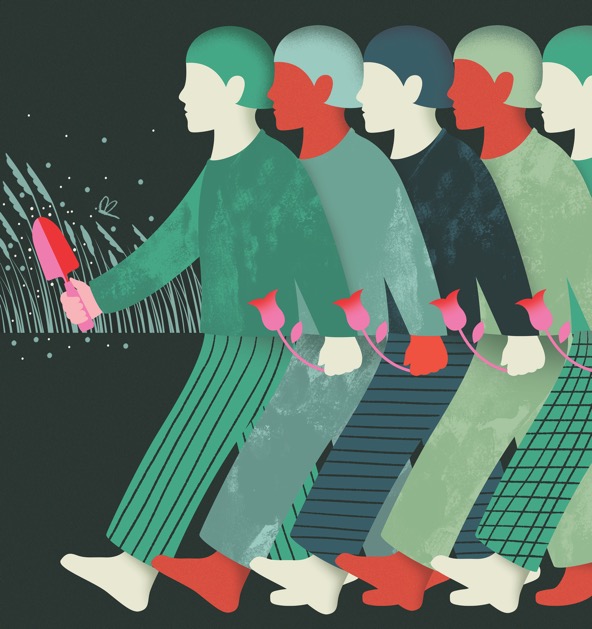
 (Illustration by Vicki Turner)
On a bright spring day, 50 students sit in a circle on the grass at the University of California, San Diego. Over the next 90 minutes, their instructor leads them through a series of contemplative practices designed to deepen their connection with the natural world. They listen to poetry, follow guided meditations, and meander across the lawn, noticing the sights, sounds, textures, and sensations around them. As the session draws to a close, each student returns with a small natural object—a fallen leaf, a blade of grass, a feather—and reflects on what drew their attention, what helped them stay present, and what pulled them away.
These students are among more than 800 who have participated in Contemplative-Based Climate Resilience (CBCR), a course now offered across the University of California system. The course began with a simple question: What if climate education taught students not only the science of climate change, but also the emotional and relational capacities needed to face it?
That question reflects a growing reality. As climate-fueled disasters become more frequent and visible, more young adults are experiencing anxiety, grief, and hopelessness about the future. Approximately 60 percent of 16- to 25-year-olds report feeling anxious, powerless, or angry about the climate crisis, yet traditional climate education rarely addresses these emotional realities.
To meet that challenge, we created CBCR, an accredited course that combines climate literacy, contemplative practice, emotional resilience, community building, and collective climate action. Over the past three years, we have brought together faculty, meditation instructors, and students from across the UC system to develop and refine a new model of climate education. Rather than simply teaching students about climate change, the course helps them develop the inner and interpersonal capacities they need to respond to it.
What the Course Teaches
The course unfolds through a series of interconnected learning experiences that integrate climate science with inner development and community engagement. Through contemplative practices—including mindfulness of emotions, compassion for others, self-environment interconnectedness, reflective writing, and guided dialogue—participants learn how to work skillfully with emotions such as anxiety, grief, anger, and hope while connecting course material to their own lives. Interpersonal capacities are cultivated through empathetic listening, climate conversations, and collaborative group work.
Exposure to diverse perspectives is central to the course. Recorded interviews and course materials feature climate scientists, contemplative teachers, Indigenous leaders, activists, and systems thinkers, including Joanna Macy, Rebecca Solnit, Tiokasin Ghosthorse, and many others. Together, these voices illuminate both the complexity of the climate crisis and the many pathways for responding to it.
A distinctive feature of CBCR is its emphasis on collective action. Throughout the semester, student teams design and implement projects that translate reflection into tangible community impact. Their projects have included teaching CBCR concepts to children in local schools, organizing climate cafés, contributing to climate-policy campaigns, writing op-eds, helping businesses reduce their carbon footprint, and raising awareness of sustainable climate solutions within their communities.
Each class moves through a cycle of learning, experience, reflection, and action. New ideas are explored intellectually, processed through contemplative practice, deepened through dialogue, and ultimately applied through collective climate projects.
Between classes, guided nature meditations and weekly reflections help students integrate course materials, class discussions, and contemplative practices. Together, these experiences cultivate resilience, self-awareness, connection, and a greater sense of agency in responding to an increasingly uncertain future.
Course Impact
During the course’s first two years, we evaluated outcomes among more than 460 CBCR students and a comparison group enrolled in environmental-studies courses. Participants completed assessments before the course, immediately afterward, and five months later.
Compared with students in the control courses, CBCR participants showed significant reductions in climate distress and symptoms of depression, anxiety, and stress. They also reported greater climate self-efficacy, or the belief that their actions can make a meaningful difference. Equally important, students developed capacities associated with long-term resilience, such as mindfulness, self-compassion, emotional regulation, connection with nature, and reduced feelings of hopelessness and loneliness.
Some of the strongest benefits were observed among students who had experienced higher levels of adversity earlier in life. These students showed greater gains in self-efficacy and greater reductions in climate and mental distress. We also found that instructors became more confident facilitating conversations about the emotional dimensions of climate change, an increasingly important skill as educators encounter students grappling with uncertainty about the future.
Enrollment has expanded across participating UC campuses, and ongoing research is examining the wide range of sustainability projects students are launching through the course. Taken together, the evidence suggests that climate education can do more than increase knowledge about environmental challenges. It can help students transform climate distress into resilience, connection, and collective action, equipping them not only to understand the future they are inheriting, but also to help shape it.
Sustaining the Course
Across the UC system’s 10 campuses, we are working to make CBCR an integral part of climate-literacy education while expanding the network of trained faculty and meditation instructors who can deliver it.
Beyond the classroom, we are cultivating a community of student leaders through teaching assistantships, climate-ambassador programs, research opportunities, and nature retreats that deepen students’ engagement with climate resilience and collective action.
Building on its success within the UC system, CBCR is expanding to the 23-campus California State University system and partner institutions across the country. To increase accessibility and reach, we are also developing an online version of the course, which we will evaluate alongside the in-person model.
This growth is supported by public and private funding, which also enables ongoing research to assess the program’s impact over time.
Lessons for Educators, Students, and Communities
After four years of developing and evaluating CBCR, several lessons stand out.
For educators: CBCR demonstrates the value of contemplative pedagogy, which invites students to reflect on course material through the lens of their own lived experience rather than passively absorbing information. By coleading the course with meditation instructors, educators learn to guide experiential exercises and facilitate conversations that deepen awareness of emotions, insights, and values in both themselves and their students. The Latin root of “education” is educere—to draw out and awaken potential in others. We believe climate education should do both: help students understand the challenges they face and cultivate the capacities needed to respond to them.
For students: A course that prioritizes emotional awareness, expression, and validation within a psychologically safe learning environment can be a profound mode of learning. Working with others on a climate project—and developing a sense of collective resilience—can be transformative. Cultivating an ecological worldview grounded in the web of life challenges oppositional, binary thinking and deepens our understanding of interconnection.
For communities and institutions: These lessons return to one of the original intentions behind the design of CBCR. As Buddhist monk and peace activist Thich Nhat Hanh observed, “The way out is in.” Cultivating inner resilience is essential for sustaining effective outer action. We have found that individual distress, whether related to climate change or other crises, can be eased through introspection and mindfulness, recognizing our shared humanity, connecting with nature, and engaging in empowering collective action. We are eager to share and adapt this curriculum with interested groups and to continue evaluating its impact. Ultimately, this is a call to action for education leaders to create similar opportunities that support both well-being and leadership in future generations.
The question that inspired CBCR was simple: What if climate education taught students not only about climate change, but also how to face it? Our experience suggests that when climate literacy is paired with inner resilience and collective action, students are better equipped to meet the challenges ahead.
Read more stories by Philippe Goldin, Jyoti Mishra, Gail Wright & Elissa Epel.