


 (Illustration by Jasmin Pamukcu)
When the data-driven collective impact nonprofit, Baltimore’s Promise, set out to map the city’s youth programming, the numbers seemed to tell a clear story: For every four opportunities available to elementary school-aged children, there was only one for older youth, ages 19-24. So the fix seemed obvious: raise money, provide more programs for teenagers and young adults, done.
Before acting, Baltimore’s Promise took the finding to the people. Through its Youth Opportunities Landscape project, the organization held 19 group conversations that included 161 young people, parents, and caregivers. More programs would not have fixed the problem. Instead, Baltimore’s Promise learned that existing youth programs were often unavailable: Older youth described long bus rides of up to two hours to reach a program site. Many were parents themselves or primary caregivers for younger siblings with no way of arranging sibling care. Others were already working, and programs built around a school-day schedule could not accommodate them. The issue wasn’t just a supply or access problem; it was whether opportunities were available, realistically accessible, and aligned with what young people wanted and needed.
The map data was insufficient because it only showed where programs were located, but not why the existing programs went unused. Only the community knew that. And their insights changed what happened next: When programs across the city applied for a grant from the Baltimore Summer Funding Collaborative, Baltimore’s Promise ensured that the application and scoring rubric prioritized cost, transportation, sibling care, and work schedule flexibility in their selection criteria. Parents and youth ages 14 to 24 served as community reviewers, scoring applications and guiding how the Collaborative distributed more than $5 million. Baltimore’s Promise paid community reviewers and provided transportation and childcare, thoughtfully removing from its own process barriers young people had associated with inaccessible programs. The Baltimore Children and Youth Fund then joined the Collaborative the following year to provide an additional $2 million for programs led by people of color and serving youth ages 14 to 24, which, with other contributions, lifted funding for programs focused on older youth by 82 percent. By 2023, older youth had gained ground. Elementary school-aged children now had 2.3 opportunities for every one available to older youth, down from four to one.
This experience illustrates the positive benefits that can occur when communities have opportunities to contribute data on their own terms and can use it to make critical decisions that impact their lives. When the people most affected by a problem are treated as sources of credible evidence, are able to govern how the information they share is used, and can ultimately guide decisions, it helps ensure that dominant institutions (e.g., governments, for-profit companies, universities, hospitals, foundations, and other organizations that have historically controlled resources and decision-making) are less likely to misdiagnose problems, invest in ineffective solutions, or create programs people can’t use. Community governance makes this possible.
Community governance is a process through which community members collectively direct and determine decisions that affect them. Oftentimes, at the center of those decisions is civic data: the information communities collectively generate and that institutions use to allocate resources, shape policy, and govern public life. Communities can sometimes govern themselves and make decisions independently. Other times, they share authority with governments or other institutions through collaborative governance, a specific type of community governance. The structure varies with the community, the location of its data, its autonomy and capacity, and the relationships and organizations at play.
The stakes are not evenly distributed. Taxes—a form of civic data—provide a useful example: Black communities have long paid taxes into public systems while being simultaneously and systematically excluded from the decisions that governed how these resources were used, often financing the very segregation and disinvestment imposed upon them. Community governance helps correct that imbalance by restoring authority over decisions made with public resources to the communities most affected by them.
Communities in Baltimore City, Pittsburgh, Portland, Oregon, and Tucson, Arizona, are applying that principle in different ways. Each has built a governance process around civic data that reflects local priorities, relationships, and capacity. The result is the same: When communities govern their own data and the decisions made with it, the outcomes are more effective, more durable, and more desirable.
What Community Governance Is Not
Gathering information and filing it away—or using it to justify decisions already in motion—is not community governance. A focus group, a listening session, or a survey you might consult later are simply consultations. They can be done well or badly, but none of them transfer decision-making authority. Consultation merely gathers input. Governance gives communities a critical role in shaping what happens. When community governance is inauthentic, dominant institutions claim one-sided decisions were “shared,” when in actuality, the communities involved are tokenized and denied real decision-making power.
What real community governance looks like in practice can vary, but it must always involve sharing authority and decision-making power with community members and residents. For example, Baltimore’s Promise regularly convenes a Community Research and Action Committee (C-RAC), a body of Baltimore residents, including young people, that helps direct the city’s Youth Data Hub, an integrated data system linking school, health, and program records to track how young people are faring. The C-RAC guides processes, requests analyses, and decides how findings are made accessible and to whom.
In Pittsburgh’s Larimer neighborhood, residents participating in a Neighborhood Power-Building Project (NPP) process set their own meeting schedule, choose the issues they will prioritize, and walk the neighborhood with city officials to identify hazards to walkability and road safety. They ultimately co-authored a Built Environment Action Plan (BEAP), a community-led initiative driven by the Black Equity Coalition and the Larimer Consensus Group to tackle local disinvestment and health disparities. NPP facilitators were explicit that their role was not to direct the process but to support residents in directing it themselves.
In Arizona, an advisory council at the Tucson Indian Center determines what information is worth collecting in the first place, not simply how findings are reported, so that the data serves the community’s own priorities for fostering employment opportunities and advancing economic mobility. Portland’s engagement in climate justice work moves community governance even earlier in the process, bringing community members together to define problems long before governments begin drafting policy responses.
Although these communities have different structures, they function with the same principle in mind: Communities set the terms. The distinction matters because of a persistent and paternalistic assumption that communities do not know what they need. This belief wrongly assumes that communities lack the know-how to co-author a plan or lack the expertise to govern. The demand for technical expertise is often used to scare community members away from the material or to justify leaving them out when the subject really is not that complicated. But that assumption is wrong, harmful, and often self-serving. Community members do not know less than credentialed experts. Their expertise is different, grounded in a lived experience that those with credentials often do not have. Data work that fails to center this kind of experiential knowledge tends to produce solutions with little chance of success.
Earlier community engagement frameworks often described their highest aspiration as “empowering” communities, a term that implies power is a gift that dominant institutions bestow rather than something the community already holds. But power that a dominant institution confers can be rationed or withdrawn at any time. In these frameworks, the inherent power within a community goes unrecognized, as the dominant institution is considered the authority in the relationship. This is why more contemporary frameworks instead emphasize community leadership, self-determination, and shared governance. Community governance starts from a different premise: Communities already possess the power, authority, and expertise to shape decisions that affect them.
Finding Your Place on the Spectrum
The question then: How do organizations know where they are when it comes to facilitating an authentic approach to community governance, and what can they do if they want to improve? One useful answer comes from the Spectrum of Community Engagement to Ownership, developed by Rosa González of Facilitating Power. It arranges an institution-community relationship along a line of increasing community governance and authority: from ignore, to inform, to consult, to involve, to co-govern, to defer to (see figure below). At the shallow end, the dominant institution acts alone or announces what it has decided. In the middle, it asks for input and takes it into account. At the far end, the two share decision-making authority (co-govern), or the institution defers to community leadership outright (defer to).
Two features of the spectrum matter in practice: The first is that movement along it is incremental and iterative. Dominant institutions do not leap from marginalizing communities to supporting full community leadership. Each increment of collaboration and shared authority moves you along the spectrum. But the journey is not always one of linear progress. Trust can be lost as well as built. Failing to act on feedback, making meetings less accessible, or letting the process go opaque moves an institution back down the spectrum because the relationship symbolized by the spectrum is dynamic, ever evolving, and in need of constant tending.
The second is that a single organization rarely sits at a single point. Different organizational teams, initiatives, and even different components of the same initiative can sit at different places on the spectrum depending on the task, the funding, and the capacity available. For example, Baltimore’s Promise operates at the co-govern stage because they have a community advisory board that holds equal voting power with the board of directors over the annual budget. Its Youth Grantmakers initiative, a youth-led body that controlled the allocation of over $1 million, sits at “defer to.”
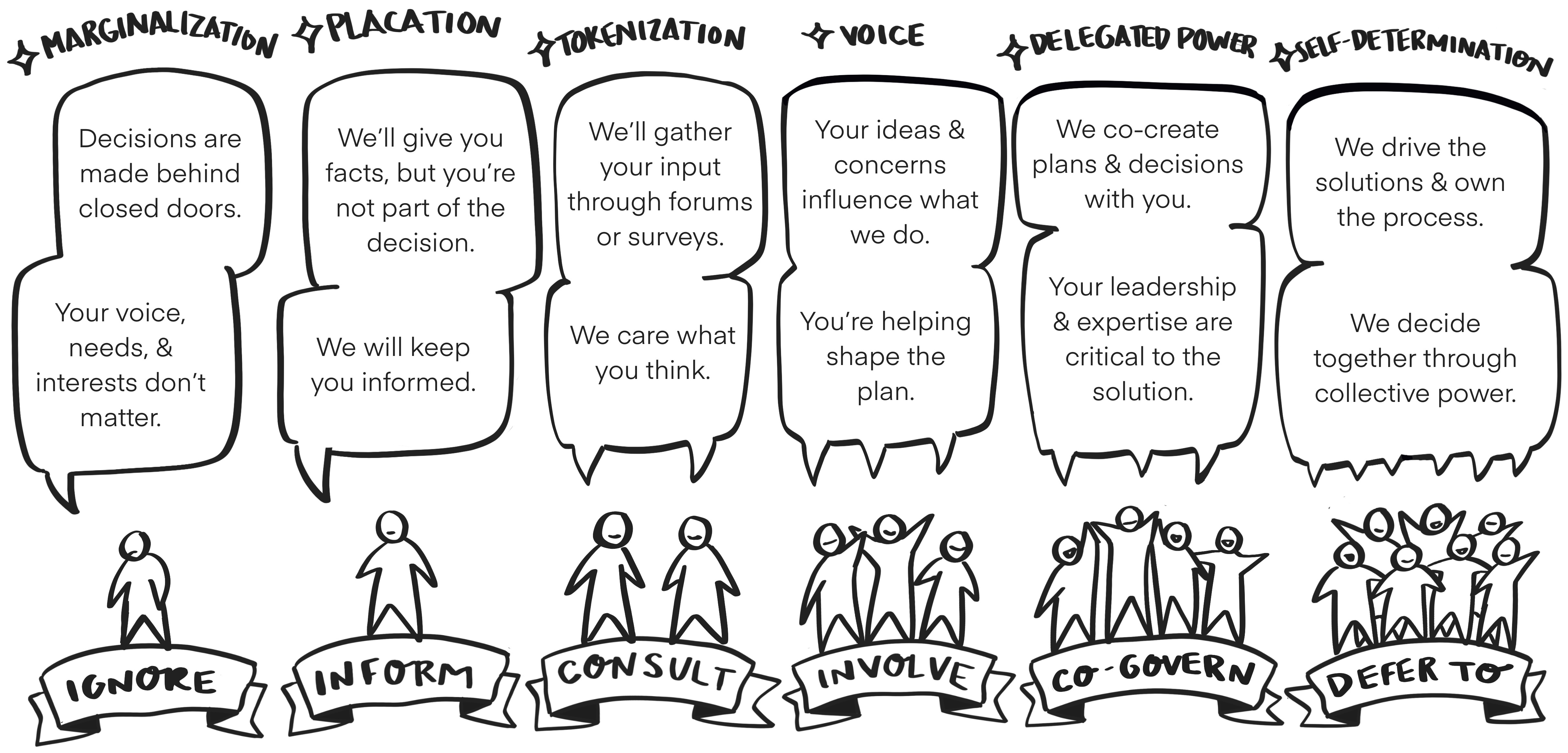 (Click to enlarge) The Spectrum of Community Engagement to Ownership illustrates how to increase community authority over decisions. Across the spectrum, decision-making authority increasingly shifts from dominant institutions to communities. Source: Advancing Equity and Justice by Jamila M. Porter and Aysha Dominguez Pamukcu, 2025. Adapted with permission from Rosa González, Facilitating Power. Published with permission from the American Public Health Association. Artist credit: Jasmin Pamukcu.
The point of locating yourself on the spectrum is to know, step by step, where you are and where you mean to go. The most useful time to do this is while a project is still being designed. As you plan, map every point where you intend to hear from communities and ask who is constructing each of those access points.
Did the community set the meeting time, co-create the agenda, or shape guiding questions, or only answer them? Then ask what will be done with what you hear, and how will it be communicated back? An access point that feeds nothing, and is never explained, is theater regardless of how it looks on an organizational chart. And you don’t have to redesign everything at once. Identify one decision, in one initiative, where you can share more authority now, and start there.
Don’t Talk Yourself Out of It
If the further end of the spectrum produces better results, why do so few institutions get there? In our experience, part of what might be stopping them is a misreading of what community governance requires. Some assume it means that communities must always own the decision outright. Faced with the distance between that and where they currently sit, some organizations conclude they can’t get there, and do nothing, or they tokenize communities and call it collaboration.
But a possible cause is even simpler: Dominant institutions are often unwilling to commit the time, money, and accountability that shared decision-making requires, and the all-or-nothing framing gives them a reason not to start. Budget constraints, internal power imbalances, and shifting politics also limit what institutions can commit, though none of these excuse standing still.
However, institutions can make progress toward facilitating genuine community governance processes by keeping two considerations in mind. The first is a caution against moving too fast. An organization that leaps from nothing to full community ownership overnight will almost certainly mishandle it, because the trust and credibility are not yet there. Governance maturity is built over time, not declared into existence. The second is a caution against the opposite assumption—that full community ownership of every decision is the only legitimate form of governance. Not every decision calls for the same degree of community authority. A community has little stake in how a city processes its internal invoices. It has every stake in the governance of its civic data: the information about its streets, schools, health, and other conditions that shape public decisions. Decisions about civic data belong at the far end of the spectrum, where dominant institutions co-govern with communities or defer to them.
The point is not to maximize community authority in every circumstance. It is a spectrum, and the useful question is not “Have we done it?” but “Where are we on the journey thus far, and what’s the next step toward making our approach more authentic and community-centered?”
Although community governance produces more durable solutions and stronger community buy-in, it does have a cost: time, energy, resources, control, and professional humility. But the alternative is more expensive. Decisions made on a tight timeline and without essential community data and expertise that can surface root problems tend to produce solutions that are ineffective or even harmful. The up-front investment is often the most cost-effective path because it’s the surest way to identify the real problem—and identify the right solution—the first time around.
What More Authentic Community Governance Demands
Authentic community governance means investing the time to expand community capacity in lieu of inviting people into a meeting to merely rubber-stamp decisions they had little opportunity to shape. Institutions and communities should also be open to learning throughout the process of collaborating. For example, community members can gain insights about the intricacies of internal agency dynamics, budgeting and procurement processes, and data systems, learning well enough to hold their own in decisions that affect them. Practitioners, researchers, and government staff can gain insights about residents’ experiences, learning to value their knowledge as trusted evidence that’s essential to understand the depth of a problem and what’s needed to work toward a solution.
Authentic community governance also requires investing in resources and supports that allow for meaningful community participation. That means providing stipends, childcare, transportation, flexible meeting hours, interpretation, meals, and the practical supports that ensure people can actually participate in governance processes. Governance approaches that overlook these realities end up only involving people who need the fewest accommodations but then mistake that convenience—and their contributions—as symbolic of true community representation.
Together, these investments can create the conditions in which trust can grow over time through shared learning, practical support, repeated follow-through, and opportunities for communities to shape outcomes in material ways they can see. The Larimer community’s work in Pittsburgh illustrates what those investments can produce. For years, drivers used residential streets as a cut-through to downtown, reaching speeds as high as 70 miles per hour. Residents had long known that speeding in the area increased the risk of fatalities and endangered children in their neighborhood. City data confirmed the problem, yet officials said traffic-calming measures could not be funded for a year or more. Through the NPP process, residents organized around the evidence, determined that traffic calming should become a neighborhood priority, worked with their community liaison, and brought both the data and their recommendations directly to their councilman. Instead of a year, funding for improvements to slow traffic, including speed bumps, was approved within weeks. Just as important, the process created an opportunity for residents to move beyond reporting a problem to helping determine how public evidence can translate into public action.
As residents began seeing tangible results—improved street lighting, speed bumps, an approved street mural, and regular attendance by a councilmember at meetings—they also began seeing their community data differently. In nearly every workshop, they returned to one statistic presented early in the project: Average life expectancy in Larimer was 62 years, compared with 85 years in a neighborhood less than a quarter mile away across a bridge. The number became emblematic evidence of inequity and a shared impetus for understanding why investments in lighting, traffic safety, housing, and neighborhood conditions mattered, and why residents themselves needed to shape the decisions that followed.
From Principle to Practice
Fostering community governance is not the responsibility of any one institution or sector. Different actors shape different parts of the process, and each has a role to play in making shared decision-making possible.
Government partners should bring communities into the process before priorities have been established rather than after plans have already been drafted. They can adopt frameworks like the Spectrum of Community Engagement to Ownership (above) as standard practice. Government partners should also compensate community members for their time, and provide the childcare, transportation, interpretation, and scheduling flexibility that determine who can participate at all. And they can build community timelines into project plans rather than treating urgency as an excuse to bypass participation.
Funders should treat governance infrastructure as a legitimate program investment rather than administrative overhead. That includes funding staffing, relationship-building, stipends, childcare, transportation, accessibility supports, interpretation, and meeting space. They can also fund the training that lets residents read a budget, a dataset, or a policy draft well enough to argue with it, and the staff time inside institutions to learn how to share a decision.
Practitioners should begin with an honest self-audit. Map every place where your organization hears from community members. Locate each of those moments on the Spectrum of Community Engagement to Ownership. Next, ask who designed the engagement process, who framed the questions, what decisions community members can influence, what changed because of what they shared, and how those decisions were communicated back. Then ask: What is the next deliberate step toward sharing a little more decision-making power?
Across these roles, the goal is to build community governance that can withstand changing administrations, shifting funding priorities, and the end of any single program. When genuinely built and continually cultivated, relationships can become vital infrastructure that allows communities and institutions to keep solving problems together long after any single grant or administration has passed.
Ultimately, community governance of data is not a box that an institution checks. It is not a committee added to satisfy a grant requirement or a listening session held before returning to business as usual. It’s an ongoing relationship that institutions cultivate, initiative by initiative, decision by decision, over time. Our experiences in Baltimore City, Pittsburgh, Portland, and Tucson have shown us that community governance changes more than who has influence over public decisions. It changes the quality of the evidence those decisions are built on. Data can identify that a problem exists. But only communities and community data can help explain why a problem exists and, most importantly, what can be done to solve it.
Read more stories by James Sadler, Bridget Blount, dallas haley, Santi Sanchez, Ruth Howze & Dylan Baysa.