


 (Illustration by Rose Wong)
Organizations that hope to make a social impact can’t go it alone. They need to work with other organizations to scale their efforts if they hope to make progress on social issues. The simple truth of this principle hides great complexity. Groups of organizations can work together in a variety of ways. The choices that they make about how to organize influence the capacity of the coalition, the type of change that it will make, and whether communities that are the most affected will have any say in its decisions.
Organizations are often confused about how to describe their work with other organizations and how it compares to that of other partnerships and collaboratives. They frequently identify themselves as using the popular model of “collective impact,” whether or not they adopt its tenets in practice. This tendency has created an overreliance on the model’s vocabulary, because coalitions lack the terms to describe other ways of organizing.
In 2017, the Network for Nonprofit and Social Impact (NNSI) at Northwestern University launched a nationwide study that takes a comparative approach to identify the conditions that make collective impact useful for education reforms. In our experience of speaking to representatives of education-focused collaborative coalitions across the country, we found that nearly all considered themselves to be implementing collective impact, but their interpretations of the model’s principles vary widely and many were not able to fully implement its practices. In the process, we realized that better ways of describing how coalitions collaborate exist and that naming these variations can help guide local leaders and the diverse communities they serve. To realize these goals, we propose the community system solutions framework.
The Need for a New Approach
Collective impact, a collaborative model that brings together relevant actors from different sectors to solve a complex social issue, has gained tremendous momentum across the United States since FSG consultants John Kania and Mark Kramer introduced it in Stanford Social Innovation Review in 2011. Successful collective impact efforts, according to the authors, distinguish themselves from other community collaboration models by meeting five conditions essential for achieving large-scale social change involving multiple stakeholders: common agendas, shared measurement systems, mutually reinforcing activities, continuous communication, and backbone support organizations.
How essential are these five pillars to collective impact? In a 2014 Stanford Social Innovation Review supplement sponsored by the Collective Impact Forum, Jeff Edmondson and Ben Hecht argue that only practices that adhere to these pillars should be called collective impact. Whatever the merits of their argument in theory, projects have been labeled this way in practice to appeal to funders and to connect to a broader community of advocates across the country. Coalitions take the only model available to them and tweak it for their circumstances, instead of developing an approach that takes their needs into account. But what if they had other models to choose from?
We suspect that current funder and community interests in collective impact have created an overreliance not only on the language of this particular model but also on the actual approach. One reason, we propose, is that coalitions lack the language to describe other types of networks for social impact. To address this deficit, we interviewed coalition leaders across the United States, including officers at nonprofit organizations and foundations, and collected archival data from more than 55 coalitions. We then reviewed our conversations with coalition leaders and the data that they gave us.
The community system solutions framework holds that there are several pathways to solve complex social problems. Our purpose is not to suggest one singular model, but rather to demonstrate that communities may find that different approaches are better suited to their current environment, the population served, the problem each community is facing, and existing partnerships within a community. We offer this framework as a tool to help communities identify their current collaboration framework, its benefits, and its drawbacks. It also supplies a language for communities to describe various ways of networking with partners to generate social impact.
Classifying Solutions
The community system solutions framework is informed by two lines of academic research that predate the conceptualization of the collective impact model. The first line describes the different ways in which cross-sector collaborations between businesses and nonprofits and between nonprofits and governments occur. It focuses on what kinds of organizations participate in cross-sector partnerships and how they integrate their activities.1 The second line of research describes how coalitions are most commonly governed.2 It introduces three forms of governance: network administrative organizations, lead organizations, and self-governance. Network administrative organizations are similar to the backbone entities of the traditional collective impact framework. That is, they are independent bodies with their own dedicated staff that coordinate the activities of a network. In lead organizations, by contrast, a participating organization steps in to coordinate. In self-governed networks, the members of the coalition share governance responsibilities.
The resulting community system solutions framework describes how coalitions differ in two dimensions: who participates and how work gets done.3
Who participates? The original publications of the collective impact model emphasize cross-sector collaboration, in part because business leaders played such a large role in the emergence of the Strive Network in Cincinnati, Ohio—an effort that became a foundational example for the model. However, in our experience, not all networks easily attract cross-sector partnerships. Nonprofits led many networks in our study. Government agencies, such as the health department or city government, led others. These entities often had difficulty recruiting businesses. In other cases, conflict between the school district and the local nonprofit community prevented collaboration. Because of these issues, community networks often differ in who participates and the degree to which particular participants engage.
How does work get done? The collective impact model highlights the presence of a backbone organization in which a staff separate from the participating organization manages network activities. However, communities described variations, including organizations splitting up the backbone functions, or networks saying that their backbone was more of a “connector” than a “manager.” In some networks, partners self-organize because they cannot afford a backbone organization. In these networks, partner organizations may work together without agreeing on the problem to be solved, and they tend to work on multiple agendas under distributed leadership.
The answers to these two fundamental questions inspired us to divide the community system solutions framework into four different models and present them in a two-by-two diagram divided by two axes. One axis represents the amount of cross-sector engagement, while the other represents how centralized the coalition’s governance is. For each of the four quadrants in the framework, we present two communities as examples to demonstrate how their context and peculiar characteristics influence the adoption of a particular model of collaboration. Let us examine the four models in turn.
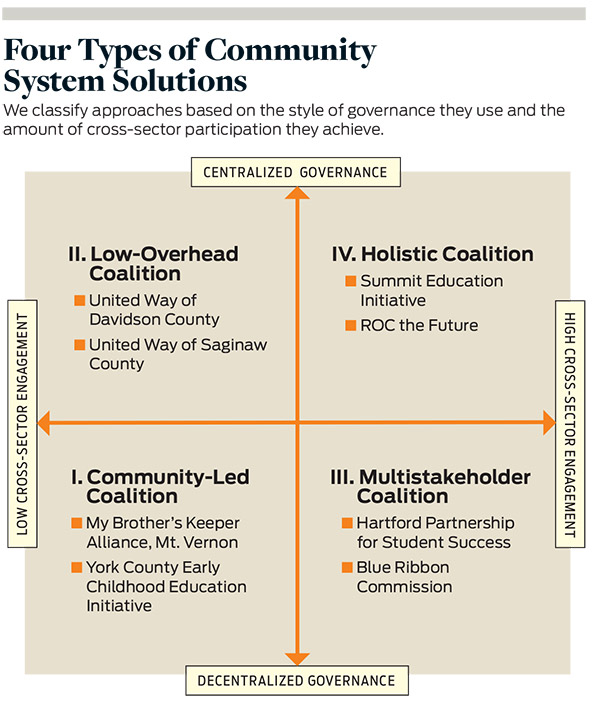
I. Community-Led Coalition
The community-led coalition model (Quadrant I, in the lower left part of the diagram) has a strong focus on community engagement and involves the community served in making decisions. Its participants are typically local organizations or nonprofits that have strong local connections. Cross-sector relationships rarely take root.
Primary Features of Community-Led Coalitions
- They emphasize community-organizing approaches and citizen volunteers more than the other models.
- They balance multiple agendas and respond to community changes.
- External funding is scarce or nonexistent.
- Decision making does not rely on data-driven metrics.
- They focus on coordinating events and raising awareness, and may include a few programs, but they are not project driven.
- Participants include volunteers, nonprofits, community-based organizations, and religious organizations, which do not maintain continuous communication.
- They often don’t involve a backbone organization, or, if they do, it is not equipped with a robust infrastructure.
The model often seeks to build a sense of community by engaging local leaders and stakeholders. It specifically takes a grassroots approach to program design and implementation. A local nonprofit frequently initiates the network to empower the community, but the collective effort usually reflects a lack of coordination. Funding sources for the coalition are scattered and program-specific. Community-led coalitions tend to focus on implementing programs across multiple agendas, and they do not strongly emphasize metrics or data collection. The downside of this model is that it does not allow for continuous or structured communication between partners, or for participation from other sectors. The upside is that the coalition wins sufficient community support.
My Brother’s Keeper Alliance in Mount Vernon, New York, is a community-led coalition, founded in April 2016 as a city-level initiative. Its steering committee consists of six influential people in the community, including a religious leader. The Boys & Girls Club of Mount Vernon manages the alliance’s financial affairs, such as accepting funding and handling tax issues. The steering committee considers the network itself a social movement. It currently focuses on running programs to help community members parent better and to cope with mental health issues, and on raising community awareness of the coalition. It has no backbone organization. To manage the network’s efforts, core partners—mainly community organizations or local people—belong to smaller working teams that meet weekly to address different agendas concerning disadvantaged youth. These agendas include getting to school, becoming prepared to learn, reading by third grade, graduating from high school, entering the workforce, and avoiding violence. The network would like to involve more businesses, but it hasn’t been able to attract them. Its leaders would also prefer that government agencies and the school district be more proactive in addressing their agenda items. Because the alliance is only three years old, it hasn’t yet secured resources for sustaining cross-sector alliances, such as partnerships between government agencies and education nonprofits. The network has also not yet collected any data on education outcomes.
Another example of a community-led coalition is the York County Early Childhood Coalition, an education initiative in Biddeford, Maine, that United Way of York County started in 2011 and that seeks to raise awareness of the importance of early childhood education at the county level. It has no budget for running specific programs and focuses instead on coordinating events and programs for local partners such as school districts, the YMCA, Boy Scouts, and Girl Scouts. For example, it hosts a yearly York County Community Conversation on Early Childhood and encourages local organizations to attend. But it has not yet led partners to engage with one another outside of the meetings.
The coalition also conducts education and outreach on issues related to investing in young children. Programs include a volunteer reader program that places adult volunteers with children up to third grade who read below grade level to improve early literacy. The initiative collects evaluation data about the programming by asking participants to complete a survey, but it does not yet track any educational outcomes of the programs.
II. Low-Overhead Coalition
In contrast with the community-led coalition model, the low-overhead coalition (Quadrant II) has a more structured way of organizing and motivating partners to work collectively on a common goal. Networks in this quadrant typically have an active lead agency that serves as a backbone organization but do not necessarily enjoy participation from multiple sectors. A member of one sector—typically a nonprofit or a government agency—usually facilitates or coordinates the effort. Consequently, the implementation of programs is top-down. In addition, organizational partners do not engage in regular communication, or only a small set of core partners from the same sector communicate with one another.
Primary Features of Low-Overhead Coalitions
- A clearly defined agenda aligns partners’ efforts.
- Sector diversity in partnerships is lacking, although the coalitions try to take advantage of and build upon existing collaborations.
- A small set of core partners maintain regular communication with one another, but the network lacks momentum because of resource constraints.
- A government organization or foundation serves as the lead organization and plays a significant role in determining the agenda and coordinating participants.
- The network chooses this model to save money or because it lacks the resources to support a backbone organization and data system.
Because partner organizations in low-overhead coalitions often come from the same sector and have financial constraints, a lack of partnership diversity frequently results. The low-overhead coalition model has fewer coordination costs, which makes it less expensive than the collective impact model. Most, but not all, of these coalitions self-identify as early-stage collective impact initiatives that have struggled to attract partners from different sectors. Low-overhead coalitions also have limited community engagement.
The Impact Committee for Education in Davidson County, North Carolina, is a low-overhead coalition. The United Way of Davidson County founded it in 2015 after a community-needs-assessment survey identified three focus areas: education, health, and financial stability. United Way serves as the only funder for the committee and the lead agency to coordinate meetings and manage communication among partners. Operating at the county level, it has drawn partners mainly from the nonprofit sector, such as the Salvation Army Boys & Girls Club of Davidson County, YMCA, and local charity organizations providing education and community-outreach programs. Its partners also include school districts and one local business. The committee aims to recruit additional advocates, such as the county superintendent of schools and other policymakers.
The Impact Committee for Education is relatively new. It was the first collaborative effort in the county to address educational issues. The network decided not to pursue the collective impact model because of its limited resources. The committee currently seeks to identify which education issues in the community it should focus on.
The United Way of Saginaw in Michigan founded a low-overhead coalition in 2014, to ensure that every high school graduate in Saginaw County is prepared for a career. It consists mainly of local nonprofits. The United Way functions as the lead agency and plays a central role in overseeing partner organizations. For example, it requires all partners to submit quarterly reports with measurements and outcomes to ensure that they are on track to meet the goals set by the funding agreements.
In contrast with the Impact Committee for Education in Davidson County, North Carolina, the Saginaw coalition identifies as an early-stage collective impact initiative and is in the process of building upon existing partnerships in the community. But it has yet to attract the funding necessary to build a systematic, diverse database.
III. Multistakeholder Coalition
In contrast with low-overhead coalitions, multistakeholder coalitions (Quadrant III) attract a diverse set of stakeholders, but the lead agency plays a less central role in the organizing process. In this model, there is often no backbone organization, either because the lead agency decides not to serve in this capacity or because it simply hasn’t taken on a formal role in managing partnerships because a lack of staff or money prevents it from doing so. The lead agency sees itself instead as a “connector” or “convener.” The partners feel responsible for sustaining communication and self-organize their efforts toward achieving collective goals.
Primary Features of Multistakeholder Coalitions
- Multiple agendas accommodate a variety of partner goals.
- They collect data to inform decision making.
- Partners include government, business, and nonprofit sectors. These partners typically form teams focusing on a single agenda.
- The lead agency or backbone organization acts as a facilitator, but not as the agenda setter, for the network. It facilitates the team’s work by providing technical and communication support among the groups.
This model faces a potential downside in trying to focus on numerous agendas and struggling to align partners’ efforts. Multistakeholder coalitions can be early-stage collective impact efforts that are in the process of developing a shared vision among partners. In some other cases, these coalitions strive to become collective impact initiatives but fail because of a lack of a strong backbone organization.
The Hartford Partnership for Student Success (HPSS) is a multistakeholder coalition established in 2006 through equal partnerships among four organizations: the United Way of Central and Northeastern Connecticut, the City of Hartford, the Hartford Foundation for Public Giving, and Hartford Public Schools in Connecticut. HPSS aims to improve the academic, social, emotional, and physical health of Hartford students by applying the Community School model, which coordinates the services that students need to be successful in school, while promoting healthy families and communities through extended days and hours. HPSS staff functions as the backbone of the coalition. United Way of Central and Northeastern Connecticut, on the other hand, functions as the lead agency by convening regular meetings focused on technical assistance and best practices. HPSS implements multiple strategies to boost student achievement (such as school readiness, attendance, high school graduation rates, and college and career readiness) in alignment with the district and individual schools’ operating plans. The partnership helps to coordinate, align, and utilize each partners’ different strengths, but it does not define how the partners work together. Local schools, nonprofits, and government agencies participate in the partnership and engage in continuous communication—for example, through biannual executive committee meetings, monthly leadership team meetings, and monthly meetings among nonprofit partners. HPSS emphasizes data sharing among the core organizations.
Another multistakeholder coalition is Blue Ribbon Commission (BRC) on the Prevention of Youth Violence in New Haven County, North Carolina. Established in 2007 and modeled after Harlem Children’s Zone, BRC focuses on interrupting the cycle of multigenerational poverty in the community through reducing youth violence and conducting youth programs that help social development (such as renovating a multipurpose athletic field and a community garden and offering college scholarships). It primarily serves the Youth Enrichment Zone, an approximately 140-square-block area on the north side of downtown Wilmington that suffers from high crime and poverty rates. This low-income community distrusts the mayor, the district attorney, and the superintendent of schools. As a result, BRC positions itself as a middleman between the local community and government agencies. As the backbone organization, BRC sees itself as a connector among diverse partners, including school districts, local nonprofits, the county health department, higher-education institutes, and local businesses. Partners from different sectors work together through different action teams, including ones dedicated to education, community engagement, and youth violence. Each of these teams is composed of more than 20 representatives from different community partnerships.
IV. Holistic Coalition
Multistakeholder coalitions differ from some of the most mature collective impact initiatives we have studied, which we refer to as the holistic coalition model (Quadrant IV). Under this approach, the partners come from different sectors, share specific goals, and are committed to sustained communication and collaboration to achieve those goals. The backbone organization facilitates various partners’ efforts to enact a common agenda and ensures effective decision making about partnership activities and outcomes. It can also play an important role in identifying appropriate measurement systems and formulating detailed plans about achieving collective goals.
Primary Features of Holistic Coalitions
- Partners have a long history of working together toward a shared vision.
- Programmatic decision making tends to be data driven.
- Diverse partners hold each other accountable through continuous communication and combined effort.
- They are generally larger than multistakeholder coalitions.
- Of the four models, they have the most developed partner coordination.
- Holistic coalitions do less direct community engagement than other types of coalitions.
Under the holistic coalition model, the management of partnerships and programming is typically top-down and often has less direct community engagement. Most holistic coalitions deliberately choose this model because the community the network serves has both the need and the capacity to sustain a lead agency and support cross-sector collaboration. Holistic coalitions are often collective impact initiatives at the sustaining stage—they have adequate funds to support the backbone organization, to maintain a shared data-collection system, and to conduct advocacy.
The Summit Education Initiative (SEI), based in Akron, Ohio, is a holistic coalition. Founded in 1994, SEI was created to improve reading scores in Akron public schools. SEI followed a cradle-to-career model, which focuses on helping every child reach his or her full potential from birth to employment. In 2013, SEI joined the StriveTogether network and embraced the collective impact approach. The backbone organization, also named SEI, coordinates more than 300 partners, including school districts, local institutions of higher education, local businesses, and community-based organizations. Between 2010 and 2011, SEI experienced leadership turnover, program termination, and staff layoffs, which left a lot of empty promises in the community. When the organization was rebuilt in 2011, it needed to cultivate diverse partnerships and repair its relationships.
Guided by the principle of “acting on education data,” SEI maintains a robust data-collection system and uses it to identify issues that require attention, to measure progress, and to keep itself accountable. SEI was able to become a holistic coalition because it has sufficient funding to support its programs, including an endowment and additional funds from other donors. The fact that some funders require all partners to work closely with SEI explains its preference for centralized governance.
Another holistic coalition is ROC the Future in Rochester, New York, a city-level initiative established as a StriveTogether coalition in 2011. Much like SEI, ROC the Future has sufficient financial support—in this case, from private foundations. The community ROC the Future serves has a rich history of cross-sector collaboration, which enables the initiative to use existing partnerships to identify areas to focus on. The current backbone organization, the Children’s Agenda, advocates for policies and evidence-based practices to improve academic achievement. More than 60 diverse partner organizations exist, including stakeholders from community-based nonprofits, research institutes, local foundations, businesses, and government agencies. The Children’s Agenda coordinates all the subcommittees and aligns their separate goals toward the overall mission of boosting the academic achievement of Rochester’s children. The collaboration is organized around different task forces defined by educational outcomes, such as school readiness, attendance, and college access, and includes a special task force on data sharing. ROC the Future has not done much direct community engagement, preferring to partner with local organizations to connect with communities.
Opening Possibilities
The communities discussed here represent only a sample of the education-reform initiatives in the United States, but together they present a diverse set of cases to capture the various needs and solutions on offer at the community level. The framework we propose captures the variations of how organizations can work together to solve community problems. With four categories based on who participates and how work gets done, the framework demonstrates how coalitions can follow multiple pathways to solve social problems and generate systemic change. We acknowledge that coalitions vary in numerous measures, including size, tenure, population served, challenges faced, goals sought, existing social capital, and potential resources available for mobilization.
We believe that the community system solutions framework can serve as a guide for coalitions to figure out the best way to align partners and implement programs specifically suited to their communities. It provides an alternative, more precise language for collaborative coalitions to describe the varieties of ways in which they can organize their partners for social impact. It also clarifies the advantages for particular coalitions of some models over others.
The framework is not static, and the divisions among the four quadrants are not walls. Some coalitions may see change over time, and those that aspire to conform to a more integrated model may begin in one quadrant and ultimately move into the others. But such a progression may not be the goal for all coalitions, especially those with limited cross-sector engagement that do not attract significant funding, or those that have found success with less centralized, more grassroots approaches to organizing.
We hope that communities will be better informed about the potential approaches available and embrace the one that best suits their context. Similarly, we hope that funders will be open to different models of community system solutions and seek to fund initiatives with the best chances of success in their respective communities. Whether collective impact is superior to the other models remains unclear, but we suggest that for communities aware of their resources and goals, it need not be the final destination.
This article appeared in the Winter 2020 issue of the magazine with the headline: "The Community System Solutions Framework"
Read more stories by Rong Wang, Katherine R. Cooper & Michelle Shumate.