


 (Illustration by Jasmin Pamukcu)
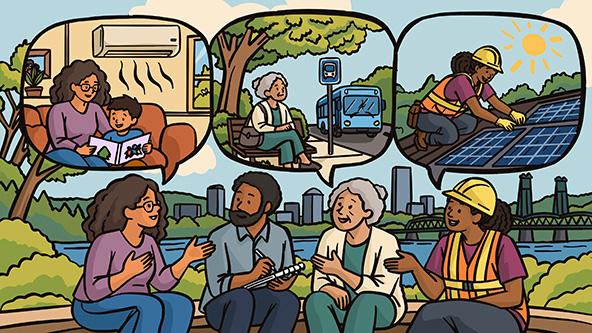
In June 2021, a heat dome settled over the Pacific Northwest and Portland reached 116 degrees. Nearly 100 Oregonians died of heat-related illness, most of them at home. By then, the Coalition of Communities of Color (CCC) had a long-standing partnership with the City of Portland and was collaborating with community members to design building and energy policy. A community policy workshop took place shortly after the heat dome, bringing residents’ recent experiences of extreme heat directly into the conversation. CCC asked community members what they needed to stay cool and what it was costing them. During these conversations, attendees said the extreme heat wave was stressful. They said it forced impossible choices. Residents said they felt like they were being chased by the mafia.
Community members described what they wanted their city to protect, and the values they surfaced became the HEART Standards: Health, Equitable energy, Anti-displacement, Resilience, and Temperature, a community-developed framework for shaping building policy. These standards anchor Portland’s approach to the buildings its residents live in and the climate-resilient policies designed to protect them.
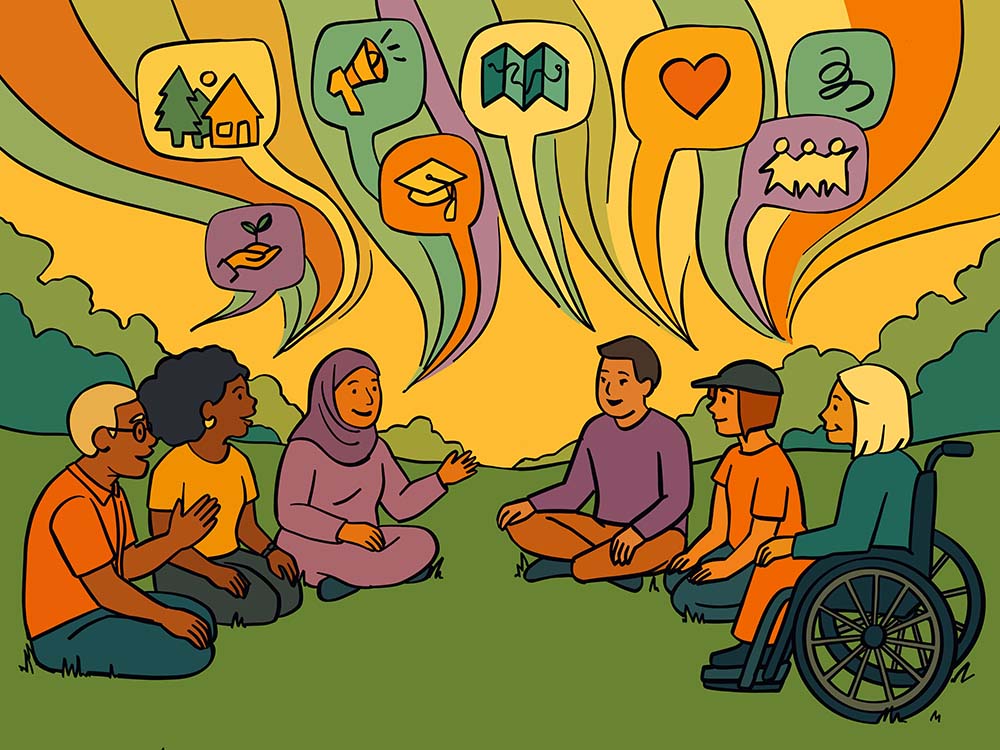
This is not how climate policy usually gets made. The standard process starts with technical experts who define the problem, draft a policy, and then invite community members to react to a near-finished proposal. Portland reversed that sequence. Community members were convened before the policy existed; their expertise was used to help craft it. Residents defined the questions the city should ask and the values the policy should protect. That reversal produced broader participation and a policy grounded in community data, evidence generated by communities about their own lives. Community data can take many forms, including numbers, stories, maps, music, and art, but most importantly, it’s gathered systematically on community terms and built for action rather than neutrality. In this unique instance, community data from Portland residents on what makes a building livable became the basis for climate policy.
What Emission Numbers Alone Miss
When it comes to climate policy, greenhouse gas reduction remains its dominant metric, but emissions alone cannot show whether policies improve the daily lives of people most affected by climate change—or whether they widen existing disparities.
Climate change threatens people’s homes, their health, their neighborhoods, and their ability to remain housed. A policy optimized for emissions alone can hit its target while the frontline communities—particularly communities of color and low-income neighborhoods experiencing the greatest impacts of climate change—see little improvement in their daily lives. In the context of climate policy, community data can’t replace emissions metrics, but it can tell policy makers what those metrics cannot. The two provide a fuller picture of whether a policy is actually working to reduce emissions and benefit communities.
The clearest example of why it’s valuable to integrate community data comes from the virtual community convening CCC and its partners hosted in 2021, shortly after the Pacific Northwest heat dome. A key finding from the conversation was that people living in households that could afford a window air-conditioning unit were often prevented from installing one because their landlords prohibited it, sometimes for reasons as trivial as prioritizing aesthetics.
Working from what residents surfaced, Verde, a CCC member organization focused on environmental justice and climate resilience in low-income communities and communities of color, served as a lead lobbyist and policy developer for Oregon’s Senate Bill 1536, and led a coalition of organizations that helped it become law in 2022. The legislation established new protections for tenants seeking to use portable air conditioners and other cooling units, including window units, by limiting when landlords could prohibit them and requiring those restrictions to be justified in writing. The bill also created the Oregon Rental Home Heat Pump program, a $15 million fund to be administered by the Oregon Department of Energy that provides rebates to landlords for installing electric, energy-efficient heat pumps for heating and cooling rental units. The program did so well that two years after Senate Bill 1536 passed, the legislature directed another $4 million to bolster its funding.
The new policy addressed the actual barrier the community had identified: not the cost of cooling but the inability to use cooling units they could already afford. A policy built only from emissions data might have focused solely on appliance efficiency or reducing energy consumption, ignoring impacts on people. But because community data was central to defining the problem, Oregon has a policy that speaks to the needs of people.
Rethinking Climate Solutions
Portland’s HEART Standards and policy wins like Senate Bill 1536 are compelling examples of how community values can shape what climate policy is designed to achieve. They arose from a broader effort to rethink who gets to define climate solutions in the first place. Two initiatives carried that effort, and each did so in different ways: 1) The Build/Shift Collective changed the content of climate policy, and 2) the Climate Justice Plan for Multnomah County, which includes Portland, changed the process by which it gets made.
Build/Shift, short for Building Community, Shifting Power, brought together a group of Black, Indigenous, and other community leaders of color through a partnership convened by CCC and Verde to help shape Portland’s approach to decarbonizing buildings. Buildings are among the largest sources of greenhouse gas emissions in the United States, so a shift away from a reliance on fossil fuels for heating and cooking sources will address emissions and lead to a successful outcome for climate. However, effective climate policy must also address the unequal burdens created by racist housing policies, environmental injustice, unhealthy housing, and the rising costs of keeping a home safe and comfortable.
Build/Shift convened residents to ask how climate policy could also improve housing stability, health, affordability, and resilience. That work produced the HEART Standards, which later informed Portland’s Climate and Health Standards for buildings, including a proposal that would require landlords to make energy upgrades, such as switching from gas heating to heat pumps that also provide cooling, and a requirement that landlords disclose cooling and gas-stove health information to prospective tenants. But community-driven policymaking did not stop with Build/Shift. The same principles also shaped the development of Multnomah County’s Climate Justice Plan, a community-government partnership that pairs universal climate goals with targeted strategies to advance climate justice.
Early in the planning process, the steering committee, made up of members from 13 community-based organizations serving frontline communities, refused to organize the Climate Justice Plan around familiar government sectors such as transportation, buildings, and energy. Those categories merely reflected how government agencies divided responsibility, not how residents experienced the impacts of climate change. Communities described climate impacts through housing quality and availability, health, affordability, mobility, neighborhood safety, cultural belonging, and economic opportunity. Reorganizing the plan around those lived realities made it easier to develop solutions that connected housing stability, transportation, workforce development, public health, and climate resilience instead of treating them as separate policy challenges. For example, the plan’s goals are written from residents’ perspectives, including that every community member has access to affordable, reliable, and safe transit, biking, and pedestrian infrastructure; has the opportunity to build wealth and find green jobs; and has access to affordable, nutritious, culturally specific food and food practices, such as cultivating wapato and gathering lamprey, which are traditional foodways of the region’s Indigenous people.
The planning process reflected the same spirit. Community members helped define objectives, review drafts, refine recommendations, and shape priorities before proposals entered county government. Engineers, planners, and policy specialists still modeled emissions, evaluated feasibility, and drafted policy language. But what changed was the sequence of events. Technical expertise responded to questions communities helped define.
What Counts as Community-Driven, and What Doesn’t
Community-driven policymaking emerged because practitioners kept finding that decisions made on communities’ terms were the ones that worked and the ones that lasted. Also, asking people to weigh in after the important choices had already been made produced policies that satisfied a process requirement and little else.
For example, Portland’s 2015 Climate Action Plan brought an equity lens to a plan whose overall infrastructure had already been set. It represented meaningful progress at the time, but today the standard is higher. Community-driven policymaking requires government agencies and policy makers to involve communities while problems are still being defined, issues are still being debated, and success is yet to be determined. The goal is to ensure that community knowledge and expertise help shape the policy at the outset.
That shift in approach reflects a broader change in how expertise itself is understood. For decades, technical knowledge has been privileged and deferred to in some policymaking circles. This is not to say policy gets decided on technical merit; ideology, relationships, and individual agendas do far more of that work, at every level of government. But technical fluency has long determined whose claims are taken seriously enough to enter the room at all, while lived experience was treated as anecdotal, occasionally useful for illustrating a problem but not for solving one. Community-driven policymaking challenges and disrupts that hierarchy.
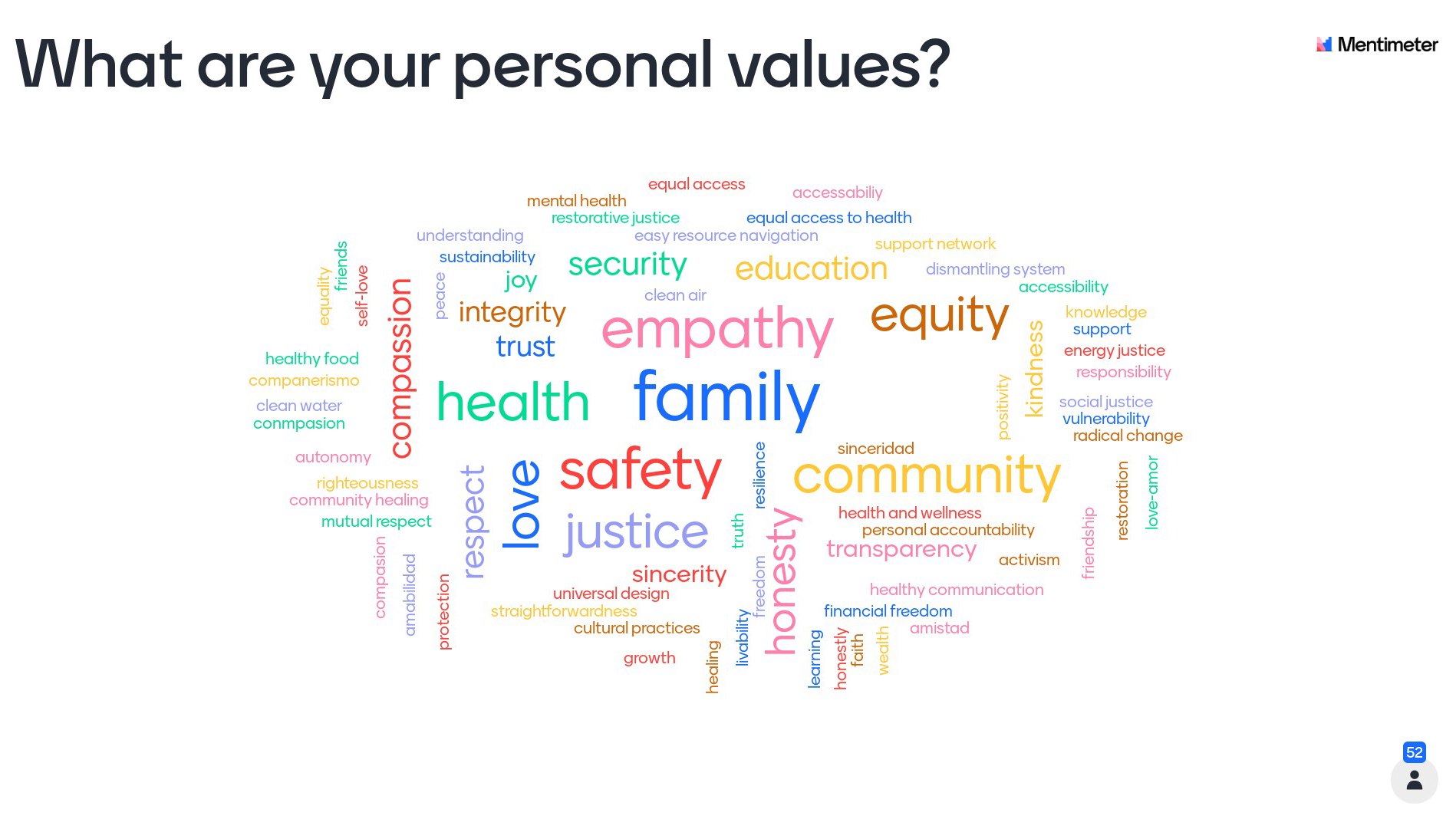 (Click to enlarge) A word cloud generated during virtual Build/Shift convenings illustrates the values participants identified before discussing policy solutions. Beginning with community values became a defining feature of Portland’s community-driven policymaking process.
Residents who live with a problem possess knowledge that technical models lack. That is not a flaw in modeling; a model reflects the variables its designers thought to include, and residents have rarely been in the room when those choices were made. A tenant who has spent three summers in an apartment a landlord refuses to cool understands something about heat resilience that no emissions model captures. Excluding that knowledge does not make climate policy more rigorous. It makes it less accurate and less effective.
Recognizing lived experience as expertise is only worthwhile if policymaking can incorporate it. A values-first process provides that pathway by beginning with questions about people’s lived experience before introducing technical solutions or policy categories. Rather than sorting people into the fluent and the excluded, it asks questions that residents can answer from their own lives. What do you love about the buildings you spend time in? What does it cost to keep your home comfortable? The answers emerge as shared values that can then be translated into standards and policy.
Where It Was Genuinely Hard
The city of Portland’s embrace of community-driven policymaking didn’t happen overnight or because public agencies suddenly decided to listen more carefully. It happened because they were willing, at least in specific moments, to change how decisions were made. Despite collaborative willingness, the process was not without its frictions. Some challenges were political. Others were institutional. Still others were deeply human.
Timing compounded the challenge. Community-driven policymaking does not unfold in a political vacuum. An earlier city council may well have advanced the building standards. But an election shifted the political landscape, producing a council more closely aligned with business and industry priorities, and the work stalled. Build/Shift stopped meeting. Today, a newly configured council has reopened the possibility of moving the building standards forward. This lesson is an uncomfortable one: Even the strongest community-driven process cannot overcome political constraints. Sometimes success depends not only on building the right policy, but on recognizing and acting within the window when adoption is possible.
Not everyone welcomed the reversal in sequencing. Utilities and other industry stakeholders, accustomed to shaping policy from the outset and independently of community preferences, bristled at being brought into the process later—precisely the position frontline communities have traditionally occupied. Mainstream environmental organizations, by contrast, largely accepted the community-first approach. The differing reactions underscored that shifting who enters the room first inevitably reshapes long-established expectations about whose expertise receives priority.
Perhaps the most surprising challenge came from the communities themselves. Asking residents to co-create policy rather than simply react to it represented a fundamentally different civic role. Residents who had spent years experiencing government as something done to them—not with them—did not always feel comfortable exercising the authority they were being offered. The work required continual reassurance that the invitation to shape priorities was genuine. Community-driven policymaking requires building institutional capacity and community confidence at the same time.
One anticipated obstacle, however, never materialized. CCC compensated Build/Shift members at consultant rates and paid community members to participate in meetings and convenings. Instead of resisting the practice, city partners helped connect the coalition with funders, and philanthropic partners supported treating community expertise as knowledge worthy of compensation. As the City of Portland understood, and as all organizations should, paying residents for their insights shouldn’t be controversial when organizations intentionally design participation as shared governance.
A Model Others Can Use—And Why It Matters Now
The experiences of CCC, the City of Portland, and Multnomah County reveal that a policy can be technically sound and still fail the people it’s meant to serve when they have no say in shaping it. The only way to know what they need is to ask them. Because local and state governments control the sequence through which policy gets made, that lesson points to a small set of practices they can adopt to make community expertise part of how policy is designed.
First, bring communities into policymaking before problems and solutions have already been defined. Second, begin with values rather than technical language so residents can define what success should look like before weighing in on how to achieve it. Third, acknowledge past harms openly instead of assuming trust. Finally, budget for community participation as a standing cost of governance and treat community organizations as sources of policy expertise rather than outreach channels.
Structural reforms in government matter as well. Portland’s move to district-based representation and ranked-choice voting produced a city council that more closely reflected the communities affected by climate policy, including stronger representation from East Portland, an area of the city that is historically neglected and underinvested in. Multnomah County voters also approved ranked-choice voting for county offices. Community-driven policymaking depends on relationships, but it is also shaped by institutions. The rules governing representation, participation, and political accountability influence which kinds of policymaking become possible.
That matters because climate policymaking is entering a period of extraordinary instability. The United States has withdrawn from the Paris Agreement for the second time, making meaningful federal climate leadership unlikely for the foreseeable future. Meanwhile, communities are simultaneously confronting climate disruption, housing affordability, economic uncertainty, and declining public trust. Government budgets are tightening even as needs continue to grow.
But again, Portland offers a reason for optimism, and this is in part due to the ways community-driven policymaking has produced constituencies that understand the work they helped build. Community-driven policymaking is often described as a more equitable way to govern. Portland suggests it is also a better way to produce and use community data. The knowledge communities needed was never missing. The challenge has always been whether public institutions were willing to recognize it as evidence and build policy around it.
Read more stories by Taren Evans & Nikita Daryanani.