


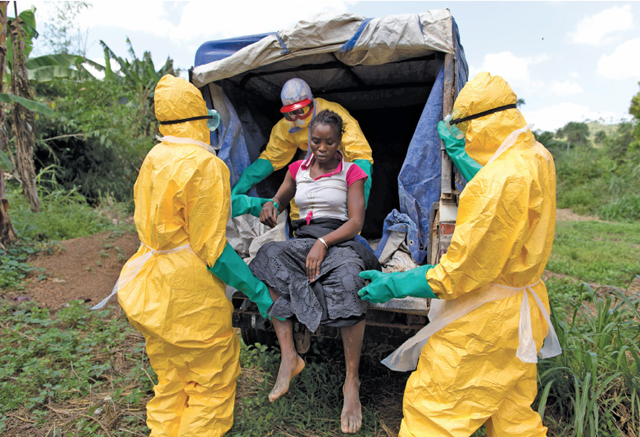
 In late 2014, frontline health workers transport a patient to an Ebola treatment center near Macenta, Guinea. (Photo by Kenzo Tribouillard/AFP/Getty Images)
Philip Joubert, a technologist from South Africa, was en route from Cape Town to California in late 2014, when the Ebola outbreak grabbed his attention. “Going through airports and seeing the warnings made the crisis quite real to me,” he recalls. He and his brother, Malan Joubert—cofounders of Journey Apps—decided to leverage their expertise to create Ebola Care, a mobile app that aims to support aid workers in Liberia, Guinea, and Sierra Leone.
Many tech-for-good projects never go beyond the pilot stage. But Ebola Care quickly gained adoption by more than 20 community organizations in West Africa. People in the region are using custom versions of the app to trace patient contacts, to educate people about Ebola prevention, to organize ambulance pickups, and to monitor school absentee rates—and for a host of other practical purposes that the Joubert brothers never envisioned.
That success, argues Marc Maxmeister, a consultant who works with the online fundraising organization GlobalGiving, is a direct result of the Ebola Care team’s willingness to learn from end users. “It’s far different from the way I’ve seen technology implemented by any agency in Africa or the global South,” he says. Maxmeister chronicles the Ebola Care story in Ebola: Local Voices, Hard Facts, a book (published in late 2014) that captures insights from people who have been on the front lines of the recent crisis.
Technologists aren’t waiting for the crisis to end before they begin applying lessons from the field. “We’ve learned much from the mHealth tools that have been deployed up to now, including Ebola Care,” says John Tippett, director of mobile health innovations for the Grameen Foundation. Grameen, for its part, is working to create a suite of mobile tools that will support an upcoming Ebola vaccine trial. Built on an existing platform called Mobile Technology for Community Health System, or MOTECH, the new set of tools will use both voice and text messages to encourage vaccination, to remind people when they’re due for booster shots, and to gather data. (The Innovative Medicines Initiative, a partnership of the European Union and European pharmaceutical companies, is conducting the trial as part of a $250 million effort to combat the virus.)
For such tools to be useful, Tippett says, developers need to work hand in hand with health workers and others who are responding to the crisis in cities and villages. The goal, he explains, is “to strengthen the work being done in those communities, not replace it with technology.” To respond quickly to fast-changing circumstances, some organizations have re-purposed existing technology. UNICEF, for example, has used text messaging to inform teens about school closures caused by the Ebola outbreak. A start-up called Halt Ebola uses voice messages in local languages to educate people in rural communities about the disease.
The Emergency Telecommunications Cluster (ETC), a global network led by the World Food Programme, has focused on filling gaps in basic infrastructure. By installing satellite dishes and Wi-Fi networks in affected rural areas, ETC has enabled health workers to communicate patient information, order supplies, and stay in touch with distant family members. At an Ebola treatment unit in N’zerekore, Guinea, Internet service put in place by ETC enabled people on the treatment staff to use cloud-based databases to share patient data. Previously, staff members had to shout patient updates back and forth across quarantine lines, according to Michael Redante, information management officer for ETC in West Africa. “In an environment where miscommunication can mean the difference between life and death, bringing in these vital services can reduce fatal errors,” Redante wrote in a blog post early this year.
In all of these efforts, attending to user needs has been crucial. The developers of Ebola Care, for example, relied on GlobalGiving to introduce them to local aid organizations. “We went into each conversation with very clear goals and questions, knowing that each minute [that aid workers spent] with us was a minute not [spent] treating a patient,” Joubert says. “We weren’t just passively listening. We actively engaged [local staff members], tried to understand why they wanted to solve problems in certain ways, and challenged their thinking.”
Within a week of their first conference call with aid organizations, Joubert and his colleagues field-tested an initial version of Ebola Care. “Within 30 days, based on user feedback, there were five more versions of that app,” he says. Within four months, more than 20 customized apps were in use. “Previously, it was time-consuming and expensive to create mobile solutions for aid organizations,” Joubert notes, “You can now build mHealth apps in days.”
One other factor helped Ebola Care scale up quickly: Amazon donated 1,000 Android-based phones, each of them preloaded with the app, to aid groups in West Africa. Having all organizations use the same device eliminated the need to develop the app for multiple operating systems. GlobalGiving, which distributed the Amazon phones through its network, typically avoids handling “stuff” of this kind, Maxmeister says. But the severity of this crisis has caused everyone in the affected region to think differently.
Read more stories by Suzie Boss.