


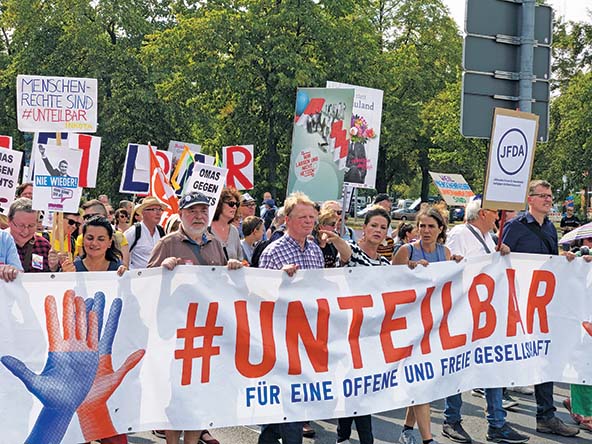
 The MBTs organized a racial unity demonstration in Dresden, Germany, in August 2019. (Photo courtesy of Mobile Beratung gegen Rechtsextremismus)
Far-right extremism has increasingly gained popularity in many nations around the world in recent years. In Germany, this extremism has worsened since the country’s unification in 1990, especially in the formerly communist eastern states where frustration with parliamentary democracy and the capitalist market economy is widespread. Racist violence, armed neo-Nazi gangs, and even a far-right political party—with so much support that it was elected to the national parliament in 2017—have forced Germany to grapple anew with increasing levels of hatred targeted at minority communities.
The problem, however, is not confined to the eastern states. According to the Amadeu Antonio Stiftung, a foundation dedicated to strengthening democratic society, extremists are responsible for the deaths of more than 200 people across the country since 1990. In 2019, German authorities counted 22,300 criminal acts with right-wing motives, and Interior Minister Horst Seehofer has called right-wing extremism “the greatest challenge to security in Germany.”
Where the far-right extremists are well organized—particularly in eastern cities such as Chemnitz, Frankfurt, and Dresden—thousands of their members terrorize locals through street demonstrations. In towns and villages, gangs assault immigrants, Jews, people of color, and leftists. Since the 2015-16 migration crisis, when 1.3 million migrants entered Germany, there have been hundreds of arson attacks on migrant hostels.
The Mobile Counseling Teams Against Right-Wing Extremism (Mobile Beratung gegen Rechtsextremismus, or MBTs) combat this extremism by mobilizing citizens, labor unions, and local governments to defend themselves against this violence. The NGO was founded in 1992 by five political figures—former East Germany dissidents Marianne Birthler, Regine Hildebrandt, and Almuth Berger, and anti-racism activists Ralf-Erik Posselt and Ines Schröder-Sprenger—concerned about the right-wing violence that jolted postunification Germany. The NGO now has 55 teams across the country.
MBTs advance their mission to promote and defend democratic culture and equality by assisting local communities in reclaiming public spaces—from town squares to Twitter—encroached upon by the far right. Each MBT is staffed with a diverse team of experts, from social workers and social scientists to legal experts and anti-racism activists. MBTs’ community interventions use tactical tools aimed at teaching communities how to respond to conspiracy theories and right-wing propaganda, to recognize far-right symbols and codes, to protect community events from rightist assaults, and to prevent neo-Nazi cultural events from happening in their communities. These interventions take shape in media campaigns, various forms of grassroots activism, and interactions with the municipal administrations and police forces.
MBTs’ strategy is conflict avoidant—they do not engage with extremists but focus on the communities harmed by them. “We’re not trying to win over right-wing radicals or hardcore racists,” explains Michael Nattke, who established MBT’s Saxony office in 2001. “Rather, we want to help communities and organizations to resist the far right, to push them and their slogans out of the public sphere. We’re not going to get rid of all neo-Nazis this way, but we can effectively marginalize them.”
MBTs’ work, he claims, has prevented eastern German regions from going the way of many in Poland and Hungary, where the far right has a foothold in government and public opinion. There may not be fewer extreme rightists in Germany, Nattke admits, but now there is a much more vibrant, resourceful civil society there to reduce their impact.
Tactical Mobility
In 1992, three social workers—Frauke Postel, Axel Zimmermann, and Bettina Berger—opened the first MBT office in the eastern state of Brandenburg in response to the shocking spike of postunification violence. The first MBT followed two principles: the belief that most Germans want a peaceful, diverse, and pluralist democracy; and the commitment to respond swiftly to crisis.
The first project began that year in the southeastern town of Storkow, Brandenburg, where a flush of violence struck a home for asylum seekers, mostly Bosnians and nonwhite Germans. Rupert Neudeck, director of the humanitarian NGO Komitees Cap Anamur, and Manfred Stolpe, then premier of Brandenburg, proposed the creation of a safe space to protect these vulnerable communities. They conceived their “peace village” as a citizen-led construction project composed of 10 houses with a total of 21 apartments, which would be built by immigrants, residents, former right-wing extremists, and international volunteers. The Brandenburg MBT coordinated the nearly €2.3 million ($2.7 million) effort, cobbling together funds from the state and private donations. Over a six-year period, the Storkow citizens not only completed the project but formed a community based on the values of tolerance and open-minded political culture.
After state officials declared the project a success, the MBTs expanded their operations, first throughout the eastern states and then to all of Germany’s 16 federal states. Financing has come mostly from short-term state and federal funds—today, from the Federal Ministry for Family Affairs, Senior Citizens, Women and Youth, as well as private sources, such as German churches.
Among the MBTs’ greatest challenges has been the rapid expanse of broad-based, nationwide far-right efforts, which have taken the form of town-based gangs, terrorist cells, itinerant mobs, and cultural phenomena like neo-Nazi music festivals. Some local authorities, furthermore, are sympathetic to the far right or are simply too afraid to respond to their actions.
The decentralized, sporadic, yet unrelenting nature of these extremist efforts reveals the significance of the “mobile” in the MBTs’ name. Mobility epitomizes the NGO’s tactics, which are directed at “the very fluid nature of the far right and its activities,” says Reiner Becker, a sociologist at Marburg University, which hosts the MBT office in the western state of Hesse. The MBTs’ mobility is physical as well as strategic. “They go to where they’re requested and assist with a specific problem there,” Becker adds, “constantly rethinking and reanalyzing their modus operandi.”
Controlling the Narrative
Nowhere in Germany is right-wing extremism more profuse than in Saxony, a state that lies along the Polish and Czech borders. The state’s intelligence service reports that 3,400 far-right militants are currently active there.
Many of the small towns and villages have been tyrannized by far-right groups to the extent that democratic civil society has been severely threatened, if not eliminated. This was the case for Limbach-Oberfrohna, a town of 26,000 residents, where the neo-Nazi National Democratic Party of Germany (NPD) had seats on the city council, but the ruling Christian Democratic political party (the party of Chancellor Angela Merkel) was particularly nationalistic.
In schools and on the streets, right-wing youth gangs regularly harassed and beat other youth they identified—through style and dress—as leftists. In 2010, the left-leaning youth club Social and Political Education Association of Limbach-Oberfrohna (Supblo) was burned to the ground. Yet, the authorities took no action. For more than two years, the parents of the youth petitioned the city council to respond to the violence, but to no avail. The mayor not only refused them an audience but blamed the parents and teenagers for making a fuss and besmirching the town’s good name.
Exhausted, frustrated, and scared for their children’s well-being, the parents contacted Saxony’s MBT. A two-person team sent from the nearby Chemnitz MBT advised them to form an initiative to rally the town’s citizens opposed to rightist extremism. In late 2010, the residents established the Diverse Citizens’ Forum for Democracy (Buntes Bürgerforum für Demokratie; BBD).
The BBD conducted its own public meetings to set a community agenda to respond to the violence, rather than rely on the city council. “The MBT helped us maneuver the obstacles, such as the recalcitrant city council,” says Christoph Lordieck, an architect in the town. “They helped us look for allies, like in the churches and trade unions.”
The idea, according to Anne Winkel of the Chemnitz MBT, was to bring together a coalition of residents to crowd out the far right from the city’s discourse. “We helped the BBD pick out the right topics and order their arguments in a way that would have the most impact,” says Winkel, including writing “the letter that made the council member respond.” After two years of public activism and increasing media attention, a member of the city council agreed to attend a BBD-sponsored roundtable discussion. Soon after, the city agreed to prioritize the issue. It requested and received state and federal funding for municipal associations to develop and incorporate anti-racism efforts into their policies and practices.
In 2011, the BBD was awarded the Saxon Award for Democracy, winning national headlines for curbing extremism. Today, while the BBD is less active than it was a decade ago, Lordieck notes that other community groups have emerged to keep civil society strong enough to prevent a relapse. He wishes the MBT team maintained a permanent presence in town, since MBT teams leave an area after a project’s conclusion.
As for the future, the MBTs’ greatest challenge, Nattke and Winkel agree, is to keep pace with Germany’s fast-evolving far right, which now includes the coronavirus deniers’ movement. “We have to adopt our strategies to this ungainly movement,” Nattke says. In contrast to the neo-Nazis, many of the deniers consider themselves democrats. The MBTs want to drive a wedge into the group by pinpointing and petitioning people who are angry about the lockdown restrictions but are not hard-core far rightists.
If this effort is unsuccessful, Nattke believes they could join the far right permanently. Despite Germany having one of Europe’s strongest democracies, the MBTs’ work is far from over.
Read more stories by Paul Hockenos.