


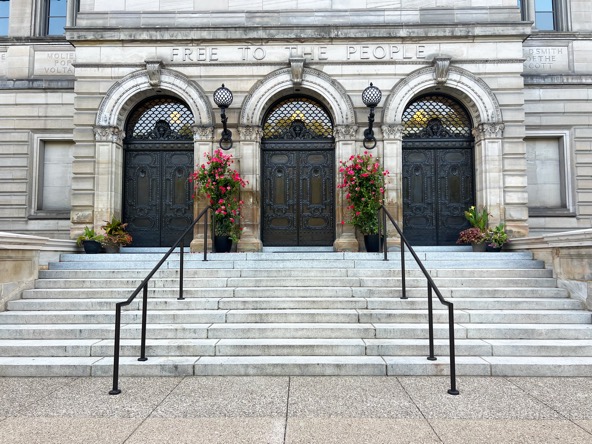
 (Photo by iStock/bgwalker)
I grew up in a town with a Carnegie library. Constructed in 1904 thanks to a $27,000 grant from the industrialist Andrew Carnegie, the building served as the community’s public library for seven decades. It’s where my mom went to borrow books. By the time I was a kid, it had been converted into a public arts center, hosting classes and performances and giving countless families a place for creativity and connection. Today, the city still operates the building as an event space—one of my high school class reunions was held there.
As Sarah Cone writes in her cover essay, “Why Don’t Philanthropists Build Anymore?,” it would have been impossible to project the impact of the more than 2,500 Carnegie library buildings in quantitative terms that would pass muster with many modern strategic grant makers. Yet their benefit to the civic fabric of communities like mine has been immense and long-lasting.
Cone’s argument is a challenge to those with extraordinary means to do extraordinary things. We live in a culture that endlessly celebrates trailblazing founders and risk-takers, yet our most financially successful fellow citizens seem to rarely extend the same ambition beyond the realm of business. While the titans of the first Gilded Age, like Carnegie and John D. Rockefeller, applied their resources and managerial talent to constructing novel and lasting civic institutions, today’s ultrawealthy seem satisfied with the relative safety of writing big checks. Existing nonprofits, universities, and other organizations do critical work, yet today, as global problems seem to be outpacing the capacity of such institutions, Cone’s call to build is a timely provocation.
One contemporary inspiration for would-be builders might be Ghana’s Ashesi University and its founder, Patrick Awuah, profiled in these pages in a case study written by Nimesh Ghimire. Awuah believed the African continent needed a new generation of entrepreneurial and ethical leaders, so he set out to build the institution that would train them, free from the legacies and limitations of the past.
John Kluge Jr. and Christine Mahoney’s article, “Building the Refugee Economy,” begins with the moving story of Hau Thai-Tang. His journey from evacuating Vietnam to a leadership role at one of the world’s great industrial firms shows what’s possible when displaced people are given opportunities to maximize their talents rather than treated as burdens to be managed or diverted. In this area too, with staggering numbers of refugees and forcibly displaced people around the globe, perhaps new, truly transformative institutions still need to be founded, but Kluge and Mahoney document how many leaders, investors, and organizations are already acting generatively to build more humane, welcoming, and prosperous pathways.
This issue, the first since I took on the new leadership role of executive editor, exemplifies much of what first drew me to SSIR, rigorously detailing innovative solutions on one page and asking difficult questions about power on the next. As has been the case throughout our 23-year history, our success won’t be determined solely by the attention these ideas capture online or in print but by their ultimate influence and application. We all—editors, writers, and readers alike—are not just students or observers of the world around us but builders of its future.
Read more stories by Bryan Maygers.