


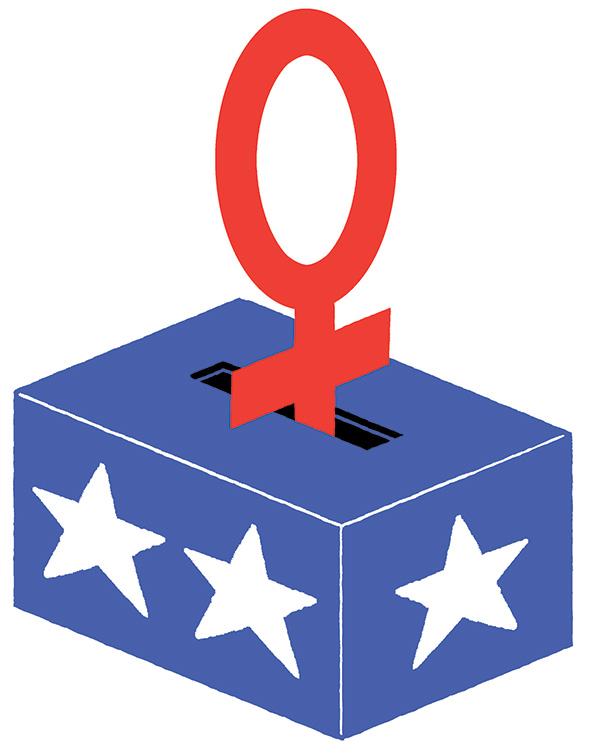
 (Illustration by Adam McCauley)
In 2020, four women appeared on the slate of candidates vying for the Democratic presidential nomination. As the primary contests got underway and the race narrowed, polls showed that for many Democratic voters, electability mattered more than policy positions or ideas. For these voters, settling on a nominee primarily meant deciding who was most likely to defeat Donald Trump in the general election. Weighing the prospects for Senators Elizabeth Warren (Massachusetts), Kamala Harris (California), Amy Klobuchar (Minnesota), and Kirsten Gillibrand (New York) alongside other candidates who were all men, voters and pundits alike asked whether a woman could garner enough support to be elected US president.
To investigate the relationship between gender and electability beliefs, or popular perceptions of a candidate’s chances of winning, Christianne Corbett and Jan G. Voelkel, both PhD candidates in Stanford University’s Department of Sociology, teamed up with Marianne Cooper, a sociologist at the Stanford VMware Women’s Leadership Innovation Lab, and Robb Willer, a professor of sociology at Stanford. The researchers conducted six experiments during the 2020 Democratic presidential primary that focused on the role that “pragmatic bias,” a form of groupthink, plays in shaping the actions of American voters and the outcomes of US elections. In a new paper sharing their research, the authors find that it plays an important but correctable role in preventing voters from supporting female candidates whom they might otherwise favor.
Defined as “a tendency to withhold support for members of groups for whom success is perceived to be difficult or impossible to achieve,” pragmatic bias refers to a voter’s expectation that supporting a woman candidate will be futile. Pointing to gender bias, sexist media coverage, and the exacting standards by which women candidates are judged, many Democratic voters assumed that a woman could not win the party’s nomination. “Even with people who don’t hold gender bias, and even with those who prefer women leaders,” Corbett says, “the ideas and assumptions they have about what others are thinking can undercut their support for a woman candidate.”
The first study, based on a partnership with LeanIn.org, the women’s leadership organization cofounded by Meta COO Sheryl Sandberg, scrutinized responses from a sample of likely Democratic voters. Participants answered two questions: “Do you think it will be harder or easier for a woman to win the 2020 election against President Trump, compared to a man?” and “How ready do you think most Americans are for a woman president?” The respondents also selected a “personal preference” candidate from a list that included the highest-polling six men and four women candidates. The Stanford researchers confirmed their hypothesis: Many voters perceived women candidates to be less electable than men, which became a self-fulfilling prophecy. The result was “gender shifting,” or voting “for a person of a different gender than the gender of the person one personally prefers,” usually for a man instead of a woman candidate.
The second study collected electability beliefs about men and women. Participants answered queries such as “How much would most Americans like to see a [woman/man] elected president?” and “If it came down to Joe Biden and Elizabeth Warren, who is more likely to beat Donald Trump in the presidential election?” When the researchers adjusted their questions, making electability a more salient issue, voters’ intentions to support a woman candidate decreased.
Studies three through six analyzed what it would take to successfully counter voters’ pragmatic bias. Simply letting people know that American voters were ready to elect women candidates wasn’t enough to challenge their assumptions about the actions of others, the researchers found. Instead, voters required evidence that women candidates win at the same rate as men. These studies, controlling for gender, age, race, and education, demonstrated that effective interventions—presenting voters with proof of women’s electoral victories—boosted voters’ intentions to support all women candidates, not just a particular woman running for president.
“Unlike other elections,” Corbett says, “what was so exciting is that we had four women, so we were able to look at patterns by gender, separate from the candidates’ many other attributes.” An unprecedented primary allowed the Stanford researchers to study voters’ ideas about gender, irrespective of a candidate’s qualities or policies. It also allowed the researchers to test strategies that will help women candidates win, despite the pervasiveness of pragmatic bias.
“This paper identifies a devastating but critically important factor preventing women candidates from ascending to the highest levels of political office,” says Lindsay Owens, the executive director at Groundwork Collaborative, a progressive economic policy organization, and former economic advisor to Elizabeth Warren. “Political communicators and candidates should look closely at the authors’ recommendations for overcoming this bias if they want to improve their odds of electoral success.”
Christianne Corbett, Jan G. Voelkel, Marianne Cooper, and Robb Willer, “Pragmatic Bias Impedes Women’s Access to Political Leadership,” Proceedings of the National Academy of Sciences, vol. 199, no. 6, 2022.
Read more stories by Daniela Blei.