


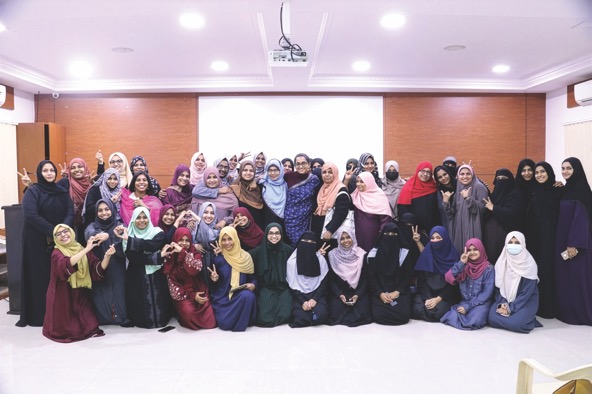
 Led By Foundation participants receive career mentorship and join a network of women who hold like aspirations and confront similar challenges. (Photo courtesy of Led By Foundation)
When Ruha Shadab began working as a physician at a government hospital in New Delhi around 2015, she witnessed firsthand the resource constraints of the public health-care system. But what struck her most, in her encounters with Indian Muslim women patients, was their lack of agency and their limited power to make decisions about their own lives.
“If we spoke to them about family planning, for example, they would be hesitant and say, ‘My husband will not allow it,’” Shadab remembers.
It prompted her to shift gears. “I wanted to bring systemic change and focus on the economic empowerment of Muslim women,” she says. Shadab went on to earn a Fulbright scholarship to study public policy at Harvard Kennedy School. Stark numbers reinforced her conviction. Only about 15 percent of Muslim women in India participate in the workforce, and around 5 percent hold formal jobs, compared with an overall female labor-force participation rate of 34.9 percent. “Muslim women could be a major growth driver for our country,” she says. “We are not investing the resources needed to leverage that potential.”
She turned that conviction into action in 2019, when she was selected for the Cheng Fellowship at Harvard Kennedy School’s Social Innovation + Change Initiative and awarded $30,000 in seed funding to start Led By Foundation, a professional-development organization for Indian Muslim women.
“I wanted to help Muslim women upskill, secure jobs, and stay in those jobs,” she says. To that end, she established a research arm within Led By to examine workplace retention and hiring practices. One hiring-bias study by the organization found that Muslim women received roughly half as many job callbacks as Hindu women. Growing up in a Muslim family, Shadab had faced similar biases herself, even in school, and understood what it meant to be part of a minority.
Led By Foundation’s first cohort kicked off in 2020. “I remember hoping that I would get 20 Muslim women to sign up for the fellowship,” Shadab recalls. “We ended up getting 200 applications in two weeks. So just off the bat, our selection rate was 10 percent. The following year we had around 1,500 applications. We started with 20 women and now take in 400 a year. There’s such a demand for being that potential engine of growth for the country.”
Over seven years, the foundation has trained more than 1,200 Indian Muslim women between the ages of 18 and 35, drawn from metro areas across 25 states and union territories. “We reach out to women to apply for our fully funded programs through outreach efforts, social media, university workshops, and word of mouth,” Shadab says.
What started as a one-woman effort has since grown into a six-member team with program managers, associates, marketing support, and a chief of staff, alongside interns and volunteers, all working remotely. Several team members are Led By alumni.
Shadab led the organization while working full time as a public-health consultant and strategist at McKinsey & Company until recently. In March, she stepped away from consulting to focus on scaling Led By’s operations as it enters a new phase: expanding accessibility, offering bilingual programming, strengthening tech support, boosting skilling initiatives, and building a stronger community for Muslim women.
Long-Term Agency
The organization currently runs three core professional-training and mentorship programs online, with some specialized in-person workshops and networking events. The Led By Accelerator Program supports recent college graduates entering their first jobs and women returning to the workforce. The Corporate Leaders Fellowship aims to fast-track Muslim women into leadership roles, while the Shepreneurs Program is designed for early-stage founders looking to scale their ventures. Several leading firms across industries now regularly recruit from Led By’s pool of graduates.
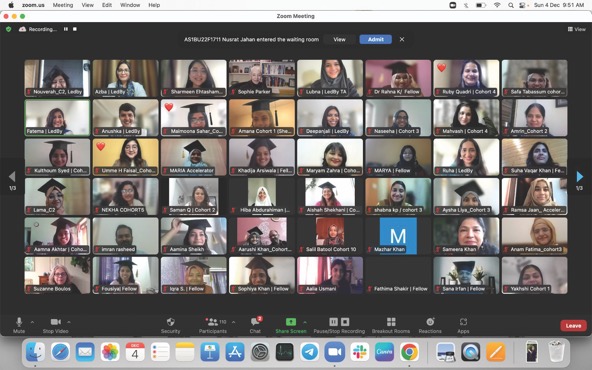 A cohort of Led By Foundation program graduates assemble for an online graduation ceremony. (Photo courtesy of Led By Foundation)
Each program accommodates between 25 and 75 women annually across multiple cohorts. Programs run for six months, with virtual sessions every weekend led by the team, alongside facilitators and mentors from across industries. Participants are expected to put in several hours on assignments during the week. The fellowship also offers one-on-one mentoring, executive coaching, and curated panel discussions with industry leaders. The curriculum, covering communication, problem-solving, networking, personal branding, feedback, negotiation, and structured thinking, is refined each year. This year, for example, the team introduced sessions on using AI in the workplace to strengthen professional profiles.
“It’s not just about being job-ready, it’s about long-term agency. We are a platform to build capacity,” says Led By program manager Anam Farzeen, a 2022 graduate of the Accelerator Program and cofounder of the e-commerce platform Islamic Shop. “When I joined Led By as a participant, I was looking for a community. The advisors were role models—the kind I didn’t have growing up. Now every woman who joins Led By has nieces, sisters, and daughters who will look up to us,” she says.
Participants range from students and graduates to homemakers, young mothers, and working professionals, all navigating different familial, societal, religious, and patriarchal challenges. “There are layered realities, and we do not aim for uniformity,” Farzeen says. “Whether you wear a hijab or not, no one will question you. While the focus is on empowering Indian Muslim women, the curriculum is not religious in nature.” At the same time, open sessions give participants space to raise sensitive issues, such as navigating a Muslim identity in the workplace.
One Sunday morning in February, the Led By team welcomed a new cohort to the Accelerator Program via a virtual orientation. “This is a space for Indian Muslim women where different parts of your identity feel at home,” Shadab told participants. “Our mission is to create more visible role models. So, make the most of this program.” The team encouraged the cohort to inspire the next generation of Muslim women and become ambassadors in their own cities.
Resham Fatma, 28, an acid-attack survivor and a Led By graduate, became a program ambassador in Ranchi, in the state of Jharkhand. “The fellowship opened my mind to new visions and opportunities. Earlier, I had considered journalism because I was interested in women and politics. But when I joined Led By, I realized I could do more specialized work and start my own foundation. So, I decided to pivot. It gave me the confidence to say no to unfair opportunities. We realized Muslim women are so capable. It’s not just about the six-month accelerator; it goes beyond that—it’s a tribe for life,” she says. After graduating, Fatma founded Ebrah, an organization that works with schools on gender and women’s rights.
At the heart of the Led By fellowship is specialized mentorship delivered by facilitators, advisors, and executive coaches from across the world who volunteer to develop and lead specific modules. This rotating pool of mentors, drawn from corporate leadership, academia, and consulting, is sourced through recommendations and extended networks. “We have professionals associated with firms such as McKinsey & Company and Bain & Company, as well as professors from Harvard University, Columbia University, and Massachusetts Institute of Technology,” Shadab says.
One of them is Anita Guha, an HR leader and former IBM executive who spearheaded diversity initiatives there. “I found that the women participants at Led By have immense substance, but they may not always have had the opportunity or confidence to express themselves fully,” Guha says. “The Led By workshops help them develop that style, including the ability to articulate, position, and present themselves. They particularly benefit from support in areas like personal branding and overcoming imposter syndrome,” she says.
Budding Confidence
Given the diversity of each cohort, participants raise a variety of concerns: Where do I begin? How do I hone what I can offer? How do I frame my ask? What if I hit a wall? Networking can feel self-serving, so how do I navigate that?
Sajjad Ahmed Shaik, global head of learning for insights and data at Capgemini, leads a networking module at Led By. He begins by demystifying what networking means, online and off. “We then talk about personal barriers and come up with practical solutions together,” he says. He offers a structured framework that covers how to reach out, maintain relationships, stay relevant, and build proximity in professional spaces, including strengthening one’s LinkedIn presence and writing effective direct messages. “After the sessions, I see a visible difference in confidence levels,” he says. “From the first cohort to now, the shift has been huge.” Participants are encouraged to stay in touch and reach out to mentors whenever they hit a roadblock.
Scholarships at Led By are funded through grants and incubators, including Echoing Green, which awarded $80,000 in funding. “Additional support comes from high-net-worth individual donors in India and a growing alumni pay-it-forward model, with recurring contributions of up to Rs 3,000 [$32],” Shadab says. The gains so far have been encouraging. Between 2020 and 2025, the foundation’s 1,200-plus graduates have seen a cumulative income increase of over $5 million. On average, a Led By graduate’s income doubles after completing the program, Shadab says, with a 95 percent employment rate across cohorts and a career pivot within three months of finishing.
Tania Alam, a product manager at a finance company who joined the Corporate Leadership Program in 2024, calls her time at Led By “life-changing.”
“I will never forget the facilitator who taught us negotiation strategy. Within a year, I got a better job, a better salary, and better benefits, and moved from a smaller town to Mumbai,” she says. Several small shifts transformed her as a professional. “The sessions on empathy and communication were so helpful. I learned how to stay nice but be direct, how to address conflict respectfully, and how to be a good leader without having to be aggressive.”
She counts continued access to role models from within her community as one of her biggest takeaways. “I don’t want to replicate their journey. I want to take motivation and inspiration from theirs and create my own.”
Read more stories by Neha Bhatt.