


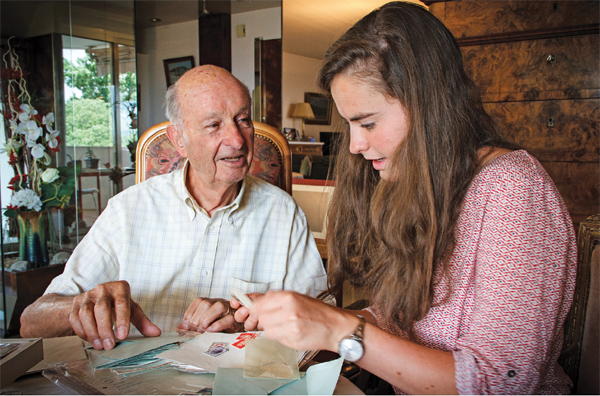
 At his apartment in Lyon, France, Jacques Bellet (left) goes through his mail with Bénédicte Picart. (Photo by Juliane Dubois, courtesy of Esdes Intergénérations)
What’s it to be this morning? Brioche?” says Jacques Bellet, 86, to Bénédicte Picart, 18. They’re fixing breakfast, as they do every morning. They usually have dinner together, too. They live as roommates in Bellet’s apartment in Lyon, France.
Picart is one of approximately 1,100 students in France who take part in intergenerational home-sharing schemes. The group that organized her and Bellet’s home-sharing arrangement is ESDES Intergénérations, a nonprofit sponsored by the ESDES School of Business and Management, which is part of the Catholic University of Lyon.
Students who enter a home-sharing situation sign a contract that stipulates what they can and can’t do in the home that they’re sharing—and what they must do. Typically, students can invite family members, but not friends, to visit them at home. (“That doesn’t mean I can’t go out,” Picart explains. “I can go and see my friends after dinner.”) A contract might also require a student to play a weekly game of Scrabble with a homeowner, for example, or handle grocery shopping.
The main benefit of this model for students is clear enough: they pay no rent, although in some cases they agree to share utility costs with their host. Often they also get meals at no cost. But for Picart, the homesharing experience isn’t just transactional. “It’s nice when you get home in the evening and tell each other about the days you’ve had,” she says. “It’s better than being in a room, preparing your meal on your own—especially if you’re away from your parents for the first time. It’s good to have company and to make yourself useful. And with Jacques, we have good conversations.”
Picart is Bellet’s second live-in student. The experience has changed his life. “After my wife died, I started digitizing all our home movies. Seeing her again made me miss her so much that I got quite depressed,” Bellet recalls. “I was in quite a bad state for several months, and my son said, ‘We’re going to do something about this.’ He got on the Internet and found this association.”
This past April, Bellet and Picart attended a play put on to mark the 10th anniversary of ESDES Intergénérations. On hand to enjoy the performance were many of the 500 home-sharing pairs that ESDES Intergénérations has brought together over the past decade. The play, written and produced for the occasion, was a love story about two students who live in the same apartment block with two senior homeowners. The relationship between the students turns out to have a pivotal connection to the past love life of one of the seniors.
Gaelle de Chevron Villette, president of ESDES Intergénérations, says that the play reflects the way that home-sharing participants open up to each other in real life. “It’s sometimes easier to talk to people who are not close, who are not family,” she says. Typhaine de Penfentenyo, founder of Ensemble2Générations, another homesharing organization, agrees. “Put two 50-year-olds together, and it’ll probably be a nightmare,” she says. “But there’s something about the two-generation gap. It works.”
Giving and Getting
Both de Chevron Villette and de Penfentenyo emphasize the effort that goes into matching the right student with the right senior. Before committing to live together, the parties in a home-sharing arrangement meet and get to know each other. Careful preparation has resulted in low failure rates. According to de Chevron Villette and de Penfentenyo, only in about 2 percent of cases does one of their organizations need to break up a home-sharing pair.
To fund their services, home-sharing associations in Lyon rely partly on public-sector support. Governments at various levels cover about 40 percent of expenses for ESDES Intergénérations, Ensemble2Générations, and a third association, Pari Solidaire. These associations also get revenue from home-sharing participants. ESDES Intergénérations, for instance, charges an annual fee of $340 to student members and $450 to senior members.
De Penfentenyo is developing a book of stories that illustrate the benefits of intergenerational home sharing. There is, for instance, the story of an elderly Christian woman who would read from the Bible to her young Algerian roommate, who in turn would read to her from the Koran.
Here’s another story: A few years ago, the father of the president of Stade Français, a Paris-based rugby team, contacted de Penfentenyo because he wanted to find a roommate who would liven up his lonely apartment. Two days later, she interviewed a Moroccan student who was looking for a home-sharing situation. “What are your hobbies?” de Penfentenyo asked her. “I love rugby,” said the young woman. For a year, the student and the old man shared his apartment, and whenever Stade Français played at home, they would attend the match together.
And here’s another: A 70-year-old widow who lives in Versailles had become so lonely that she would raise the volume on her television set just to mask the silence in her home. After her doctor prescribed antidepressant medication, she decided to treat her condition in a different way—through home sharing. Before long, a young Argentine woman who was studying violin at the Versailles Conservatory had moved in with her. The young woman played her instrument for the old woman, and they became good friends. The old woman, de Penfentenyo reports, is now planning to open a home-sharing agency in La Rochelle, a city in the west of France where she has a second home.
ESDES Intergénérations, Ensemble2Générations, and Pari Solidaire, all came into being after the summer of 2003, when 15,000 elderly people perished in France during a major heat wave. While families were away on vacation, old people died in record numbers because no one was around to check on them or to look after them. The founders of these organizations viewed home sharing as a way to end the life-threatening isolation of many French seniors.
These founders had the needs of students in mind as well. “We speak a lot about the solitude of the elderly, but there is also a solitude of the young,” says de Penfentenyo. Home sharing also emerged as a way to ease shortages of student housing: Each summer, Lyon faces an influx of 100,000 students who need a place to live.
Home sharing can also save students, the elderly, and the government a lot of money. Students, clearly, save on housing costs. But the gain for seniors and their families can be even greater. The cost of having a 24-hour nonmedical caretaker at home is about $180 per day, and living in even the cheapest seniors’ residence in Lyon costs $22,500 per year.
Françoise Rivoire, deputy mayor in charge of intergenerational relations and the elderly for the city of Lyon, notes that governments in France operate many of the country’s nursing homes for seniors. So when home sharing allows elderly people to stay in their houses or apartments, those governments can reduce spending. The same logic applies to young people. “In France, students have the right to 200 euros [about $220] per month to help them pay for somewhere to live. If they have free lodging, the government doesn’t have to pay out this money,” Rivoire explains.
In addition, says de Penfentenyo, “there are non-quantifiable benefits.” Intergenerational home sharing helps give seniors a sense of purpose. That sense of “social utility,” as she calls it, can have positive effects on their physical as well as mental health. As for students, home sharing can improve their chance of success in school: With fewer money worries, they are better able to concentrate on their studies. (According to research cited by de Penfentenyo, students who must work are twice as likely to drop out as those who don’t.)
Supply and Demand
Intergenerational home sharing has a great deal of potential, says David Sinclair, director of the International Longevity Centre, a London-based think tank. Housing price inflation in many parts of Europe has reduced the range of affordable lodging options for students. What’s more, the number of older people who might benefit from companionship keeps rising. Between 2010 and 2060, Sinclair notes, the proportion of people in Europe who are age 65 and older will double. Perhaps the main impediment to the expansion of home sharing, Sinclair suggests, is the tendency among seniors to think, “My home is my castle.” In Lyon, there are nearly four students who seek a home sharing arrangement for every available opening. Many elderly people are simply nervous about sharing their house with a young person.
Sharing one’s private home isn’t an issue for seniors who live in nursing homes or other institutional settings. In Lyon, the city government houses students in some institutions that it runs. This year, officials plan to increase the number of places for students from 80 to 100. In the geriatric care unit of the Croix-Rousse hospital, for example, 16 students live in single apartments. Tin-Hinnane Benmouhoub, a 22-year-old sociology student, lives at the Croix-Rousse facility. At first, she says, she hardly ever saw her elderly neighbors because their schedules are so different from hers. In the evening, they go to bed before she even gets home from her classes. Today, though, students must sign a contract each year in which they promise to organize an activity that engages elderly residents. Benmouhoub organizes two activities: a gin rummy game and a coloring book class. (Coloring books for adults are all the rage in France.)
Now, especially during weekends, she talks quite a lot with some of her older neighbors. Her parents and grandparents are in Algeria, and the opportunity to interact with seniors at the hospital helps fill an important social gap. “They [older residents] teach me things about life,” she says. “They ask about my studies and give me advice. They talk about their youth, and where they were when they were my age. I like listening to them, because it’s so different from what I hear from other people I know.”
Read more stories by John Laurenson.