


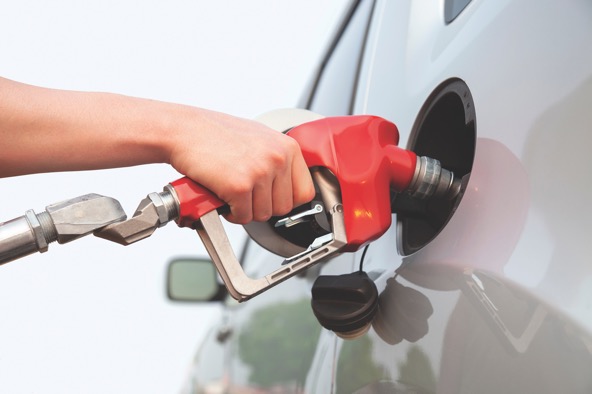
 (Photo by Daniel Thornberg)
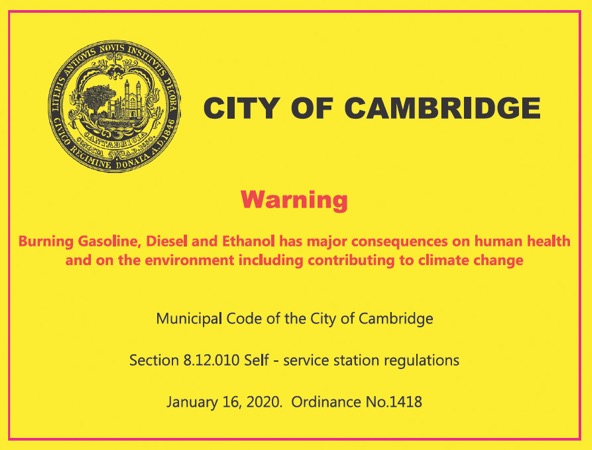
Since 2020, gas pumps in Cambridge, Massachusetts, have displayed a label that says, Warning: Burning gasoline, diesel and ethanol has major consequences on human health and on the environment including contributing to climate change. Most residents of the town famous for harboring Harvard University and MIT already support stronger action on climate change. In fact, across the political spectrum, majorities nationwide express concern about the health and climate harms of continued fossil-fuel use.
Health-climate warning labels, often called “warming labels,” are notices placed on gas pumps that inform consumers about the health and environmental consequences of burning fossil fuels. In practice, however, they may do less to warn consumers than to remind them, each time drivers fill their tanks, that concern about the harms of fossil-fuel use is widely shared. By making that concern visible, warming labels can help establish a social expectation that people should consider cleaner alternatives to gasoline and diesel whenever possible. Over time, that expectation could help drive a broader cultural shift away from fossil fuels.
And now new research shows that such labels prove effective in reducing gas consumption even among those who already support reduced fossil-fuel use. A forthcoming study by Fazli Salim, doctoral student in psychology at Boston College; Gregg Sparkman, assistant professor of psychology at Boston College; and Stylianos Syropoulos, assistant professor of sustainability at Arizona State University, finds that labels emphasizing harm to others and broad public support for a transition away from fossil fuels increase intentions to drive less and use more sustainable transportation.
Warming labels operate differently from most climate policies. Rather than raising prices or restricting choices, they disclose the otherwise invisible health and climate costs of fossil-fuel use. That distinction matters politically. Policies that increase fuel prices are often perceived as threats to household budgets and livelihoods, while labels simply make hidden consequences visible. Climate policy has long struggled with this tension. Although most Americans express concern about climate change, relatively few rank it above the economic demands of daily life, and dependence on fossil fuels remains deeply embedded in transportation systems.
Industry Resistance
Efforts to require health-climate warning labels on gas pumps have faced significant political and legal resistance. In 2020, Cambridge, Massachusetts, became the first US city to require them. The measure, championed by City Councilor Patricia Nolan—it was first introduced by former City Councilor and Vice Mayor Jan Devereux before leaving office—was controversial. The ordinance might never have advanced without the support of then-City Attorney Nancy Glowa, whose determination that the labels were constitutional gave Cambridge a legal pathway forward. Earlier efforts in Berkeley, California, and Seattle, Washington, had foundered after city attorneys concluded that similar measures would be difficult to defend in court.
Momentum has since built elsewhere. In 2023, Hawaii’s Senate passed a warming-label bill, though the measure later stalled in the House. A similar proposal advanced in Colorado in 2024 before Governor Jared Polis signaled that he would veto it, citing skepticism about its effectiveness. Beyond the United States, Swedish Environment Minister Karolina Skog championed legislation requiring climate information on both gas pumps and EV-charging stations. Sweden’s eco-label program rates fuels according to their climate impact and origin, making it easier for consumers to compare alternatives. The NGO Green Mobilists reports that the policy has encouraged fuel producers to reduce the carbon intensity of their products and helped inspire similar initiatives elsewhere.
Warming labels reflect the logic of the Endangerment Finding, the landmark US Environmental Protection Agency determination that carbon dioxide is a pollutant harmful to human health. Although the finding was recently revoked by the Trump administration, the underlying principle remains: Activities that impose significant harms warrant public disclosure and regulatory action. Duke University professor of Earth Science Drew Shindell estimated that a gallon of gasoline imposes roughly $6.50 in external costs, and a gallon of diesel approximately $8.00. Warming labels make those otherwise hidden costs visible at the pump.
Changing Consumer Attitudes
Researchers Salim, Sparkman, and Syropoulos argue in their working paper that efforts to reduce transportation emissions face a “triad of hurdles.” First, the harms caused by fossil-fuel emissions are often invisible or indirect, weakening the sense of moral urgency. Second, driving fossil-fuel-powered vehicles remains socially normalized. Third, many people doubt that their individual actions can meaningfully contribute to solving the problem.
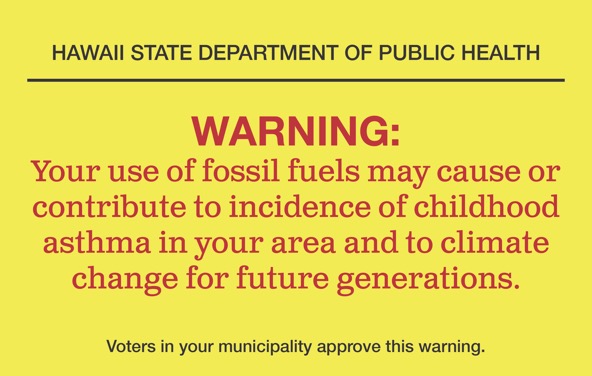
Warming labels can help address all three hurdles simultaneously. By linking fuel consumption to its health and climate consequences, they reduce the psychological distance between actions and outcomes. Research suggests that messages connecting fossil-fuel use to local harms—for example, childhood asthma—resonate across political lines. By highlighting widespread concern about those harms, labels signal that cleaner choices are socially valued and help correct what researchers call “pluralistic ignorance”: the tendency to underestimate how many others share their views. When paired with broader climate policies, labels can also strengthen the belief that individual actions contribute to meaningful collective change.
Labels function less as a regulatory mandate than as a social-norm intervention. By signaling that concern about fossil-fuel harms is widely shared, they help create what researchers refer to as an injunctive norm: a shared expectation that cleaner transportation options should be considered whenever possible.
Labels are particularly effective when they complement existing climate-action plans. At least 24 states and the District of Columbia have adopted economy-wide greenhouse-gas reduction targets. Colorado’s proposed warming-label bill coincided with the state’s goal of reducing transportation emissions 90 percent below 2005 levels by 2050. In this context, labels can strengthen the sense that personal choices contribute to a larger collective effort. According to Hye-ryeon Lee, professor and chair of the School of Communication and Information at the University of Hawai‘i at Mānoa, warming labels could “bridge the gap between intention and behavior through repeated ‘external cues’ and serve as an important reinforcement to ensure that the individual’s readiness to act is sustained until the climate supportive action becomes a settled habit.”
The Decarbonization Fight
A low-carbon transportation future will not be easy to realize. It is not just a technical challenge; it also presents a social and political dilemma. Although many Americans express concern about climate change, fossil-fuel use remains deeply embedded in everyday life, and the urgency of reducing emissions often ranks low among competing priorities. Decarbonizing transportation will therefore require more than new technologies. It will require lasting shifts in attitudes, behaviors, and expectations.
The obstacles are substantial. Political forces favoring fossil fuels remain powerful, and efforts to keep petroleum inexpensive continue. Policies designed to accelerate the transition to cleaner vehicles remain vulnerable to political reversal. The result is a persistent gap: Many Americans recognize the harms of fossil-fuel use but do not yet prioritize the behavioral and policy changes needed to reduce it.
This is where warming labels may matter. According
to transportation scholar Dan Sperling, future low-carbon transportation
systems are likely to rely on shared mobility, greater electrification, and
automation. Whether that vision is realized will depend in part on public
willingness to embrace new transportation habits and support continued
investment in clean infrastructure. Warming labels can help cultivate that
willingness. By making the health and climate costs of fossil-fuel use visible
at the point of purchase, labels can help lay the foundation that a lasting
transformation will require.
Read more stories by James Brooks.