


 (Illustrations by Gérard DuBois)
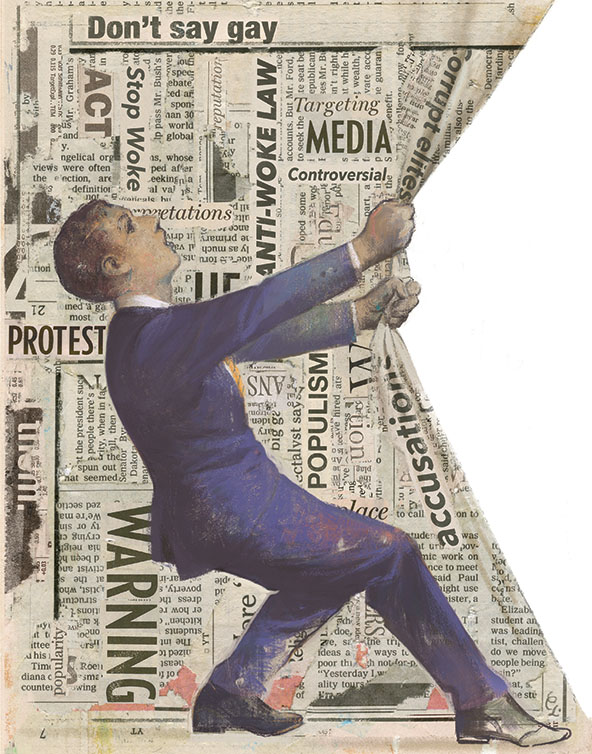
When Disney decided to challenge Florida’s “Don’t Say Gay” bill, signed into law by Governor Ron DeSantis in March 2022, it anticipated a backlash, but not on the scale that it generated. The law prevents discussion “about sexual orientation or gender identity” at all public school grade levels, and LGBTQ+ advocates condemn it as an attempt to curb visibility of the LGBTQ+ community and marginalize them in education and society. DeSantis touted the legislation as a necessary move against “woke gender ideology.” Disney’s public opposition to the bill thrust the company into the center of an unprecedented power struggle that resulted in DeSantis’ dissolving Walt Disney World’s special independent self-governance status in Florida, in February 2023. This dissolution gave DeSantis control of the board of Disney World’s governing district, whereby he created a new state oversight board to manage the district’s municipal affairs and—unsurprisingly—staffed it with allies.
Such morality-driven attacks on minority groups—more dramatically conceptualized in terms of “the culture wars”—are not new. Yet in recent years political leaders have increasingly deployed them as part of their populist strategy to amass power. Populism, according to the political scientist Cas Mudde, is a political approach that divides society into two opposing groups—the people and the corrupt elite—to argue that politics should be an expression of the will of the former. Put simply, populism is an antielitist and antiestablishment political standpoint designed to stoke division for power.
In the United States, populism gained momentum in the mid-19th century, when farmers and labor unions protested corrupt bankers and politicians, whose decisions had left farmers in debt and without legislative protection against high fees on the storage and transportation of their crops. Their alliance became the foundation of the People’s Party, soon thereafter renamed the Populist Party, which was founded in 1892 to fight for political reforms that supported the working class and regulated the private sector. They specifically targeted monopolistic corporations that benefited from high tariffs on farm machinery and banks that imposed difficult loan terms and ruinously high interest rates on farmers. Gradually, the populist movement in the United States waned as the People’s Party merged with the Democratic Party in 1896, when both parties nominated popular orator and lawyer William Jennings Bryan to represent them in that year’s presidential election.
In more recent years, populism has gained a greater foothold in Latin America and Europe, among other parts of the world, where people feel abandoned and deprived of government support and safety nets because of the swift expansion of globalization and free-market capitalism. Authoritarian leaders like Venezuela’s president, Nicolás Maduro, and Hungary’s prime minister, Viktor Orbán, have adopted populist messaging that exploits economic and cultural tensions around issues like immigration and trade and professing to represent the interests of the people. In addition to Maduro and Orbán, political leaders, including the current leaders of India, Italy, and Turkey, and recently ousted leaders like former Brazil president Jair Bolsonaro, former UK prime minister Boris Johnson, and former US president Donald Trump appropriated populism as a political strategy. Even well-known authoritarian leaders who employ hard-power repressive tactics such as surveillance, harassment, and violent crackdowns, including China’s president, Xi Jinping, and Saudi Arabia’s crown prince, Mohammed Bin Salman, have increasingly adopted a populist approach by depicting themselves as champions of the people as a soft-power strategy to mobilize the masses.
For many populists like DeSantis, it is politically advantageous to attack big corporations, which they portray as allies of the corrupt elite that are interested only in increasing their profits. Populist politicians profess to speak for the interests of working-class people who have been exploited by profit machines like Disney. Furthermore, the hostility against big business has become an area of convergence among right- and left-wing populists, as both factions identify corporate hegemony as a common enemy of the people—albeit for different reasons.
Yet populist efforts to address the needs of the people are more often performative than substantive. Authoritarian leaders will use populist framings and language to centralize power by feigning an allegiance to the people, onto whom they project their own beliefs and on behalf of whom they then claim to speak. Such a narrative enables populists to gain political capital and vilify businesses that disagree with or dispute their agenda. Additionally, populists rely on mis- and disinformation to further stoke social tensions.
Populism raises several challenges for companies, like Disney, Ben & Jerry’s, and Starbucks, that are proponents of corporate social responsibility (CSR), whereby businesses enact practices that benefit society in addition to earning profit. Our team of researchers from the University of Bath have examined these challenges to provide new insights and resources about how to rebalance democracy and capitalism. In what follows, we identify ways in which populism poses a threat to responsible business practices and explore why businesses might choose to pursue a responsible business strategy despite these challenges. We conclude by offering a strategic framework for responsible business stances against populism.
Populism’s Threat to Responsible Business
According to 2023 research published by the Carnegie Endowment for International Peace, populism “has negative effects on economics and business” resulting from political corruption and cronyism. Johns Hopkins University professor of the practice of international affairs Yascha Mounk has also argued that countries led by populists have more volatile economies. However, little scholarship or media attention has been given to the examination of populism’s effects on CSR.
We identify three significant ways in which populism threatens CSR: It discredits businesses’ reputation through the slanderous accusation of elitism, it delegitimizes corporate prosocial engagement by asserting businesses’ single purpose is to grow the economy, and it manipulates the market by inhibiting the conditions necessary for responsible business.
First, populism can negatively influence the public’s perceptions of the roles of business in society, causing increased scrutiny and challenges in maintaining responsible business practices. By depicting businesses as allies of the corrupt elite, populist leaders endeavor to undermine businesses’ traditional sources of power: business networks and associations. Populists then construe businesses’ social responsibility efforts as merely a guise for growing their own profit, rather than serving the public.
The discrediting of businesses as dishonest actors aligns with a broader populist strategy to polarize society. Populist leaders aim to foment social distrust not only toward businesses but also toward other so-called elites and experts, including scholars and journalists—people who barter in language and information. For example, populists like DeSantis refer to tech leaders as “Silicon Valley elites” as part of their criticism of CSR efforts that, as DeSantis declared, “impose an ideological agenda on the American people.” The intention is to persuade the public to believe that businesses are not on the side of the people.
Second, populist leaders seek to delegitimize businesses’ socially responsible efforts by claiming that they detract from the corporate purpose to create more jobs and grow the economy. This argument is closely aligned with economist Milton Friedman’s view that the sole purpose of the corporation is to pursue profit within existing economic and legal frameworks. The intention is to control the scope of business activities by pressuring businesses to pursue a narrow economic mandate. Accordingly, populists like DeSantis and US Senator Josh Hawley blamed the March 2023 collapse of Silicon Valley Bank on its diversity, equity, and inclusion and climate change policies—which populists lambasted as “woke-related policies”—that deterred management from achieving its core business objectives. Conversely, industry experts like CEO Anne Glover rightly explained that the collapse was due to a combination of poor banking practices, rising interest rates, and investor panic.
Environmental, social, and governance (ESG) goals have incurred the wrath of populists who claim that they undermine business purpose—an allegation that has given rise to a spate of anti-ESG legislation. For example, Texas’ 2021 anti-ESG law prevents businesses from contracting with banks that have ESG policies against fossil fuel and firearms companies. Similarly, DeSantis signed a bill in May 2023 barring state officials from ESG investments. “We want [investment firms] to act as fiduciaries,” he said. “We do not want them engaged on these ideological joyrides.” Trump even characterized the adoption of ESG policies as “radical left garbage that would never be funded on their own and certainly never be funded on their own merits.”
The ESG backlash is part of a wider crackdown on sustainability, since populist narratives explicitly favor economic growth and the unbridled consumption of natural resources. Often, the populist pursuit of economic growth is self-serving and shortsighted and legitimizes environmentally destructive business practices. Populists dismiss climate-protection and sustainability efforts because they do not have explicit and immediate political and/or economic benefits. This pattern was exemplified by Trump’s 2017 “America First” energy policy, which lifted environmental protections and authorized an oil pipeline infrastructure, including the controversial Keystone XL pipeline, to turn the United States into a global oil and gas producer. Similarly, in Brazil, Bolsonaro introduced policies to weaken environmental legislation protecting the Amazon to satisfy the agribusiness lobby, despite concerns by academics and environmentalists that such policies would destroy the Amazon, its biodiversity, and its Indigenous communities.
The populist propaganda against inclusion can be so persuasive and vitriolic as to spark consumer backlash against a business. This was certainly the case in early 2023, when Anheuser-Busch’s Bud Light beer suffered close to a 25 percent loss in sales after its marketing campaign featuring transgender TikTok star Dylan Mulvaney became the focus of the conservative media’s transphobic ire, with conservative outlets and talking pundits calling for a nationwide boycott of the beer and posting visuals of themselves destroying cases of the beer online. In light of the nearly 500 anti-LGBTQ+ bills that have been introduced across the United States in 2023 alone, the Bud Light example demonstrates how populist rhetoric fuels a broader cultural “war”—here, gender panic—that risks alienating a business’s stakeholders.
Anheuser-Busch responded to the backlash by buckling under market pressure. It abandoned not only its campaign but also Mulvaney, who faced death threats and harassment. The company then issued a vague statement: “We never intended to be part of a discussion that divides people. We are in the business of bringing people together over a beer.” Yet this statement failed to stand in allyship with Mulvaney and the trans community, and it indicated the company’s return to the status quo of making profit and abdicating its social contract. Consequently, when Anheuser-Busch faced the prospect of losing its “perfect corporate equality” rating—a designation of the Human Rights Campaign that measures a business’s treatment of LGBTQ+ people—it rushed to recuperate its standing via a $200,000 donation to the nonprofit National LGBT Chamber of Commerce’s Communities of Color Initiative. When companies find themselves in opposition to populist agendas, they are pushed either to address their responsibilities more substantively or to abandon them. Shifting position on civil rights issues is highly problematic, because companies’ inconsistent responses can harm the very causes they seek to support and fuel further social distrust of responsible business.
As populist tactics increasingly affect the private sector, they deteriorate the conditions for responsible business practices. Consequently, businesses may shift their focus to passively navigating a complex and often unpredictable regulatory landscape.
Third, populism can undermine the functioning of market systems. Populist leaders impulsively enact policy changes and regulations to consolidate and increase their power. These changes can take various forms, including regulations promoting state ownership, the imposition of extra tariffs, increased political red tape, barriers to trade, and/or even withdrawal from international agreements, such as the United Kingdom’s Brexit from the European Union or the United States’ withdrawal from the Paris Agreement. The populist aim of sowing social division—the Manichaean struggle of “good versus evil” and cleaving society into “us versus them”—drives these changes. This simplistic and divisive “othering” strategy targets minority and underrepresented groups—especially migrants, asylum seekers, and refugees—who are then scapegoated and blamed for a nation’s economic disparities and crime rates.
The “us versus them” populist mantra represents a form of hypernationalism that negatively influences public perception of foreign companies. During Trump’s presidency, Chinese businesses were threatened with blacklisting after certain Chinese firms were placed on an entity security list, due to their connections to the Chinese military. One of the companies on the list, Huawei, was barred from trade with the United States. Trump implemented several other measures that targeted Chinese companies, including investment banks, and delisted Chinese companies from the US stock exchange. And Trump’s hateful anti-Chinese rhetoric—in which he egregiously blamed China for the COVID-19 pandemic—significantly contributed to a surge in anti-Asian violence in the United States.
Populist-stoked hypernationalism also harms foreign companies under the guise of increasing “state ownership.” In Hungary, Orbán used regulatory and economic measures like taxes and price caps to force foreign-owned companies out of the banking, telecom, and energy sectors to take control of them. In 2022, the government pressured Vodafone to sell its two Hungarian holding companies to the state, claiming the sale was critical to “the security of the telecom services supply” and was therefore of “national strategic significance.”
As populist tactics increasingly affect the private sector, they deteriorate the conditions for responsible business practices. In such a climate, businesses may shift their focus from fully engaged socially responsible practices to passively navigating a complex and often unpredictable regulatory landscape. This shift can lead businesses to become more reactive to policy changes, rather than proactive in pursuing responsible business initiatives, and ultimately can significantly impact the overall health and integrity of market systems.
How and When to Fight Back
Despite the numerous challenges the populist turn poses, companies have not been deterred from pursuing their corporate responsibility to defend and promote democratic ideals and human rights. Ben & Jerry’s responsible business stance highlights the positive role that business can play in countering populist agendas around the world. Take the ice-cream company’s response to the United Kingdom’s 2023 Illegal Migration law, which prevents refugees from claiming asylum in the United Kingdom if they arrive by sea. Upon introducing the bill into Parliament in 2022, UK Home Secretary Suella Braverman asserted that it reflected “the will of the British people.” In response to the bill’s proposal, Ben & Jerry’s openly criticized Braverman and other UK politicians who supported it. The company also launched a “Safe Routes for Refugees” social-media campaign, which suggested safer alternatives for asylum seekers traveling to the United Kingdom, including a digital-visa system that eliminates the need for sea travel.
 (Illustrations by Gérard DuBois)
Businesses do not need to refrain from CSR efforts under populist conditions. In fact, they can serve as a first line of defense when quick responses are needed against populist actions, especially if populists employ a business’s products or services to advance their agendas. X (formerly Twitter) permanently suspended Trump’s account just two days after the 2021 attack on the US Capitol for violating the company’s protocol to protect public safety—Trump and his allies had rallied and advised his supporters via the social-media platform (X, under the ownership of populist billionaire Elon Musk, released Trump from his suspension in August 2023). The decision to ban Trump was due largely to substantial pressure from X’s stakeholders, including users and advertisers, who publicly called upon the company to take immediate action. In this case, it is important to acknowledge that a business’s motives for “doing good” might not be entirely altruistic but could also be a strategic decision tied to its bottom line.
Businesses with considerable financial resources, networks, and legal clout can contest populist attempts at legislative overreach. Consider how Disney, following the initial setback, used its legal team and extensive resources to exploit a legal loophole in its contract with the state to block DeSantis’ plan to strip Disney of its autonomy: A sensational legal “royal clause,” which states that Disney’s self-governing provisions must remain intact until 21 years after the death of the last surviving descendant of King Charles III. Additionally, Disney’s net worth of more than $151 billion—which surpasses the wealth of several nations—enabled the company to freeze all political donations to politicians who supported the “Don’t Say Gay” bill. In the 2020 election cycle, Disney’s donations amounted to nearly $4.8 million to Florida’s political candidates of both major parties. Because of DeSantis’ actions, the company has instead vowed to allocate that amount—a total of $5 million in donations—to organizations supporting LGBTQ+ rights. In addition to using its deep financial pockets to challenge populist politicians, Disney launched its first official “Pride Nite” this year to celebrate Pride Month in June—a clear act of defiance by celebrating, rather than erasing, the LGBTQ+ community.
Similarly, in August 2021, Poland’s ruling populist party, Prawo i Sprawiedliwość (PiS), proposed a controversial media law known as Lex TVN that would restrict foreign ownership of Polish TV outlets. In response, Poland’s leading independent TV channel, TVN, owned by US corporation Discovery Inc., threatened legal action. TVN also gained the support of US officials and issued warnings to investors and businesses about doing business in Poland. The combined pressure of these efforts resulted in the bill being vetoed by Polish president Andrzej Duda in December 2021.
Corporations can play an active role in protecting the public interest by depriving populists of their goods or services and/or openly challenging populist efforts. But businesses need to select their battles carefully and should consider taking action only when populist actions conflict with their values. Performing a value test, in which companies assess their values to check for misalignment against populist agendas, can enable responsible businesses to determine their best course of action. Does the issue clash with a business’s values? Does the populist action harm its customers and stakeholders? An affirmative answer to either question indicates that a responsible business stance may be appropriate.
Following the value test, businesses should develop a response plan based on two factors: resources and urgency. The framework offers four approaches to addressing populism that can be employed singularly or in combination, depending on a company’s available resources and the urgency of the issue.
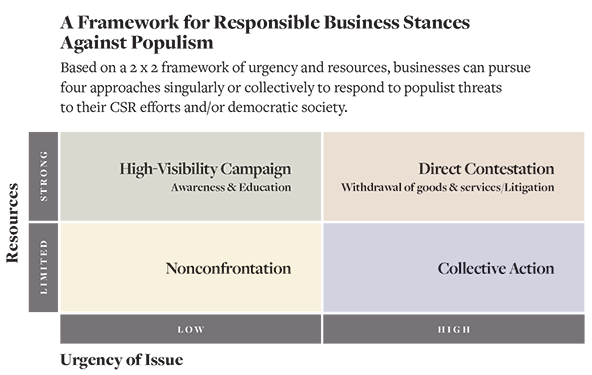
First, companies must consider whether they have the resources and capacity to counter populist efforts that may clash with their own values. Such an undertaking requires significant resources, but even companies with limited resources can use less resource-intensive strategies based in collective action, such as issuing joint statements or joint social-media campaigns. Consider the Main Street Alliance, a national US small-business network whose members launched a joint petition and released a statement condemning Trump’s 2017 Muslim travel ban, which barred US entry to citizens from seven different Muslim-majority countries. The joint petition allowed small businesses to challenge a populist action without depleting their limited resources.
A second factor is urgency, which arises when authoritarian populists make regulatory changes or foment civil unrest and violence. Businesses might need to respond rapidly to populist actions, particularly if populists are using their products or services to carry out their harmful actions—as was the case when Twitter banned Trump because he used the platform to organize the attack on the US Capitol and communicate with his followers.
In cases where urgency does not exist, businesses have several options for direct action if they possess extensive resources and are willing to directly challenge populist leaders. Strategies include creating high-visibility campaigns that engage and collaborate with civil society to achieve greater impact, such as Ben & Jerry’s “Safe Routes for Refugees” campaign. Alternatively, companies can provide donations to advocacy groups to support their work or commission an educational campaign, such as Disney’s donations to LGBTQ+ groups.
Businesses can help protect democratic values through direct action. They are important actors in society because they occupy not only an economic role but also a social one through the communities and stakeholders they serve. Businesses have a duty to protect stakeholders and society at large when populist agendas place their stakeholders at risk.
In fact, businesses assuming the responsibilities of government to care for its citizens is not new. Businesses have long compensated for governance gaps in health care and environmental concerns like deforestation where states have been unable or unwilling to address social, political, and environmental problems. Under decentralized governance conditions, private actors—including but not limited to corporations—have intervened to address and devise solutions for global governance problems. When applied in populist contexts, corporations can take action against authoritarian populists who do not prioritize the well-being of their constituents, and they have the potential to act as a counterforce against populist excesses.
Businesses do not need to refrain from CSR efforts under populist conditions. In fact, they can serve as a first line of defense when quick responses are needed against populist actions, especially if populists employ a business’s products or services to advance their agenda.
Of course, not all businesses can risk taking direct action because they may be unwilling or unable to confront populists. We propose collective action and nonconfrontational responses as alternatives to minimize both the risk of populist retribution and use of resources.
Collective action is a strategy that reduces the risk of attracting populist ire to individual firms. In the context of CSR, it involves collaborating with like-minded actors, such as other companies or civil-society organizations, and adopting a shared position on a specific social issue. Collective action is a type of safety-in-numbers approach that distributes resources and expertise among participants, thereby reducing the amount of individual financial and nonfinancial resources required per collaborator. For example, in 2017, three large German trade associations—the Business Association of Industrial Enterprises Baden, the Mechanical Engineering Industry Association, and the Business Association for a Liberal, Open-Minded, and Cosmopolitan Saxony—mobilized to launch a media campaign against Germany’s conservative populist party, Alternative für Deutschland (AfD). One of the motives cited for the collective action was a desire to defend liberal democracy, in addition to business-related strategic aims, such as protecting the associations’ export-based businesses.
A nonconfrontational strategy seeks to minimize direct engagement with populist leaders by focusing their efforts on the issue, rather than the individual. The pharmaceutical industry’s media campaign to counter antivaxxer misinformation about the COVID-19 vaccine (and vaccines in general) emphasized scientific data to cultivate public trust and to disprove false information, rather than attack the populist leaders who espoused such misinformation and pseudoscience. Nine major pharmaceutical companies—including Pfizer, Johnson & Johnson, and AstraZeneca—also previously issued a joint statement in 2020 on vaccine production without directly mentioning a populist leader specifically. Instead, they pledged to “stand with science [because] this pledge will help ensure public confidence.”
Preparing for the Battle, the Backlash, and Beyond
Challenging populism is no easy feat, and businesses that take on this challenge will probably incur social backlash like that experienced by Bud Light and/or political recourse like that experienced by Disney. Businesses should anticipate that the scope and content of their CSR strategy will encounter profound political pressure in populist spaces. Based on our framework, therefore, managers should prepare strategies to contest the priorities and agendas of populist forces. To be clear, our framework does not dictate a one-size-fits-all approach. Rather, businesses can employ a diversity of approaches based on their objectives and capacity, from directly contesting populists when their policies threaten a business’s core values to taking a more tempered approach to lower the risk of potential backlash.
While responsible business might include different stakeholders in their decision-making processes on issues, they should be aware that populist propaganda is intended to manipulate the public and may in turn affect stakeholders’ positions on CSR stances.
Stakeholder engagement is also likely to be complicated under populist conditions, owing to the prevalence of disinformation and misinformation. While responsible businesses might include different stakeholders in their decision-making processes to determine their stances on mission-critical issues, they should be aware that populist propaganda is intended to manipulate the public’s perspectives on issues and may in turn affect stakeholders’ positions on related CSR stances. Businesses should prioritize an information-based approach to ensure that socially responsible activities are guided by insights from all relevant stakeholders, promoting well-rounded representation in stakeholder deliberations. This method allows businesses to formulate a political stance that is aligned with the public will by utilizing a democratic process in order to negate populist accusations that they are “elites” acting against “the people.”
Businesses should also expect that the degree to which they can contest populism will be highly dependent on the political context in which they operate. Companies must be closely attuned to the wider political situation. Populism can manifest across the ideological spectrum, including democratic, autocratic, and hybrid political regimes. Much of our discussion has related to populists in democratic settings where institutional checks and balances can help to insulate businesses against populists’ attacks. Indeed, democracy makes fighting populism possible, since businesses can rely on the judicial system to uphold democratic law. Even in nations where democracy is imperiled, such as Poland and Hungry, businesses like TVN have still devised ways to challenge populist threats to their socially responsible actions.
A responsible business stance offers a unique opportunity for businesses to support democratic processes that challenge populist narratives and amplify diverse stakeholder concerns that are often silenced in societies led by authoritarian populists. Yet the complex and fluid nature of populism results in continuously shifting ground for the private sector and can leave businesses at a loss for how to act responsibly. Our hope is that our analysis and takeaways will inform business leaders about how to recognize and when to respond to populist threats. And we hope to inspire businesses to go beyond a minimum responsibility to do no harm and engage in a positive obligation to do good and support liberal democratic forces.
Read more stories by Zena Al-Esia, Andrew Crane, Kostas Iatridis & Ayşe Yorgancioğlu.