


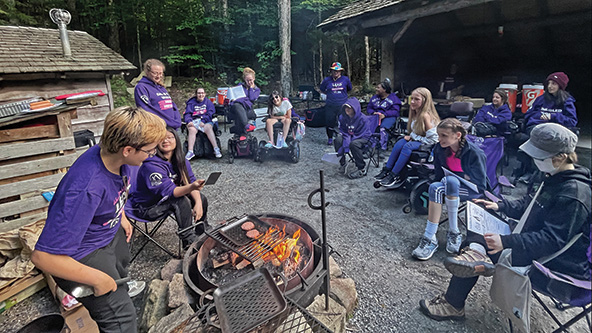
 The Disability EmpowHer Camp 2023 cohort cooks burgers around a campfire. (Photo courtesy of the Disability EmpowHer Network)
One in four women in the United States has a disability. Yet, these 41 million Americans seldom feature in media, entertainment, or school curricula. Because of this lack of visibility and representation, disabled girls grow up without seeing role models who look like them or understand their experiences.
“If you talk to any disabled women my age, they will all tell you the same thing—they wish they had disabled women role models, [but] they didn’t,” says Stephanie Woodward, a 34-year-old attorney, activist, and organizer.
Woodward founded the Disability EmpowHer Network in November 2020 to provide younger generations with the role models and mentorship opportunities she wished she had as a child. In its first year, the organization created three programs to put young disabled women on track to career success and personal fulfillment: EmpowHer Camp, Letter from a Role Model, and a public speaking and career coaching program.
The organization’s programming addresses research that shows disabled women have lower self-esteem, experience greater social isolation, and receive less education than their nondisabled peers. In addition, the unemployment rate among disabled women is more than double that of nondisabled women.
EmpowHer Camp is the organization’s premier program. A yearlong mentorship scheme, the camp commences with a week in the Adirondacks in upstate New York. During the week, disabled counselors support participants in developing disaster preparedness, independent living, and leadership skills. Its first cohort, composed of nine 13- to 17-year-olds from across the country, and several counselors from as far away as London met in August 2021.
The annual weeklong camp takes place at John Dillon Park, a fully accessible facility. The park provides free firewood and use of on-site, lean-to structures at no cost. Kelly’s Kitchen, a Charleston, South Carolina-based nonprofit devoted to healthy food and social justice, provides meals during the camp and teaches cooking skills. The Disability EmpowHer Network also receives financial support from individual donors, corporate partners, and grantors—including the Ford Foundation and the Mitsubishi Electric America Foundation (MEAF)—who combined have supported the organization with more than a quarter of a million dollars. Before attracting significant grant funds, Woodward fundraised via an online campaign and T-shirt sales.
“I’m not much of a camper,” admits Anja Herrman, a Chicago-based 16-year-old who joined EmpowHer Camp in its first year. “But hanging out with other disabled women, having that community of disabled people my own age, who had similar life experiences, was very appealing.”
Hundreds of volunteers also support the organization, including mentors like Jill Moore, an inclusive playground design expert based in Minneapolis. Moore started as a pen pal in the Letter to a Role Model program before deciding to serve as a camp counselor and yearlong mentor.
Like Woodward, Moore wishes she had seen more representations of disabled women when she was younger. “It would have been really nice to have seen artists, seen theater kids, seen people with disabilities doing different things,” she says.
After camping, Woodward tasks participants with a yearlong project on inclusive disaster preparedness with the support of their mentor. She says that developing emergency management-related projects helps build community. There’s also a real need for this work, as disabled people are two to four times more likely to die or sustain critical injuries during a disaster than nondisabled people.
Campers choose their own projects. One of Moore’s mentees, Oregon-based 17-year-old Riley Hurt, founded a core advisory group to connect emergency management professionals with the disability community in her hometown.
Herrman researched active-shooter response plans at schools across the United States and published a white paper in August 2022 with recommendations on how the US Congress could support schools to better serve and protect disabled students, including mandating individualized educational lockdown plans for disabled students and funding further research.
The cohort concluded their program with a reunion and graduation celebration in Washington, DC, in June 2022. They also presented their projects to their respective US senators. The Disability EmpowHer Network funds part of participants’ travel costs to the Adirondacks and Washington, DC.
With the camp entering its second year, its organizers are making some improvements, like expanding virtual programming. As the Disability EmpowHer Network grows, Woodward also wants to expand collaborations with other organizations. Through a new partnership with the Christopher and Dana Reeve Foundation, young women with different forms of paralysis will be paid to write blogs for the foundation’s website.
Woodward anticipates a bright and busy future: “It’s really easy to show why it’s needed … and how it connects to success in the future.”
Read more stories by Marianne Dhenin.