


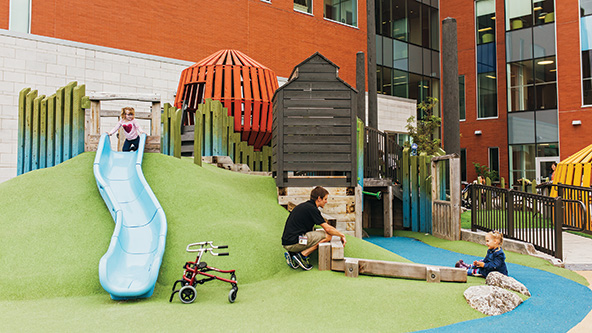
 Children play at the Ron Joyce Children's Health Centre therapeutic playground in Ontario, Canada. (Photo courtesy of Earthscape Play)
There are hundreds of thousands of playgrounds at schools and public parks across the United States. But the vast majority are inaccessible to disabled kids—meaning they exclude a significant portion of the population they intend to serve. According to the US Census Bureau, the country has more than 40 million disabled people. That number includes more than seven million children enrolled in public schools who receive accommodations for conditions ranging from autism spectrum disorders to bone-, joint-, or muscle-related disabilities.
Traditional playgrounds include uneven ground coverings, such as wood chips or pea gravel, which make them unnavigable for children who depend on mobility aids like wheelchairs and walkers. Other issues are less obvious: Playgrounds designed without quiet spaces for children means that those with sensory processing disorders, like autism spectrum disorders, will be forced to leave play spaces when they need to recalibrate. Playgrounds without fences also pose a risk to children with autism spectrum disorders, who, research shows, tend to wander away from supervised places.
While the Americans with Disabilities Act (ADA) requires all new or renovated playgrounds in the United States to comply with accessibility standards, those requirements provide only a basic level of access because they emphasize maneuverability over actual physical engagement.
“The ADA standards don’t take into account the experience of play,” explains Nathan Schleicher, lead playground designer at Earthscape Play, based in Ontario, Canada. “It’s more about circulation.”
Jill Moore, an inclusive play specialist at Landscape Structures, a Minnesota-based organization that designs and manufactures playground features, says that playgrounds were not accessible or fun for her as a wheelchair user when she was a child. “There wasn’t a lot to do,” Moore says. “The standards didn’t dictate the experience; they just looked at the bare components for access.”
Not having access to play opportunities poses significant problems to developing children. Studies show that play helps kids establish the foundations of social, emotional, and academic learning. For many kids, playgrounds are where they exercise their imaginations, tune their motor skills, and interact with their peers to develop emotional intelligence.
Responding to increasingly vocal demand for inclusive spaces, some organizations have begun specializing in playgrounds that go beyond basic access toward radical inclusion. They are dedicated to designing and building maneuverable and sensory-rich spaces that invite all children to participate in the outdoor play their developing minds crave.
Mission Minded
The movement for inclusive play has taken off “fast and furious,” Moore says. Landscape Structures was one of its trailblazers. Scott Roschi, the organization’s creative director, says that the shift toward inclusive playground design began thanks to activism by and collaboration with the disability community. Landscape Structures first started designing for inclusion in 2002, when it was contracted by Inclusion Matters by Shane’s Inspiration, a California-based nonprofit whose mission is to foster a bias-free world for disabled kids through play.
Harper’s Playground, a nonprofit that designs and consults on inclusive playgrounds, also joined the movement more than a decade ago. “It all started in 2009 with a walk in the park,” says G. Cody Q. J. Goldberg, executive director and cofounder of Harper’s Playground. That stroll was the first for his 4-year-old daughter, Harper, whose walker got stuck in the wood chips at their local playground. Goldberg registered Harper’s Playground as an entity the following year before fundraising for his first project, an inclusive playground in Portland, Oregon.
Fundraising for that project was a grassroots effort, Goldberg says. He and his wife, April, hosted bake sales, solicited monetary and in-kind donations from local businesses, applied for grants, and even wrote letters to celebrities asking for support. They succeeded in raising $1.2 million in three years, and the first Harper’s Playground was opened in 2012.
The organization’s fundraising strategy has since evolved—it now relies primarily on grants and corporate partnerships—and it has worked on dozens of playgrounds across the country. According to Goldberg, the team, which consists of five employees, has a “legion of volunteers,” and is led by an 11-member board of directors, now partners with communities at different levels of collaboration. It gives seals of approval to playgrounds that adhere to its design standards, which aim for inclusion through what it calls “three layers of inviting”—physically, socially, and emotionally.
“There are no tried-and-true standards for what allows people to use the term ‘inclusive,’” Goldberg explains. “It is used far too often synonymously with ‘accessible,’ and accessibility is very important, but it’s only one layer of what makes a good, inclusive design.”
Designing features that are accessible to kids who use mobility aids satisfies the requirements of what Goldberg calls “physically inviting design.” But his organization also requires that its designs be socially and emotionally inviting. Teams can accomplish this by incorporating natural building materials, circular seating areas, clean lines, art, and musical instruments—features intended to ensure that everyone who enters the space feels welcome and inspired.
Harper’s Playground’s emphasis on designing these inviting spaces exemplifies how the turn toward inclusive playground design has happened in tandem with the rise of natural playgrounds, which honor local landscapes, are built with natural materials like wood and rope, and feature sensory-rich mediums like sand or water that nurture social play and children’s imaginations.
While Earthscape Play focuses on inclusive playground design, it also differentiates itself through its reliance on natural building materials. The towering and often animal-themed play structures that it builds from wood are much larger and more complex than what other playground companies create with the material.
Earthscape was founded as a local residential landscaping company in Ontario, Canada, in 2005 and designed its first playground in 2010. “We’ve never looked back,” says Laura Hilliard, the organization’s communications director. “We took on more and more projects and then recognized that there was demand to substantially grow the playground business.” The original landscaping firm helped finance the new venture until Earthscape Play was established as an independent business in 2016. It now has more than 40 full-time employees.
For all three organizations, activism and collaboration remain at the core of their work. Every designer at Earthscape Play is trained in designing for basic access needs, and senior members of the team review designs to ensure that they address access and inclusion in creative ways. The team also partners with local representatives on its projects. For example, the Committee to Advocate for Persons with Impairments in St. Petersburg, Florida, reviewed and gave feedback on the designs for Earthscape’s award-winning playground on St. Pete Pier, which opened in 2019.
Landscape Structures employs a team of inclusive play specialists like Moore, who, she says, embody the organization’s commitment to designing “with people with disabilities, not for [them].” Their vision centers disabled children in the design process: “Kids like challenge, they like height, motion, swinging,” Moore says. “We see where [there are] discrepancies and maybe what a child with a disability hasn’t gotten to experience in the past, and then we innovate in that field.”
An excellent example of an innovative play feature is Landscape Structures’ We-Go-Swing, which consists of an open gondola that wheelchair users can access without leaving their chairs, and levers to grip, push, and pull in order to propel the swing in a pendulum motion. The swing can be integrated into a playground setting and accommodate multiple users on either side, allowing kids of all abilities to experience swinging together.
Going Global
The most significant factors that prevent playgrounds from hosting innovative, inclusive play elements like the We-Go-Swing are awareness and cost. For communities who may not be familiar with the benefits of inclusive playgrounds, these design organizations focus on education. Both Moore and Goldberg consider public speaking a crucial part of their work. Landscape Structures also distributes pamphlets about their playgrounds to communities, highlighting the benefits of each design feature. Roschi says these documents double as public relations material, helping to drum up support for new projects.
Funding for inclusive play elements often comes from community fundraising initiatives, like those that Harper’s Playground has been organizing for years. But supporters hope that cities will begin to shoulder more of the expenses in the future, as inclusive design becomes more common. Roschi has already seen this shift happening over the last decade.
“It’s one of the trends that we’re seeing,” he says. “Communities are realizing that they’re servicing a greater portion of their communities by thinking about inclusion.” Cities like St. Petersburg; Portland, Oregon; and San Francisco, California, have offered grants or dedicated city funds to inclusive playground projects in recent years.
The future of inclusive playground design seems limitless. In 2020, Earthscape Play launched an office in Amsterdam, with an eye on Europe more broadly.
Landscape Structures has already contributed to playgrounds in Russia, Australia, Singapore, and parts of Europe. Its design team works on upward of 3,000 projects every year. Harper’s Playground is growing, too. The organization just completed its first international project in Tokyo, Japan, last year, and Goldberg has his eye on further projects abroad.
Roschi believes the movement is at a tipping point. “I don’t think communities are going to see [inclusion] as a niche item anymore,” he says. “I would say within five years, inclusive play is going to be the new norm.”
Read more stories by Marianne Dhenin.