


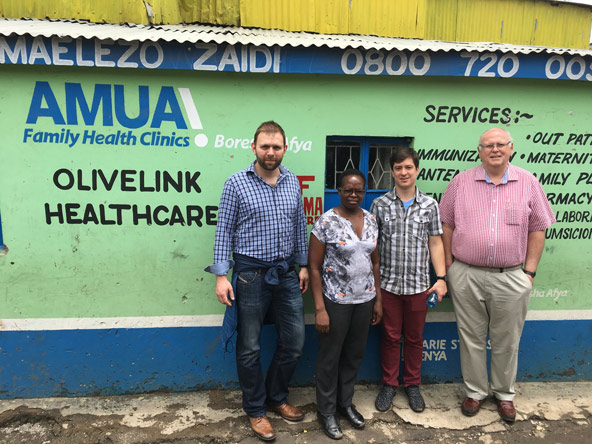
 The Ninety Consulting team visits Olivelink Healthcare, one of the projects it supports in Nairobi. (Photo courtesy of Ninety Consulting)
Every year, Ninety Consulting’s board members ask themselves a difficult question: How much annual profit should be distributable and how much should be retained to support and develop the company? The answer is important. While UK-based Ninety’s business is delivering innovation services to the insurance industry, its purpose— as its name suggests—is giving 90 percent of its distributable profits to charities and social enterprises in the developing world.
This means striking a balance between helping grow the business and giving money away. “We want to be true to our promise of giving,” explains Andrew Davies, a Ninety board member. “But if we retain nothing for investment or cash flow buffer, we could be putting the whole thing at risk.”
The company’s founder, Dan White, is ambitious. “The vision I’m chasing is to generate and give away a billion pounds over 30 years,” says White, who grew up in Burundi and pursued a successful career in the United Kingdom in digital marketing. After becoming disillusioned with a life focused on wealth creation, White decided to make a change. And while he initially imagined selling his house and car and moving to Africa, he realized that he could do more by creating a company whose profits could be given away. “The scale of impact available to me by using business as a tool to generate finance became apparent,” he says.
While this sounds simple, to meet its goal of giving away £1 billion ($1.32 billion) in the next three decades, Ninety—which White founded in 2013 and has given away £250,000 ($329,404) to date—needs to become sufficiently profitable. “We’re on track on the timeline we’ve set ourselves,” White says. “But there’s a hell of a lot of growth required to get there.”
So far, its business model— using entrepreneurship practices and innovation techniques to help clients take ideas for products and services to market rapidly—has enabled it to attract global insurance companies such as Zurich, AXA, and Allianz as clients.
And while the quality of its services is what wins it business, Ninety’s social purpose is also attractive to potential clients. “We don’t select business partners because they’re charitable,” says Mark Budd, head of innovation for Zurich’s UK operations. “But when there’s equality among suppliers, it is a real differentiator.”
Generating sufficient funds for Ninety’s ambitious giving goals will eventually mean launching other companies in sectors such as banking and energy, White explains. Forming a group of enterprises, these companies would, as Ninety has done, register as community interest companies (CICs), a legal designation for social enterprises.
The team is committed to maximizing its social impact, consulting charity evaluators like GiveWell, plus getting input from staff and clients, to identify potential beneficiaries. “We’re looking for organizations that can scale up in an impressive way and where we can get significant reach for each dollar,” says White, who follows effective altruism principles, based on evidence of where the most impact can be made.
He cites Living Goods, whose network of “Avon-like” community health workers go door to door to sell low-cost treatments and products and teach families in Africa how to improve their health. Studies have shown that Living Goods, which uses a data-driven performance management approach, is reducing child mortality for less than $2 per person, per year. “We want to deliver high impact but at a low cost, and that’s why the data and performance management is so important,” says CEO Liz Jarman.
Ninety is not alone in its approach. For example, Newman’s Own, the food and beverage company founded by actor Paul Newman, gives all its profits to charity. And, citing Newman’s Own as its inspiration, management consultancy Impact Makers does the same.
For Ninety, social-impact objectives were also behind the decision to launch an insurance consultancy. “When people and business owners don’t have access to insurance, that drives instability, which keeps people locked in poverty,” White says. “Insurance provides a stable underpinning for a developed society—that’s a significant part of why we chose this sector.”
The next step for Ninety is to start using its insurance expertise to take its impact beyond charitable checks. White plans to take the team to Africa next year to offer free consulting services to some of its beneficiaries and provide them with innovation training.
White argues that business and social impact are not mutually exclusive. “The reason I’m a social entrepreneur is that I believe business is more sustainable than charity,” he says. “But you can blend the two—they don’t have to be at two ends of the spectrum.”
Read more stories by Sarah Murray.