


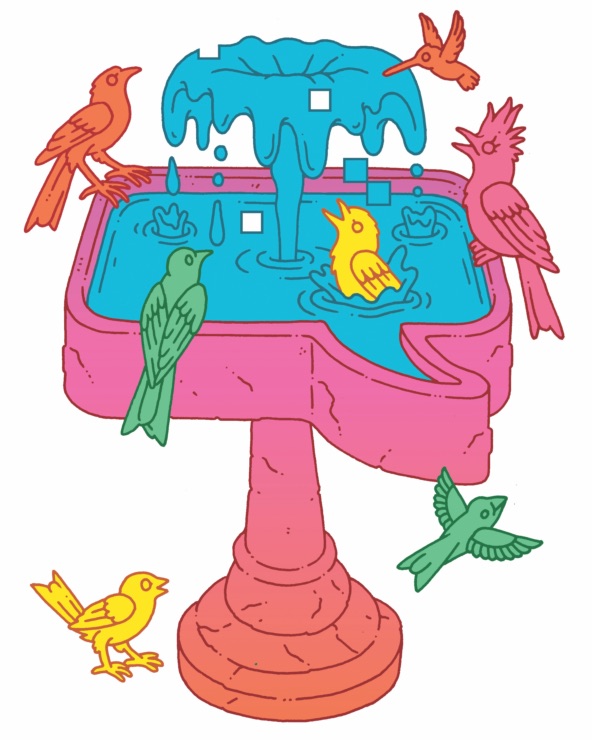
 (Illustration by Eric Nyquist)
In his groundbreaking research on social isolation, political scientist Robert Putnam highlighted a troubling trend: As civic institutions like bowling clubs, parent-teacher associations, and neighborhood associations have declined across the United States, so too has our sense of local community. Meanwhile, communal spaces like parks and libraries have declined due to funding cuts, and local newspapers are disappearing.
The resulting void has increasingly been filled by local digital spaces, such as Facebook Groups and other online gathering places dedicated to your neighborhood or town, where people now turn for everything from parenting advice to buying and selling items to local news and information. However, these spaces are largely shaped by the design and policies of the technology platforms that host them. Most platforms prioritize metrics such as likes, comments, and time spent, incentivizing content that provokes strong reactions to keep users engaged, often at the cost of constructive dialogue.
To counter this risk, local digital spaces rely heavily on community stewards—the volunteer moderators and organizers who, in ideal circumstances, embody the values of their local communities and work to create digital spaces that are welcoming and informative. At their best, community stewards keep these spaces productive and safe, but without adequate training and support, even the most dedicated of them can struggle to maintain community health and sustain the public square. As a result, while these spaces have become an important part of local ecosystems, many of them fail to serve as true community hubs. Instead, they too often devolve into arenas for poorly moderated shouting matches fueled by tech platforms and advertisers trying to hit their annual revenue goals.
Well-designed local digital spaces with well-supported stewards hold vast untapped potential, especially in our increasingly polarized environment, to help keep communities connected and democracy alive. By reimagining digital spaces as essential civic infrastructure, thoughtfully designing them to cultivate community health, and providing stewards with the right training and resources, we can empower people to be active, informed civic participants. These spaces would no longer serve primarily as data-driven features of the adtech industry but as important local resources that truly connect neighbors and neighborhoods.
The Importance of Stewards
While existing major platforms do offer a framework for connection and information sharing, they incentivize behavior that undermines the very social fabric they claim to support. Take Nextdoor, a for-profit company focused on neighborhood connection but often criticized for stoking division. This is largely due to its engagement model, in which highly provocative and sometimes racist posts, such as ones about neighborhood crime, tend to dominate feeds. Though these posts represent only a small fraction of the content that people share on the platform, they tend to create fear and lead to intense debate, which drives engagement. As a result, they are amplified by the platform’s algorithm, consequently benefiting Nextdoor’s bottom line.
However, Nextdoor is also a venue where people regularly share local recommendations and information about neighborhood events, demonstrating that it can foster community connection in positive ways. The tension between the profit motives of commercial platforms and community needs is a constant balancing act, where decisions that are made to increase engagement and drive revenue often end up intensifying conflict, pitting neighbors against one another.
Such outcomes stem from a style of governance prevalent across online platforms that prioritizes performance metrics over communal health. Most major platforms operate with centralized, top-down policies that simply don’t work well for the needs of diverse, grassroots communities. Their design, values, and rules—meant first and foremost to create shareholder value—are typically uniform to promote scale and applied without taking local context into consideration.
The rare instances where major online platforms serve as true digital civic spaces, like Wikipedia, stand out because they are built on a model that understands, values, and supports public stewardship. Unlike platforms driven by engagement-driven algorithms, Wikipedia’s success relies on a foundation of humans volunteering out of a shared commitment to knowledge and public value. As Wikipedia is a nonprofit, its entire ecosystem is set up to empower its contributors—through transparent governance, collaborative editing tools, and community guidelines shaped by the people who steward the platform.
We need ownership models that prioritize user well-being, healthy communities, and support for stewardship over unchecked growth.
Other user-led platforms, such as Reddit and Discord, combine corporate ownership with decentralized community involvement, creating a more complex stewardship model. Reddit relies on thousands of volunteer moderators who manage individual subcommunities, each with its own rules and culture, while Discord is based on a model of user-led moderation within private servers. However, unlike Wikipedia with its transparent governance, both platforms face challenges balancing their corporate interests with user-led stewardship.
Across many of the other major online community platforms, stewards struggle to do their job. Because platforms like X (formerly Twitter), Facebook, and Instagram focus on maximizing engagement, their design choices and incentives rarely align with the needs of stewards or the goals of supporting inclusive, well-supported spaces. Even in these challenging settings, there are those who do successfully act as the backbone of thriving, public-spirited online communities. They are the contributors and organizers who commit themselves daily to ensuring that conversations are constructive and welcoming to all. But too often, stewardship simply can’t succeed in these spaces.
We can build and scale digital spaces that nourish public life by investing in the right people and the systems they need in order to be successful. At New_ Public, the nonprofit R&D lab that I colead, we work closely with community stewards through initiatives like our Neighborhood Steward Fellowship, an eight-week pilot program we ran this past summer that brought together leaders of local digital spaces from across the United States to explore and test new practices and ideas.
We have learned through this work that building healthy and sustainable local digital spaces requires structural changes to how platforms are created and incentivized and how they are set up to support the people who lead these spaces. Of course, not every community or social media platform needs to follow a public-spirited model, just as not every place in a community is a library or park. But we should strike a balance—independent local spaces alongside commercial platforms, each meeting different needs.
Four Pillars of Reform
To support this balance, we need a concerted movement to invest resources into programs and models that prioritize stewardship. Such reform efforts rest on four pillars.
Training and connection to set stewards up for success | To create thriving digital spaces, we need to invest in training and supporting community stewards. While some people may naturally excel in these roles, everyone benefits from access to educational resources, training, and guidance on best practices. It is important not only to provide expert-led training but also to support peer-to-peer connections, enabling stewards to share practical advice and experiences. This network can offer new stewards needed support, techniques for building social trust and belonging, tips on moderation and conflict resolution, and much more.
Platform design for collective governance | The digital platforms where communities gather need democratic governance. Developing features that simplify shared decision-making can help create digital spaces that more accurately reflect the diverse values of their communities, ultimately improving their resiliency. Imagine platforms where stewards have easy access to decision-making tools that empower users to shape policies collectively and efficiently. Some ideas include using randomized juries of community members for dispute resolution and implementing systems that allow members to update community guidelines collaboratively.
Alternative models for business, funding, and operations | To build and sustain thriving digital communities, we need ownership models like nonprofits and B Corps, as well as funding models that leverage local foundations and public support. These models should prioritize user well-being, healthy communities, and support for stewardship over unchecked growth.
The success of Vermont’s Front Porch Forum—a network of town-specific, proactively moderated online forums run by a public benefit corporation that generates revenue through a mix of local ads and member donations—shows how technology platforms that break free from engagement-driven models can create positive, valuable spaces that actually serve their users. This small, family-owned platform stands apart by prioritizing local ownership, privacy, shared community experiences, and civility, with user features designed intentionally to support real-world neighbor connections. Remarkably, 97 percent of users reported finding the platform valuable for their community, according to a 2024 research study conducted by New_ Public and the Center for Media Engagement at the University of Texas at Austin.
Decentralized technical infrastructure | The ecosystem needs more platforms that are free from centralized corporate control and that allow for community-guided spaces that operate independently of large companies. Social media platforms Bluesky and Mastodon, which function similarly to X but prioritize decentralization and user empowerment, offer examples that could inform the design of spaces that grant users a greater degree of autonomy and control. Another example is Discourse, an open-source community platform that is fully customizable and which can be hosted independently, giving community stewards full control over data, privacy, and design. These decentralized approaches make it more possible for communities to shape their own spaces.
All of these efforts are about creating the foundation for digital spaces that emphasize stewardship and community ownership. We can succeed, if we win the support of public institutions and foundations to help create and sustain platforms that serve communities rather than shareholders.
Read more stories by Deepti Doshi.