


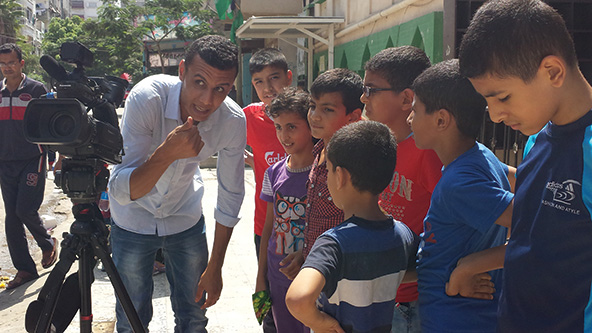
 Cameraperson Mohammed Abu Safia films for Naila and the Uprising in Gaza, in 2017. (Photo courtesy of Just Vision)
The media plays a vital role shaping how society understands events around the world. Since October 2023, no story has received more attention in the global press than the war on Gaza, which has seen tens of thousands of people killed in a region often misrepresented due to harmful and persistent racism and anti-Muslim bias.
When journalists tasked with covering Gaza seek resources to deepen their comprehension of the decades-long conflict in occupied Palestine, they turn to the nonprofit organization Just Vision. Since its founding in 2003, the organization has been upending dominant narratives and humanizing storytelling about Israel and Palestine using documentary film, journalism, and public engagement.
“We want to change the conditions that allow for what we are seeing in the war on Gaza,” explains Suhad Babaa, Just Vision’s executive director. “We do that by understanding that policies and politics are shaped by social norms, so we are looking to shape the narrative and, ultimately, the social norms that guide that narrative.”
That narrative has long been entrenched in Islamophobia and anti-Palestinian racism, which affect who the media select to be interviewed, how they frame those stories, and which stories are featured in print, broadcast, and social media. Disrupting the mainstream narrative is more challenging against a backdrop of rising suppression of the press and free speech in occupied Palestine, Israel, and the United States, where Just Vision works.
Research shows that major news outlets underrepresent Palestinian sources in their reporting. They also tend to use negative or violent language and passive-voice sentence construction more often when referring to Palestinians than to Israelis.
“When Israelis are killed, the language is very clear about who is killed and who killed them,” explains Tamara Kharroub, deputy director of Arab Center Washington DC. “But when the Israeli army kills Palestinians, the language is very passive, like ‘Palestinians died,’ as if they dropped dead.”
Last year, the academic journal Media, War & Conflict published an analysis of more than 33,000 articles in The New York Times written during the First and Second Palestinian Intifadas. The analysis found that passive-voice framing had “the rhetorical effect of minimizing the responsibility of Israeli aggressors in causing Palestinian suffering.”
Just Vision is committed to disrupting stubborn prejudices. Its team of filmmakers, journalists, and researchers—with team members in more than 10 cities—are united behind the belief that their narrative work featuring marginalized voices has the power to do so.
Storytelling for Change
The inspiration for Just Vision struck founder Ronit Avni in the early 2000s while working at WITNESS, a nonprofit organization committed to using multimedia technologies to protect and defend human rights. During that time, Avni, a Canadian, interviewed more than 400 Palestinian and Israeli human-rights advocates and organizers about their work and the challenges they faced.
Central to the notion of positive peace is an understanding that prevailing power dynamics need to be challenged.
“Their issues were invisible to the media and society at large,” said Avni in a 2010 interview about Just Vision’s origins. “That was the founding idea for Just Vision—to tell [their] stories” by producing documentary films. Early funding came from individual donors, private family foundations, and organizations, including the Sundance Institute Documentary Film Program and Open Society Foundations. Just Vision’s first film, Encounter Point, premiered at the Tribeca Film Festival in 2006. The film follows an Israeli settler, a Palestinian resistance fighter, a bereaved Israeli mother, and a wounded Palestinian ex-prisoner, who strive to forge mutual understanding at a forum for bereaved families.
Documentary film is a powerful medium because it is an immersive sensory experience. “It allows for a long-form, in-depth storytelling that helps people suspend disbelief and imagine a story that they may not have experienced themselves,” Babaa says. Just Vision’s subsequent documentaries, My Neighbourhood (2012) and Budrus (2009), featured efforts to prevent Palestinians’ displacement due to Israeli expansion in the villages of Sheikh Jarrah and Budrus, respectively.
The success of Just Vision’s documentaries drew the attention of major philanthropic funders, including the Piper Fund and the Rockefeller Brothers Fund (RBF). Perry Cammack, program director for peacebuilding at RBF, says that his organization began funding Just Vision because its work aligned with RBF’s vision of positive peace. “Central to this notion of positive peace is an understanding that prevailing power dynamics need to be challenged, and storytelling, narrative, and amplification of marginalized and unheard voices is crucial to that,” he explains.
In the 2010s, Just Vision expanded its work to meet the demand for digital media. In 2014, it launched Local Call, a Hebrew-language, citizen-journalism platform headquartered in Jerusalem. Recently, Local Call’s investigations, led by award-winning journalist Yuval Abraham and often co-published with the Israeli news site +972, have documented Israel’s use of AI technology to target assaults on civilians in Gaza. Abraham’s findings resulted in international leaders, including United Nations Secretary-General António Guterres, condemning Israel’s actions; they also served as evidence in the International Court of Justice’s May 2024 order for Israel to halt military operations in Rafah and allow United Nations fact-finders to enter Gaza.
Today, Just Vision’s team of 22 core staff members and dozens of journalists and filmmaker partners is focused on continuing to scale up to “meet the needs of the moment in Israel-Palestine, the United States, and beyond,” Babaa says.
Counter-Suppression Tactics
Despite Just Vision’s successes, Israeli government practices to suppress voices of dissent have ramped up since its invasion of Gaza last year. It has barred foreign reporters from entering Gaza, and dozens of Gazan journalists have been killed in Israeli strikes. The press freedom group Reporters Without Borders has also filed a pair of complaints with the International Criminal Court alleging that journalists killed in Palestine, including Al Jazeera’s Samer Abu Daqqa, “were the victims of attacks amounting to war crimes.”
Even before the war on Gaza, the Israeli government had a track record of shuttering independent press offices, censoring dissenting views, and feeding its talking points to the far-right Channel 14, the nation’s most-watched channel. On May 5, 2024, Israeli authorities raided Al Jazeera’s office in Jerusalem after the government ordered a shutdown of the station’s local operations. Two weeks later, officials seized broadcasting equipment from the Associated Press and cut its live feed of Gaza.
Crackdowns on dissent have also occurred in the United States, especially to suppress speech that criticizes the nation’s support for Israel and the government’s use of taxpayer dollars to fund the Israeli military’s attacks in Gaza. A May 2024 report published by the National Writers Union found that “since October 7, Western media workers have faced a wave of retaliation for speaking up against or critically covering Israel’s war on Gaza—and in particular, for voicing support for Palestinians.” The report recorded eight major forms of retaliation against media workers, some of whom had their jobs terminated or awards rescinded for actions such as expressing support for boycotts of institutions considered complicit in the illegal occupation of Palestine.
Foreseeing a rise in reprisals like these, Just Vision began tracking anti-boycott legislation in the United States in 2015. Such laws started to appear in response to the growing Boycott, Divestment, Sanctions (BDS) movement, a campaign to exert nonviolent pressure on Israel to comply with international law and end its occupation, which was inspired by the South African anti-apartheid movement and launched by Palestinian civil-society groups in 2005. Just Vision aggregates anti-boycott legislation on its website, recognizing that attempts to limit the right to boycott companies that operate in occupied Palestine threaten Americans’ right to use boycotts as a means for social and political change. It also produced the 2021 documentary Boycott, which narrates the story of a trio of plaintiffs embroiled in legal struggles against anti-boycott legislation in Arkansas, Arizona, and Texas.
Just Vision’s prescient work against crackdowns on dissent in the United States earned the organization support from the Piper Fund’s Right to Protest program, beginning in 2022. “Their work has helped the democracy, protest, dissent, and free speech field understand the ways in which anti-BDS legislation and the anti-BDS narrative can become a gateway or a template to wider attacks,” explains Melissa Rudnick, program officer at the Piper Fund. “I think that Just Vision’s work has always been critical, and I think at this moment, it is even more so.”
Read more stories by Marianne Dhenin.