


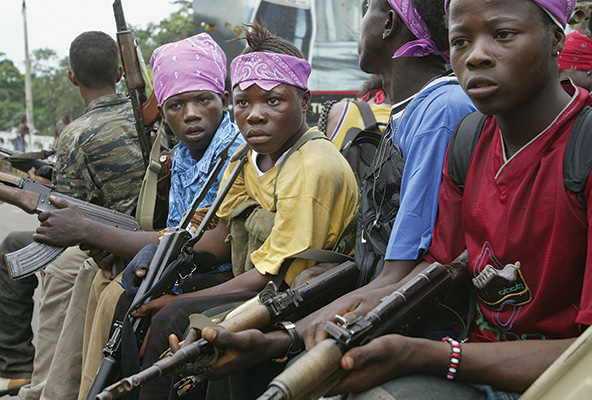
 Liberian child soldiers loyal to the government participate in combat on July 20, 2003, in Monrovia. (Photo by Chris Hondros/Getty Images)
Hassan Bility sat behind his desk with bleary eyes and a cigarette between his fingers as a generator hummed, lighting up his lime-green office in the Liberian capital city of Monrovia. Dressed in a bright pink shirt, Bility, a former journalist and newspaper editor, spoke with me in hushed tones about the recent arrest of Sekou Kamara at New York City’s John F. Kennedy International Airport at the end of March.
Kamara is a Liberian national accused of being a rebel commander named “K-1” who fought for the faction Liberians United for Reconciliation and Democracy (LURD) during the nation’s bloody 14-year civil war that ended in 2003. He is the fourth Liberian to have been arrested by US Immigration and Customs Enforcement (ICE) for allegedly lying on immigration forms when asked about his involvement in a “paramilitary unit, vigilante group, rebel group, guerrilla or insurgent organization.”
Bility is initially coy about his tipping off US authorities about Kamara’s whereabouts. He is the director of the Global Justice and Research Project (GJRP), an organization documenting war crimes in Liberia. Their Swiss-based partner organization Civitas Maxima later confirms their joint role in Kamara’s arrest. For the past decade, GJRP and Civitas have helped prosecutors in the United States and Europe gather evidence against Liberians accused of crimes committed during the civil war that claimed at least 250,000 lives. Bility’s work has won him public support but also made him enemies in a country where successive governments have yet to hold those accused of war crimes accountable in the nearly two decades that have passed since a peace agreement was signed.
Bility’s office is located at the end of a muddy road, behind unfinished buildings and banana trees, in a part of Monrovia that was littered with bodies and at the heart of some of the most brutal fighting in the early 1990s. The suburb fell under the control of a rebel leader named Prince Yormie Johnson, who ordered the torture of the late president Samuel Doe on camera before publicly displaying his dead body in open air on a metal hospital bed. Johnson, who has served as a senator for the past 16 years, is a stark reminder of Liberia’s political status quo, in which former warlords are still elected to positions of power.
But Bility is more concerned about members of his own Mandingo ethnic group, who have condemned him for going after alleged perpetrators who served in ethnically aligned factions. He’s received threats from ex-combatants when he crossed paths with them while offering condolences after a death and regularly receives menacing phone calls. “As I speak to you now, I have threats hanging over my head,” Bility says. “I don’t go out at night—absolutely not—unless there is a medical emergency or something like that.”
A decade ago, Bility teamed up with Alain Werner, a Swiss lawyer who had worked on international trials, including the landmark case against former Liberian President Charles Taylor for war crimes committed in neighboring Sierra Leone, which saw him sentenced to 50 years in a prison in the United Kingdom. Taylor was the first head of state to have been convicted for war crimes since Nuremberg.
Since then, Bility and his team of seven GJRP investigators, along with Werner’s Civitas Maxima, whose legal team is made up of Werner and seven women lawyers, have provided legal representation to victims, filed criminal complaints on their behalf, and provided evidence and assistance to international investigators. Their work has led to the arrest of eight Liberians, a Sierra Leonean, and a US-Belgian dual citizen accused of committing war crimes in five European countries and the United States. Thus far, three of the accused have been convicted; two have been acquitted, with one on appeal; and four cases, including that of the recently arrested Sekou Kamara, are pending. The US-Belgian dual citizen accused of involvement in war crimes as well as diamond smuggling died in a Brussels prison while awaiting trial.
GJRP and Civitas Maxima’s work is part of a small grassroots or bottom-up international justice movement that has emerged in recent decades in which local, victim-centered, and sometimes victim-led organizations are teaming up with international lawyers to build cases that would otherwise be neglected by large international justice institutions like the International Criminal Court (ICC) and United Nations-backed tribunals. Among these cases are those that concern heads of state and government officials such as the Chilean General Augusto Pinochet, who was tried in Spain; Hissène Habré, a former Chadian dictator who was tried in Senegal; and Anwar Raslan, a Syrian colonel who was tried in Germany for crimes against humanity. Most of the crimes committed during Liberia’s civil war don’t fall under the ICC’s Rome Statute, which mandates it to prosecute crimes committed only after July 2002. Liberia’s conflict ended in August 2003, and it incorporated the statute into its own law in 2004, a year after the conflict’s end.
Using the concept of “universal jurisdiction” in largely European countries and immigration law in the United States, organizations like Civitas Maxima and GJRP are pursuing those accused of committing war crimes in the world’s forgotten conflicts from Syria to Liberia. Melinda Rankin, a research fellow at the University of Queensland and author of De Facto International Prosecutors in a Global Era: With My Own Eyes, has described these actors as “de facto international prosecutors”—victims and witnesses who are working outside their states and the dominant international justice institutions to gather evidence and initiate cases in third countries. These “prosecutors,” she writes, are working “to close the accountability gap when local authorities in the respective jurisdiction fail to investigate and prosecute those suspected of core international crimes,” such as genocide, crimes against humanity, war crimes, and crimes of aggression.
Wars That Shocked the World
Liberia’s civil war divides into two bloody conflicts with a short intermission in between. The first civil war spanned from 1989 to 1997, before elections saw Taylor rise to power. The second civil war ignited in 1999 and ended in August 2003. The wars were fought largely along ethnic lines, with each group holding grievances against the state and other factions. While their histories and complaints varied, the groups all used euphemistic acronyms containing words like “liberation,” “peace,” and “democracy” that masked the rapes, torture, massacres, and recruitment of child soldiers that shocked the world.
On one side were the Gio and Mano people of northeastern Liberia, who were led by Charles Taylor’s National Patriotic Front of Liberia (NPFL). Taylor is an American-educated Liberian whose roots lay in the settler class of freed slaves who migrated from America in 1822. He fought alongside Prince Yormie Johnson, a Gio soldier who later broke away to form his own faction, the Independent National Patriotic Front of Liberia (INPFL). The NPFL and INPFL formed in response to massacres led by military forces loyal to President Samuel Doe, an uneducated soldier and ally of then-US president Ronald Reagan. Doe was an ethnic Krahn, who seized power in a coup and put his kinsmen into key military positions. He attacked the Gio and Mano people after a failed coup attempt by Thomas Quiwonkpa, who was a Gio soldier and had overthrown the government with Doe in 1980.
Beginning on Christmas Eve, 1989, the war soon spiraled into a bitter ethnic conflict, with the NPFL and INPFL forces murdering Krahns as well as the Mandingo people, who they saw as aligned with Doe’s regime. Early in the war, Doe was tortured on camera and later murdered by Johnson’s INPFL forces. Soon after, both ethnic groups went on to form their own militias: The Krahn and Mandingo were represented by United Liberation Movement of Liberia for Democracy (ULIMO), which later went on to split along ethnic lines into ULIMO-K, for Mandingo, and ULIMO-J, for Krahn, before the Liberia Peace Council (LPC), a Krahn-based group, was formed.
In the 1997-99 interregnum, Charles Taylor was elected president with the informal campaign slogan “You killed my ma, you killed my pa, I’ll vote for you.” His government was soon destabilized by Krahn and Mandingo factions entering from the north and southeast, looking to overthrow his government. A Krahn-affiliated faction, Movement for Democracy in Liberia (MODEL), marched from Ivory Coast through the southeast, and Liberians United for Reconciliation and Democracy (LURD), a Mandingo affiliated group, crossed the border from Guinea and fought its way to Monrovia. On August 11, 2003, Taylor resigned and went into exile, and a peace agreement was soon after signed by all sides in Accra, Ghana.
But before the war was over, the Special Court for Sierra Leone—a judicial body set up by the United Nations and Sierra Leone—had indicted Taylor for war crimes and crimes against humanity. He nevertheless managed to live lavishly in Calabar, Nigeria, under an agreement between Liberia’s peace coalition and the Nigerian government. In the meantime, faction members occupied government posts in the interim government before presidential elections in 2005 saw Ellen Johnson Sirleaf elected to power. Taylor was eventually arrested on March 29, 2006, and sent to Freetown, Sierra Leone, for trial.
Prosecutor and Witness Join Forces
Werner, a young lawyer who was part of the team that prosecuted Taylor at the Special Court for Sierra Leone, was inspired in 2012 to form Civitas Maxima by the hypocrisy he saw in the international community. Not only did they pursue war criminals in Sierra Leone but not in neighboring Liberia, but also they ignored the businesspeople who aided and profited from the conflict. Werner traveled repeatedly to Monrovia to interview potential witnesses to build the case against Taylor and was shocked by the brutality and horror of the civil war that had unfolded in neighboring Liberia. He even came face-to-face with Joseph D. “Zig Zag” Marzah, who confessed to cannibalism during the trial and testified in court that Charles Taylor ate human hearts.
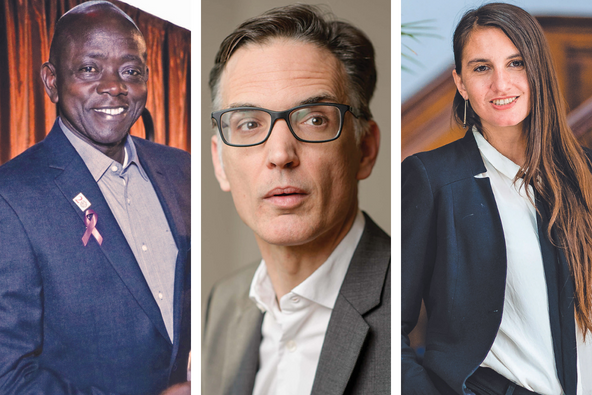 Left: The Global Justice and Research Project’s Hassan Bility receives an award. Center: Alain Werner launched Civitas Maxima in 2012. Right: Emmanuelle Marchand heads Civitas Maxima’s legal unit. (Photos courtesy of Civitas Maxima)
“I could see clearly that there was very little prospect of any kind of justice,” Werner says. “I thought it was such a mockery of international justice to have these two conflicts that are so similar and intertwined, and for one you had the United Nations putting in $30 million or what a year for 10 years, with an international court, and for the other you had nothing.” (The court indicted 13 people for war crimes from all sides of the conflict, three of whom died before their trials began, and ran at an estimated cost of $300 million in its 11-year existence.)
Around the same time Werner was searching for witnesses to testify against Taylor, Liberia was pursuing a Truth and Reconciliation Commission (TRC) that was part of a peace deal made in 2003. Its goal was to help Liberia come to terms with three decades of political violence and war. But the process would end in shambles with the possibility of prosecutions nearly snuffed, when it published its findings and recommendations in 2009, calling for warlords—some of whom were sitting representatives and senators in Liberia’s bicameral legislature—to be tried. Perhaps most controversially, the commission called for then-President Ellen Johnson Sirleaf to step down from office due to her early support of Charles Taylor’s rebel faction, the NPFL. With the TRC commissioners receiving death threats, and the government having no concrete plans for archiving the information the commission produced, all the documents were sent to the Georgia Institute of Technology (Georgia Tech) in Atlanta, according to Jerome Verdier, a former commissioner.
Werner left Sierra Leone before the Taylor trial ended and went on to represent victims of the Khmer Rouge at the UN’s Extraordinary Chambers in the Courts of Cambodia. But he continued to reflect on the war in Liberia and how the perpetrators might be held accountable in the absence of domestic or international political will. Werner had heard about Hassan Bility, a journalist who had testified at Taylor’s trial soon after he left. Bility was living in exile in Boston, having been arrested and abused by Taylor’s forces after he was accused by the former president of plotting to kill him. The soldiers allegedly shoved him into a pit and tortured him.
Bility has testified as both a victim and an expert witness in major trials against Liberians accused of war crimes, torture, and human rights abuses. These testimonies include the trials of Taylor and his son, Chucky Taylor, who was eventually sentenced to 99 years for committing torture in Liberia, and Guus Kouwenhoven, a Dutch businessman accused of involvement in trafficking arms into Liberia who was indicted in the Netherlands. Werner and Bility, who had learned of each other through mutual contacts, finally met years later and started discussing strategies to build cases against Liberians living abroad.
For Bility, who is now permanently based in Liberia, legally pursuing those accused of war crimes was about ensuring that his homeland didn’t return to conflict again. He also wanted to pay back the activists and demonstrators who had campaigned for his release from Taylor’s forces, which he said was facilitated by the US Embassy in Monrovia.
“I don’t want my kids or anyone’s kid to grow up in such an environment,” Bility says. “I know that if no deterrent is put in place, absolutely it’s going to happen again.” For Werner, creating the organization and collaboration was also about creating a fairer international justice system in which “every victim counts.”
Transcending a Broken System
After years of working on huge UN-backed tribunals in Sierra Leone and Cambodia, Werner had developed ideas about ways to pursue justice outside of politicized institutions. The International Criminal Court often requires states to cooperate and consent to investigation and prosecution of alleged perpetrators. UN Security Council resolutions must be passed by powerful nations who often have political agendas and may be liable for war crimes themselves. The UN-backed hybrid courts, which use elements of domestic and international law and are located in countries where crimes have been committed, also for the most part require consent from those same countries. After finishing up his time in Cambodia, Werner was hired in 2009 by the Aegis Trust in London, an organization based at the United Kingdom’s Holocaust Centre that supports genocide education museums. Aegis hired him for a program they launched that focused on documenting war crimes that could be pursued using universal jurisdiction. Under this approach, lawyers and civil society members could build cases against alleged perpetrators in countries and courts outside of where the crimes were committed.
“We basically had carte blanche,” Werner says. “We were given complete freedom to build UJ [universal jurisdiction] cases, and it is within the Aegis Trust that I started to collaborate with Hassan.”
Bility was living in Boston at the time but had spent most of the war years in his homeland. Werner became frustrated at Aegis Trust and decided to leave and form his own organization.
Werner managed to muster up a grant of 287,000 Swiss francs ($286,000) from Geneva-based human rights organization Fondation Pro Victimis to set up his organization and begin documenting war crimes in Liberia. He thought about hiring a recent law graduate from an elite university—a common fixture in the international court circuit—to start documenting cases, but Bility put his hand up instead. “I could hire one of these clever Brits, young and a bit adventurous, an Oxford graduate, to go with Hassan and beef up the documentation and work with him,” Werner says. “That was my idea … and Hassan told me, ‘Don’t do that, because that would mean nothing for Liberia—trust me—and with that money I will hire 10-15 people and I will start an organization.’”
“My only credit is to have trusted Hassan,” Werner adds.
“Universal jurisdiction” is a legal concept that allows states to claim jurisdiction over people accused of crimes, regardless of where the offenses were committed, or the nationality and residency of the alleged perpetrator. Sometimes an alleged perpetrator being within a state’s borders is enough to make an arrest, regardless of their nationality. Alleged perpetrators can be prosecuted using domestic laws and international laws or conventions that a state may be party to. According to a 2020 report on universal jurisdiction by the US-based International Center for Transitional Justice, there was a 40 percent increase between 2018 and 2019 in the number of “named suspects in universal jurisdiction cases around the world,” with a total of 207—among them, 11 accused were on trial, and there were 16 convictions and 2 acquittals. But transparency in the figures and number of cases remains a challenge, as do the different ways in which universal jurisdiction is implemented among different states, the report says. Cases can also be subject to the political interests of those in power.
Civitas Maxima, a Latin phrase that translates as “the greatest citizenry,” maintains that “victims of international crimes must hold the keys to their own question for justice,” and justice should exist outside of state interests. Partly for this reason, Werner has refused to take money from any governments—an approach that remains fiercely debated within the organization, he says. About 70 percent of Civitas’ funding comes from US- and European-based philanthropic organizations focused on promoting human rights, peace, and freedom, such as Fondation Pro Victimis, the Sigrid Rausing Trust, the Oak Foundation, Humanity United, the Wellspring Philanthropic Fund, and the Open Society Foundations. Civitas Maxima also sources funding from private members of the Swiss business community, although it has policies prohibiting it from receiving money from businesses or individuals who engage in illegal practices or “derive direct income from the promotion, manufacture, or sale of arms,” or those who engage in mining or extractive industries.
Civitas Maxima has steadily grown over the past decade, with an increase of funding from 10 to 20 percent each year, according to Werner. Its current annual budget is 1.65 million Swiss francs ($1.64 million). Civitas Maxima, in turn, continues to fund GJRP, but Werner hopes that GJRP will come to operate independently and collaborate with different partners. For example, it collaborated with the San Francisco-based Center for Justice and Accountability (CJA) to build a civil case against a Liberian man living in Philadelphia who was accused of participating in the July 29, 1990, St. Peter’s Lutheran Church massacre. In the greatest atrocity of Liberia’s first civil war, 30 government soldiers who were Krahn and loyal to President Doe killed 600 people—mostly Gio and Mano—within a Monrovian church. The man, Moses Thomas, was found liable for war crimes and crimes against humanity in August and ordered to pay $84 million in damages to four Liberian victims. But Thomas had left the United States for Liberia in 2020 before the verdict was handed down in September 2021 and the order for compensation made a year later. On October 3 of this year, CJA and GJRP also filed a human rights complaint against Liberia in the Economic Community of West African States court for “failing to provide justice for the victims.”
“It’s quite an achievement to still find money for it, because who cares about Liberian victims?” says Werner, acknowledging that courts and justice efforts often move to the hottest conflict. Nowadays the UN and Western governments and states are investing time and resources investigating war crimes in Ukraine. Werner also remains concerned that funders often work on a maximum 10-year cycle and is conscious of the need for attracting new donors in the coming years.
Getting to Work
In 2012, both organizations launched and began building up their first cases. Werner and Bility were soon joined by Emmanuelle Marchand, a young French lawyer who had worked as a legal assistant in Cambodia, representing victims of the Khmer Rouge, at the same time as Werner. Marchand, who is based in The Hague in the Netherlands, and is deputy director and head of Civitas Maxima’s legal unit, joined the organization in 2013. She was specifically tasked with conducting an investigation funded by Humanity United into the victims of Ivory Coast’s post-election violence in 2011. Survivors fled to refugee camps in Liberia, and many had witnessed or been victims of crimes committed by the militias that backed Ivory Coast president Alassane Ouattara. The perpetrators were, of course, unlikely to be prosecuted by Ouattara’s government.
After this work was done, Marchand turned to helping document cases focused on the Liberian civil war. She sees Civitas Maxima’s mission as documenting and assisting victims “who are not really represented” and finds it rewarding to be part of the process from the beginning of the investigation and throughout the court proceedings and afterward. She also likes having the leeway to pursue her own leads. Whether or not they go ahead with proceedings also largely depends on the willingness of the victims, making the process more “victim centered,” she says.
One of the team’s earliest cases was that of Martina Johnson, a woman alleged to have been a former artillery commander for the NPFL who participated in Operation Octopus—a four-month military offensive in 1992 against the capital, Monrovia, aimed at unseating the interim government. The operation killed and displaced thousands of people. Both Werner and Bility started gathering documentation for the case while Werner was working at the Aegis Trust. Johnson, who had been living in Belgium for more than a decade, was arrested and charged in September 2014. The case is still ongoing, although Johnson has been provisionally released. At the time of writing, sources in Liberia’s Ministry of Justice confirmed that Belgian investigators were in Liberia and the case was likely to begin in the coming year. But one of the four victims who gave initial testimony has died.
On the ground in Liberia, GJRP works on what they call “slow documentation”—the gathering evidence of war crimes that might be used at some point if Liberia ever decides to have a war crimes court. They interview witnesses and sometimes pick up leads at atai shops, where men gather, drink tea, and often trade wartime stories. Bility and his team also work on documenting cases connected to Liberians they know are residing abroad. GJRP gathers the evidence on the ground, then approaches Civitas Maxima, who helps them build the case and contact prosecutors in various countries.
Unlike other actors in the international justice field, Civitas Maxima and GJRP have not focused on the heads of state or government leaders most responsible for crimes committed during the conflict, but rather on faction commanders or people who had other leadership roles. Werner avoids the foot soldiers due to the issues with forced recruitment during a conflict that saw an estimated 38,000 children participating as fighters, ammunition carriers, porters, cooks, and sex slaves.
“It’s important for the victims, and groups of victims, and it’s important on a broader level, because there needs to be an understanding that these crimes ought to be punished to prevent people from doing what they did in the past,” Werner says. He also wants to go after the big businesspeople, some of whom are from the West, who fund and finance wars and who are often neglected by UN courts and the ICC—both of which have been criticized for pursuing cases only against Africans.
Werner’s approach has in recent years attracted attention from organizations such as the US-based Ashoka Foundation, who have supported activists and social entrepreneurs, some of whom have been involved in international justice through three-year fellowships. “There is innovation in the way that he works in that he works around the justice system with the tools the justice system provides,” says Emilie Romon Carnegie, who leads Ashoka’s Swiss office, on the reasons why Ashoka awarded Werner a fellowship in 2020. Romon Carnegie compares Civitas Maxima’s decade of arrests and three convictions (two of which were in US courts for immigration charges and one in a Swiss court), despite its “tiny budget,” with the ICC’s record over the past 17 years, which has landed only three convictions and four acquittals, despite having a budget of €154 million ($154 million).
Evidence From a Pre-digital War
Civitas has made training in evidence gathering a major priority. Learning different countries’ and international tribunals’ legal protocols for collecting evidence and interviewing witnesses can be crucial for the eventual trials. Bility and his team must record the means and time that first contact is made with a witness, cannot interview people in groups, and must do their best to ensure that potential witnesses do not come into contact with one another, if they haven’t already, so that the evidence meets international standards for prosecutions. They also cannot show witnesses photos or ask leading questions, to avoid undermining their evidentiary value.
Because Liberia’s conflict unfolded years before digital photography and open-source digital forensic tools became commonplace, eyewitness testimony remains critical. However, Civitas Maxima and GJRP have the advantage that many of the horrors committed during the war were often committed in public view. In addition, the small and close-knit nature of the Liberian domestic and diaspora communities has made it relatively easy to track down alleged perpetrators overseas.
Nevertheless, the cases they are jointly pursuing are difficult and varied. Some are criminal immigration proceedings in the United States, where prosecutors come in and conduct investigations, while others are proceedings where countries need to be invited in by the government and must adhere to strict rules of evidence gathering. The relationship between prosecutors in terms of evidence gathering can be collaborative or distant, depending on the rules and regulations in the jurisdiction for evidence gathering. “We give information to the authorities, but we don’t control the full investigation,” Marchand says.
Such complexities can make it difficult to decide how to proceed. Both organizations were initially hesitant, for example, to collaborate with US Immigration and Customs Enforcement (ICE) and its Homeland Security Investigations (HSI) division after its deportation of US resident George Boley back to Liberia in 2012 under the Child Soldiers Accountability Act, a US law that criminalizes the use of child soldiers by any military force. The decision enabled Boley to return to a country where he would not be held accountable. Boley had led the LPC and was accused of committing crimes, but he is now a representative in the legislature. But when they wanted to bring a Liberian living in Philadelphia to justice, found public prosecutors there with international trial experience, and saw that cooperating with ICE and HSI could lead to longer criminal sentences, they decided to go ahead.
In 2018, Civitas Maxima and GJRP landed their first conviction, of Mohammed Jabbateh, who had been granted asylum in Philadelphia and had been living there for two decades running a shipping-container business. Mark Gilland, an HSI investigator who was based in Philadelphia at the time, was looking at stolen cars that were being exported to Liberia. He stumbled across Jabbateh when he received a tip-off from an informant during an investigation into a passport fraud case. While Gilland and his team did not tell Civitas and GJRP who their target was in the initial stages of the investigation, they were called on to find victims from certain towns and villages where Jabbateh’s faction, ULIMO-K, fought in the 1990s. Unlike Boley, Jabbateh, who was known as “Jungle Jabbah,” was sentenced to 30 years in prison by a Philadelphia court for perjury. (He had lied on his immigration forms and in interviews.) Werner said they were lucky that one of the prosecutors had international trial experience at the International Criminal Tribunal for the former Yugoslavia.
Marchand is also a trainer in interviewing techniques with the Institute for International Criminal Investigations, an independent nongovernmental organization that was established at the same time as the International Criminal Court. She helps investigators better document cases of international crimes through courses with humanitarian experts, lawyers, and cops. She has led trainings of members of GJRP in both Liberia and The Hague. “The way we documented 10 years ago is of course different to what we do today and what we will do five years from now,” Marchand says. “We will become more and more systematized.”
In June 2021, Civitas Maxima and GJRP also won a victory in a Swiss court, where Alieu Kosiah, who was a permanent resident, was found guilty of 21 of 25 charges against him, including murder, rape, cannibalism, and the use of child soldiers. The case offered a rare instance in which Werner represented the victims—the trial was held in Switzerland, where he is a practicing lawyer. It was their first victory in a nonimmigration case outside of the United States and the first war crimes conviction in a Swiss civilian court. The case, whose decision has been appealed, also led them to another alleged perpetrator from the same United Liberation Movement of Liberia for Democracy (ULIMO) faction: Kunti Kamara. A Dutch citizen and witness in Kosiah’s trial, Kamara was arrested in Paris in 2018 and faces charges of torture and complicity in acts of torture. His trial will begin in October 2022.
Second-Class Victims
While GJRP and Civitas Maxima have had significant success over the past decade, the challenges for witnesses back home, particularly when cases are lost, can be formidable. Many of the witnesses who testify in these trials have never been on a plane before and return home to a country where rule of law is weak, witness protection is nonexistent, and psychological care is severely limited. Civitas Maxima and GJRP team members often chaperone witnesses to the trials and check on them back in Liberia. Despite their efforts, protecting them when cases fail can be daunting.
One such court failure involved the case of Agnes Reeves, a former wife of Charles Taylor, who had been living and working as a lecturer at Coventry University in the United Kingdom. She was charged with torture and facilitating the rape of captive women in Gbarnga, then the capital of Greater Liberia, the region controlled by Taylor’s NPFL faction. Charges against Reeves were dismissed in 2019 on the grounds that the prosecution did not establish that the NPFL had administrative control over the area at that time. When Reeves returned to Liberia, the names of many witnesses who were set to testify were publicly leaked. She has also sued GJRP and Civitas Maxima in a Liberian court for libel, and her filing mentioned the names of witnesses. Reeves denies any wrongdoing or military involvement with the NPFL, despite evidence to the contrary. Most notably, a photo of her dressed in military fatigues, wearing gold chains, with a pistol tucked in her belt jutting from behind her camouflage fanny pack, and a young female soldier standing next to her, was taken by French photographer Patrick Robert in 1990. At a press conference in Monrovia after she was released, Reeves claimed to have carried a pistol and worn a military uniform for her own personal protection and characterized herself as a humanitarian.
Marchand had spent a great deal of time with the alleged victims and said the dismissal of the Reeves case “crushed” her. And even when cases succeed, the threat of reprisals remains. The team continues to be concerned about the shorter sentences meted out by European courts, in which pretrial jail time counts toward sentences. Kosiah could be back in Liberia in 13 years—or sooner, if he wins his appeal.
“If you do extraterritorial cases, you have two categories of victims,” Marchand says. “If you are in Europe, for example, you will have access to psychological support and security measures, but for victims located in Liberia, at the end of the day it falls on the NGOs and local organizations, so we have to develop our own witness protection program with very limited means.” In many ways, those living in Liberia are “second-class victims,” she says.
For Werner, this is part of the reason why Civitas Maxima remains largely focused on Liberia: not only because it takes time to build cases, but also because alleged victims there have greater need of resources and care for their well-being. Liberia has no formal witness protection program and precious few psychologists and psychiatrists.
The Impact Back Home
Civitas Maxima is doing more than pursuing prosecutions and aiding victims and witnesses. They are also invested in informing the public and changing culture. Civitas has financed Liberian journalists from leading publications to travel and cover the court cases and produced cartoons and plays on the “Jungle Jabbah” trial, to help children who grew up after the war to better understand the process. For Aaron Weah, a Liberian researcher who is currently completing his doctorate on memorialization of the war at the Ulster University in Northern Ireland, GJRP and Civitas have “kept the agenda of criminal accountability alive” in a country where “the government is sending a message internationally that Liberia is a haven for war criminals.”
Weah adds that these trials could play a role in preserving historical memory in a country where it is being rapidly lost due to deaths of victims and perpetrators and the passage of time. But the impact will likely be limited, he suspects. “The documentation and reporting of these cases is very rich, but they only help if the Liberian government is interested in that to form a part of the history,” he says. Weah has been looking for memorials that have been dedicated to the more than 200 massacres, ranging from five people to more than 600, that were committed from 1979 to 2003, documented by the TRC, but he has found only one site in a village that is being used as a “civic space” to teach children about the wrongs committed during the war.
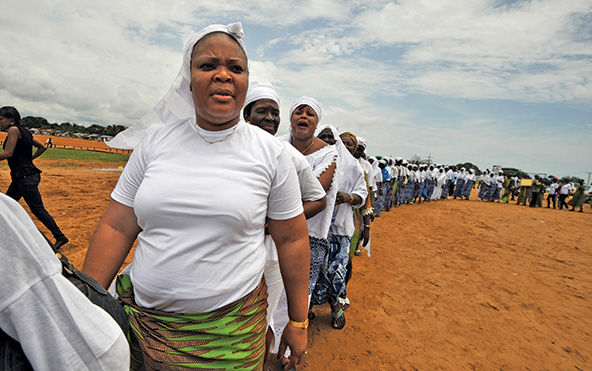 Nobel Peace Prize winner Leymah Gbowee leads a gathering of fellow women’s rights activists on October 9, 2011, in Monrovia. (Photo by Issouf Sanogo/AFP via Getty Images)
Current president George Manneh Weah’s government has granted official permission to three teams of European investigators to enter the country. President Weah once voiced support for the establishment of a war crimes court when he was a United Nation Children’s Fund ambassador. But he backtracked on international involvement and has asked the legislature to set up Liberia’s own Transitional Justice Commission, which would pass on recommendations to his office. However, such a commission has yet to be established, and many war crimes court watchers and civil society advocates remain skeptical that such a step will result in any meaningful moves toward prosecutions or reconciliation. Weah’s vice president is Jewel Howard-Taylor, the ex-wife of former president Charles Taylor, who is currently imprisoned in the United Kingdom. She has publicly defended her former husband’s actions during the conflict and said that Liberia should move on.
Liberian peace activist Cecelia Danuweli says the cases advanced by Civitas Maxima and GJRP are positive steps, but more needs to be done to ensure that prosecutions occur on Liberian soil. “The Weah-led government should have done something because this is what they asked for when Ellen was around,” says Danuweli, referring to the government of former president Ellen Johnson Sirleaf. Danuweli is a former member of the Women of Liberia Mass Action for Peace, a Liberian peace movement led by women dressed in white that helped end the second civil war. The leader of the movement, Leymah Gbowee, co-won the 2011 Nobel Peace Prize with Sirleaf and Yemeni journalist Tawakkol Abdel-Salam Khalid Karman. “Even those who are here, it would be a big thing for me if Prince Johnson was to go to a war crimes court,” Danuweli says of the sitting senator. “They are still there masquerading around and being elected and reelected, which is not a good thing for the country,” she says of the warlords. “We are going nowhere.”
Massah Washington, a former TRC commissioner who now lives in the United States, has expressed concern about perpetrators banding up to silence critics. Washington herself has been sued by Reeves for libel in an article she wrote accusing Reeves of launching a “smear campaign” against Bility and questioning whether she was vindicated because it never went to trial. “In the absence of political will on the part of the Liberian government, I think that is the best that we have now for receiving justice,” she says of the cases Civitas Maxima and GJRP have pursued. “It keeps us hopeful.”
The Future for Civitas and GJRP
Werner is hesitant about jumping to the next headlining conflict. But he and his team are keen to train activists in other parts of the world on how to use their methods to file complaints in European or other courts that have laws that enable them to prosecute such crimes.
Last year, before the Russian invasion of Ukraine, Marchand trained members of Truth Hounds, an NGO in Kyiv that has documented crimes committed in Ukraine since 2014. This past August they assisted the organization in filing a complaint in a Swiss court concerning the attack allegedly by Russian forces on Swiss photographer Guillaume Briquet, hoping to pave the way for an investigation by a prosecutor. He was shot on March 6 while driving in a marked press vehicle from Kropyvnytskyi to Mykolaïv. Werner sees a promising future for Civitas Maxima in supporting Ukrainian and other organizations to file complaints abroad and move European courts and war crimes units into action. “The Ukrainians can do it themselves,” he says.
The Civitas Maxima team is considering taking on cases outside of Liberia, but Werner underscores that he is committed to Liberian cases for the long haul. “This is very long-term work,” he says. “I think we should keep up the pressure and these cases as long as possible to make it very clear in the minds of people that even if we don’t get justice in Monrovia, there will still be justice for these crimes.”
On October 7, the day this story was filed, Beth Van Schaack, the US Ambassador-at-Large for Global Criminal Justice, was visiting Monrovia. In a press briefing, she said the United States would provide financial and technical support for any Liberian-led justice initiative. It was the first time the US government publicly voiced support for justice and accountability for war crimes in Liberia.
“I feel positive, elated, and confident that the United States will stand by Liberian victims and the people,” Bility says. “But it is we Liberians who will have to take the lead.”
Read more stories by Clair MacDougall.