


 Jackline (right), 48, is a farmer and shop owner in Kenya. She used her Kiva loan to purchase a dairy cow to add milk and yogurt to her shop’s offerings. (Photo by Lid Vidyarthi/Courtesy of Kiva)
In 2003, Jessica Jackley was a 25-year-old staff member of Stanford Business School’s Public Management Program when a lecture by Muhammad Yunus upturned her life.
Yunus popularized the microfinance solution to global poverty by founding Grameen Bank in Bangladesh. Poor people in low-income countries typically lack the collateral and credit history that most financial institutions require to give them a loan. The microfinance model sought to develop a sustainable, market-driven approach of lending to poor people, especially aspiring entrepreneurs, small amounts of money on friendlier terms than typical moneylenders. Yunus would go on to win the Nobel Peace Prize in 2006 for his efforts.
Jackley decided to quit her job and move to East Africa to experience microfinance firsthand. Her husband, Matt Flannery, a Stanford graduate working as a computer programmer at TiVo, joined her for an extended visit a few months later.
“I wanted to create a way for our friends and family to experience these new stories of entrepreneurship,” Jackley writes in her 2015 autobiography, Clay Water Brick. “And then I wanted to give them a way to respond differently too—for the first time, not with a donation but with a loan.”
The couple returned to San Francisco in 2004 and started working on a website that would connect relatives, friends, and acquaintances to people in East Africa seeking small loans. By April 2005, the couple was ready to launch a pilot to crowdfund seven loans sourced through a contact in Uganda, a pastor and community leader named Moses Onyango. Jackley and Flannery uploaded pictures and stories of people seeking $3,500 total in loans, and sent a fundraising appeal via email to a 300-person list they still had from their wedding invite. The borrowers included Elizabeth Omalla, a widow with seven children. She planned to use the $500 loan she requested to expand her fishmongering business. All seven posted loans got funded within just a few days.
“Over the next six months, a beautiful thing happened,” Jackley recalled in a public lecture. “The entrepreneurs received the money, they were paid; and their businesses, in fact, grew; and they were able to support themselves and change the trajectory of their lives.” The successful experiment encouraged the couple to launch Kiva as a full-blown website open to the public. Premal Shah, who had also been experimenting with his own microfinance project while working at PayPal, joined Jackley and Flannery as a cofounder.
By the end of 2018, Kiva had processed $1.2 billion in loans from 1.3 million lenders to 3 million borrowers worldwide. But achieving such massive growth required compromises in how the founders’ original vision was implemented. As early as 2009, Kiva ran into controversies surrounding the transparency of its operating model and its claims of impact. While maintaining a low profile about this, Kiva began experimenting with different approaches for addressing such criticisms.
By 2018, Kiva was ready to redefine the very mission for which it exists. Instead of “connecting people through lending to alleviate poverty,” Kiva set the goal of “expanding financial access to help underserved communities thrive.” Neither “connecting people” nor “lending”—the defining characteristics of Kiva since its birth as a crowdfunding-based lending model—appeared in the new mission statement. This change recognized a new reality: Kiva had diversified into a wider range of initiatives in its quest for more breadth and depth of impact, though financial inclusion remained a unifying thread.
“One of the things that goes unnoticed about Kiva is our quiet but continued pursuit of the impact being achieved,” says Shah, who until 2018 was president and the only remaining cofounder still with Kiva. “This is hard to do and hard to measure. But it is critical.”
To Kiva’s credit, it has chosen to engage with its critics, adapt its model based on evidence of what works, and explore new frontiers of impact. But for its critics, the question remains: Is Kiva trying to do too much and diverging too far from its legacy and proven strengths?
The Ultimate Shopping Experience
Kiva officially launched in 2005 as a person-to-person (P2P) crowdfunding platform connecting ordinary Americans willing to lend amounts as small as $25 with borrowers overseas needing small amounts of capital to start a business. The founders assembled a passionate team willing to work from Shah’s house and accept no pay for much of their first year.
Kiva continued to rely on the power of stories and personal connections to raise money, and its popularity rose quickly. “The human connections we build between lenders and borrowers have brought new lenders to the microfinance movement,” Flannery wrote in a 2007 article for Innovations magazine.
Kiva worked closely with a network of field partners—typically small microfinance organizations with a limited track record or no alternative source of funding—to find borrowers. The partners administered the loans, helped prepare the borrower profiles Kiva users saw, and provided periodic updates on borrower progress.
By the spring of 2007, Kiva had facilitated $6 million in cumulative lending from 60,000 users to clients served through 40 microfinance partners. The users were hooked to the diverse stories of entrepreneurship: a beekeeper in Ghana, a spinach farmer in Cambodia, a hot dog seller in Nicaragua, a carpenter in Gaza. Flannery recalls that Kiva users preferred some borrowers over others: “A female African fruit seller? Funded in hours. A Nicaraguan retail stand? Funded in days. A Bulgarian taxi driver? Funded in weeks.”
Kiva arrived in popular conscience in the summer of 2007: The Oprah Winfrey Show decided to profile the organization. Former President Bill Clinton launched the discussion with his new book, Giving. About 45 minutes in, the Kiva segment began with a video featuring Anne Brown, a Seattle artisan, who told the story of her lending money to a seamstress in Ecuador. Brown called Kiva “the ultimate shopping experience.” Kiva’s website crashed from the sudden spike in traffic. With more money flowing in from Oprah’s audience, Kiva was able to buy bigger servers.
Operating as a 501(c)(3) nonprofit, Kiva did not charge its users or field partners any interest, platform fees, or commissions. The founders wanted to avoid legal complexities around being seen as a financial securities issuer. PayPal handled all financial transactions free of cost, thanks to Shah’s connections. Once a loan was repaid, a Kiva user had three options: withdraw the money, donate it as a “tip” to Kiva, or re-lend it. Re-lending proved to be the most popular option: Less than 10 percent of funds were withdrawn by lenders. Such recirculation helped fuel growth in Kiva’s loan portfolio.
Kiva’s sustainability depended on three sources of revenue. The largest component was the tips users could add during a transaction. About half of Kiva users did so in 2008 for a total of $2 million. The second was interest accrued from Kiva’s bank balance—mainly funds from lenders not yet deployed to microfinance institution (MFI) partners. This component contributed $400,000 in 2008. The third came from expiring Kiva gift cards that people had received to use on the Kiva website but failed to redeem. This breakage contributed $300,000 in 2008.
These three revenue sources contributed $2.7 million toward Kiva’s $4.1 million budget in 2008. The shortfall was made up through additional donations and fundraising efforts. Some Kiva leaders viewed the gap as unavoidable, given the need to conduct due diligence in more than 40 countries. Others thought Kiva should strive to be self-reliant, a debate that has persisted to today, as Kiva continues to depend partly on external funds.
The Model Comes Into Question
The summer of 2007 marked not only Kiva’s popular arrival but also challenges to its core model. Kiva’s very first partner, Moses Onyango, was caught posting fake borrower profiles and diverting funds. “Moses lit up early Kiva with his tales of fishmongering, goat herding, and clothes reselling,” Flannery recalls. “But as Kiva spread, Moses began telling taller tales involving false borrowers.” Kiva decided to come clean that $250,000 had been defaulted on and refund the affected lenders—most of whom decided to reinvest their refunds into new Kiva loans.
But more incidents of partner incompetence or outright fraud hit Kiva. The organization decided to build stronger due diligence through a combination of hiring and seeking external expertise. Ernst & Young donated more than $1 million in services. Lending opportunities were now carefully screened through field visits, and Kiva’s investment committee reviewed their findings before approving funding.
A substantial part of Kiva’s work was now happening on the ground in developing countries. What was once a Silicon Valley startup became a hybrid organization operating at the intersection of technology and international development. Internal conversations focused far more on minimizing the risk of microfinance lending rather than on its impact. “The assumption was that every dollar we could get through the Kiva website and into the hands of a credible-sounding microfinance partner in a developing country was a good thing,” says Kiva’s chief investment officer, Chad Sterbenz, who joined the organization in 2013 after working in impact investing for six years.
Kiva continued to grow fast, with $36 million in microfinance lending by 2008. Its portfolio had tilted toward large MFIs as it sought to minimize risk and pursue scale. Kathy Guis, who began working with Kiva’s field partners in 2010 and is now senior director of partner investments, says, “Turning away from riskier partners meant that by 2010 we had a pretty low risk profile, despite access to capital that was likely risk tolerant in seeking impact.”
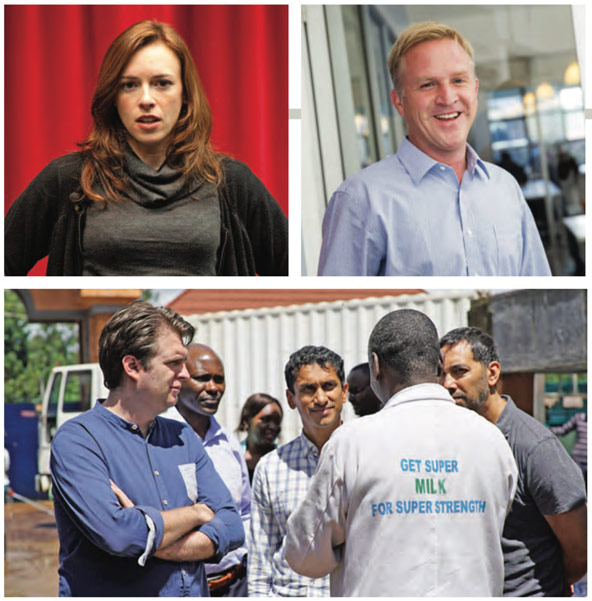 Kiva cofounders Jessica Jackley (left) and Matthew Flannery (right). Bottom: Current CEO Neville Crawley (left) and third cofounder and former president, Premal Shah (center). (Photos courtesy of Wikimedia Commons [upper left], Nairobi Garage [upper right], and Kiva)
When Kiva launched, each loan posted on its website had to be individually funded before its borrower could receive the money. But that practice changed when Kiva’s larger MFI partners sought to disburse loans faster and process transactions in batches. Loans could now be disbursed even before they had been individually funded by users.
“Kiva Is Not Quite What It Seems,” stated the title of an October 2009 viral article by economist David Roodman for the Center for Global Development. “The person-to-person donor-to-borrower connections created by Kiva are partly fictional,” he wrote. “I suspect that most Kiva users do not realize this.”
Other critics alleged that Kiva was not sufficiently transparent about its new field partners charging borrowers interest. (Kiva’s funding to the partners was interest-free.) Microfinance consultant Hugh Sinclair went so far as to accuse Kiva of “a deliberate deception of potential lenders,” adding that “Kiva spouts lovely stories backed up with photos, but fails to discuss the interest rate that the poor are forced to pay.”
Kiva’s management team was taken by surprise. They held transparency as a core value and never intended to hide anything from users. They tried to address the issue by making most information available through additional links on its website, but not in a way that might overwhelm or disengage ordinary users.
Roodman acknowledged that it was demeaning to borrowers to force them to rely on the whims of the crowdfunding public. But he noted that there was a bigger issue not within Kiva’s control: Individual lenders and donors typically did not pay attention to the nuances of lending or the real impact realized. They just wanted photos and stories to feel good.
The Kiva Zip Experiment
Flannery, then Kiva’s CEO, thought more drastic measures were necessary. He wanted to revisit the pure P2P crowdfunding approach that Kiva had abandoned in its shift to a partner-based model. In 2011, he launched a pilot platform called Kiva Zip as an alternative. “Matt came at it from a technology frame,” says Bennett Grassano, who joined Kiva in 2008 and was until recently its vice president of strategic development. “From his point of view, we could solve the problem by just bypassing the intermediaries and going directly to the entrepreneurs.”
Flannery kept the Kiva Zip platform separate from Kiva’s main website for greater flexibility in implementing pure P2P lending. Some officers at Kiva opposed this decision because it required creating a user base from scratch rather than building upon Kiva’s existing audience. Flannery nevertheless launched two pilots—one in Kenya and the other in the United States.
To ensure that Kiva Zip lenders could trust borrowers without having field partners, Kiva Zip implemented a “social underwriting” approach. Under this model, borrowers had to be endorsed by “trustees”—credible individuals or organizations in the local community. But the Kenya pilot turned out to be too complex to manage without field partners, so Kiva Zip decided to focus exclusively on US entrepreneurs—typically minorities, ex-convicts, war veterans, and immigrants excluded from the financial mainstream. Flannery hoped that zero-interest “starter loans” of up to $5,000 could help them grow their businesses, build credit histories, and integrate into the broader economy.
By December 2013, Kiva Zip had facilitated $1.6 million in loans to 410 US entrepreneurs. But the project struggled financially. Each loan had a high administrative cost, because Kiva Zip lacked the economies of scale that using field partners provided. The default rates were high, because the loans targeted early-stage entrepreneurs and the program had weaker monitoring than in a partner-based approach. And Kiva Zip also faced significant competition from other P2P lenders. Kiva ultimately decided to merge Kiva Zip into its main website as “Kiva U.S.” and to fundraise specifically for it.
Pure P2P lending faced too many challenges to be the dominant model for Kiva. Instead, it would have to stick to the partner-based approach and continue improving its transparency and impact. Flannery left Kiva in 2015 to cofound Branch, a for-profit tech venture focused on mobile-based financial services.
Rethinking Microfinance
As Kiva tinkered with its operating model, it also confronted a broader debate about microfinance as a tool for poverty alleviation. Critics pointed to the high interest rates and aggressive tactics of MFIs, and noted that borrowers often became saddled with debt. In 2010, more than 80 indebted borrowers (unrelated to Kiva) in Andhra Pradesh, India, committed suicide.
Randomized controlled trials (RCTs) also indicated that microcredit was generally not very effective for poverty alleviation. Only a fraction of the poor taking these loans were investing in businesses, and those who did were often unsuccessful. In a 2015 review paper, economists Abhijit Banerjee, Dean Karlan, and Jonathan Zinman concluded, “Summarizing and interpreting results across studies, we note a consistent pattern of modestly positive, but not transformative, effects.”
“Our founding assumption had been that microcredit was an effective tool for poverty alleviation,” Shah recalls. “But the RCTs were indicating that the actual impact, particularly on poor people’s household income and consumption, was generally not great. We therefore had a responsibility to ask: ‘How can we improve our impact?’”
Kiva’s leaders remained convinced that, even if the standard lending models of large MFIs showed limited benefits, Kiva’s lending showed impact in at least some settings. “If smallholder farmers take a loan for fertilizer, and their first payment is due in two weeks, they don’t have an opportunity to reap full benefits,” Grassano says. “But the impact can be significantly improved by offering the farmers flexible loan terms aligned with their cash flows.”
In focusing on real-world impact, Kiva’s leaders became more willing to accept the risks of trying new microfinance models. “We came to realize that our goal was not avoiding taking risks,” Guis says. “It was to get more intentional about the risks that we took, and to assess those risks relative to potential impact.”
But it would not be easy for Kiva to persuade its funders and MFI partners to adopt this mind-set, because they focused more on repayment rates than on the nuances of impact. And Kiva itself could not simply drop all the relationships and portfolios it had built over the years. Instead, Kiva started actively managing its new relationships by preferring MFIs and other organizations (such as educational institutions setting up loan programs for poor students) that were willing to experiment with innovative microfinance models with a high potential for impact.
It was not easy to persuade field partners and funders to participate in such experimental efforts. So Shah and Grassano, in consultation with other senior managers from Kiva’s strategy and investment teams, decided to launch a formal initiative. “We had this idea,” Grassano says. “Let’s just make the case more broadly for the role Kiva can play as an R&D outfit for impactful models, and put the name Kiva Labs on it.”
In facilitating such experimental innovation, Kiva Labs inevitably experienced some failure. For example, one nonprofit organization in Malawi financed pigs and repaid using piglets. “It was adorable, but then the price of pigs crashed and it was not possible to recoup enough,” Guis says. “There were things like that: cute ideas that just did not work.”
In prioritizing impact, Kiva sought challenging contexts where people typically had no sources of alternative funding, such as refugee and disaster-hit communities. For example, Kiva partnered with social enterprise NWTF to help survivors of Typhoon Haiyan, which struck the Philippines in 2013. “We came up with bridge loans to allow businesses that failed to restart so that the people could get on with their lives,” says Raymond Serios, special projects manager for NWTF. “But then we realized that many of these people did not even have a roof over their heads, and they were still staying in evacuation centers. So we came up with housing reconstruction loans as a first step. While we had many other funders willing to help us with the business loans, for housing construction it was just Kiva.”
By the end of 2013, Kiva Labs had channeled about $8 million in loans through more than 70 partners across agriculture, education, energy, mobile technology, and other sectors. Its budget was funded by a three-year $3 million grant from Google.org, with significant additional financial and in-kind support provided by Cisco Foundation and Mulago Foundation. By deploying grant money to encourage experimentation, Kiva Labs had accumulated an increasing number of data points showing the value of lending in challenging contexts.
Kiva Labs’ efforts to encourage new and more impactful microfinance have received praise. “Through [Kiva Labs], donors can enable innovation in microlending by providing subsidies that encourage lenders to absorb additional risk,” Dean Karlan wrote in a 2014 Stanford Social Innovation Review article. “As a result, lenders are motivated to tinker—to find ways to alter their loan contracts so as to improve access to credit among the poor.”
Impact Investing for Social Enterprises
As early as 2012, Kiva started working with social enterprises—albeit by still relying on its partner-based approach of connecting Kiva users to beneficiaries listed on the Kiva website. “We were looking at promising mission-driven organizations who don’t think of themselves foremost as lending institutions, but for whom financing is still a key part of the business model,” Grassano says.
One such partner was Sistema Biobolsa, a Mexican enterprise selling “biodigesters” to farmers for converting agricultural waste into biogas and organic fertilizer. “I don’t think we would have been able to develop as inclusive a loan program if we didn’t have a partner like Kiva to help make our product more affordable for the poorest of our clients through zero-interest loans,” says Esther Altorfer, Sistema Biobolsa’s chief operations officer.
Kiva also started realizing that its support often boosted the growth trajectories of the social enterprises themselves. For example, when Kiva gave Babban Gona—a social enterprise offering smallholder farmers in Nigeria loans as part of an integrated intervention—a $50,000 credit line, it helped establish a repayment track record for larger subsequent funding from other investors. In this way, Kiva’s investment team started exploring whether they could serve as an impact investor for high-potential social enterprises more broadly, even in cases where a social enterprise did not fit Kiva’s traditional operating model.
In 2016, Kiva formally launched a “direct to social enterprise” (DSE) program to provide loans directly to early-stage social enterprises in order to help them scale. One of Kiva’s earliest DSE investments was a $50,000 loan to myAgro, a social enterprise that helped farmers in Mali accumulate savings through a mobile phone app to afford seeds, fertilizer, and equipment.
Kiva’s director of strategic initiatives, Carlos Pierre, a former investment banker, joined the organization in 2012 and worked with Sterbenz to design the DSE program. Their goal was to use an impact-investing approach to fill an important financial gap.
“We were seeing two separate conversations,” Pierre says. “The social enterprises were talking about impact more than returns. But the mainstream impact investors were saying, ‘You still don’t have three years of audited financials, and your sales are not even $1 million yet. Why should I talk to you? Why aren’t there more investment-ready enterprises?’”
The DSE program targets enterprises that have already started to generate revenue and need early-stage funding to scale to a point where mainstream impact investors are interested. The economics are challenging. For example, the cost of diligence per dollar lent is high, since the loan sizes are relatively small; a typical social enterprise asks for a loan of under $100,000, whereas a large MFI’s credit line often exceeds $2 million. Kiva has tried to mitigate this issue by developing a tiered approach, allowing simpler processes and documentation for smaller loans. DSE loans also come with a greater risk of default. “These are novel market-based approaches in high-poverty communities,” Shah says. “They’re not going to have a 97-98 percent repayment rate.”
Although the DSE program is meeting an important need, it is unclear how far users would support it—they might still prefer traditional loans that provide a better personal connection to individual borrowers. “Right now a DSE loan is typically one of a kind on our website,” Guis says. “We vet it to make sure it is compelling and pretty. We post it when the users are receiving repayments.” Grassano adds that just relying on crowdfunding would likely not suffice: “The key to scaling the larger loans is getting matching contributions. Whenever we get institutional matching, the fundraising bar moves more quickly.”
By 2018, Kiva managed to provide about $3.6 million in total loans to 70 social enterprises. “For the 50 or so of these organizations who have filled out our survey, there is average follow-on funding of $7 for every dollar Kiva invested,” Pierre says.
Operating as an impact investor for social enterprises is still relatively new territory for Kiva. Some of these relationships continue to be managed through Kiva Labs (in situations where heavy subsidy or support are necessary), but most of Kiva’s social enterprise work is now part of its core portfolio.
Getting Rigorous About Impact
After launching impact-driven initiatives like Kiva Labs, Kiva was hoping that its impact had increased. However, there was no way to be sure, and it was especially unclear whether Kiva’s impact per dollar improved, since seemingly impactful but small investments still had fixed costs like due diligence. To the extent that social performance was systematically measured, the focus was practices and systems more than actual impact.
 Yolanda, owner of a farming and gardening store in Oakland, California, used a $5,000 Kiva loan to refurbish her shop and expand its workshop offerings.(Photo by Brandon Smith, courtesy of Kiva)
“We were making arguments individually for each case in the investment committee sessions,” Grassano says. “It was even harder to communicate our impact outside.”
By 2013, external organizations such as the Mulago Foundation were encouraging Kiva to develop a comprehensive framework around its impact. Kiva’s portfolio management relied on evaluating lending opportunities along three dimensions: the popularity of a loan type (based on lender preferences measured on Kiva’s website), the cost of working with a partner, and the risk of non-repayment. Investment managers expressed frustration with the discussions about impact and asked for more clarity.
“They were used to having precise financial data,” Guis says. “There was also pretty well-established science for assessing the quality of operations. So it was pretty natural that they would want some degree of precision in our impact tools as well.”
In 2015, the investment team added a fourth consideration, an indicator of impact, in a new portfolio management framework called PICR (Popularity, Impact, Cost, and Risk). But the indicator for impact remained somewhat simplistic and subjective, and not based on exhaustive research. So further refinement was necessary.
A project to codify research and apply it to portfolio management would be expensive. So Grassano pitched a proposal to Mastercard Foundation, which agreed to support Kiva Labs with $8 million under a five-year partnership starting in 2016. The collaboration would help strengthen Kiva’s capabilities in impact evaluation, including the hiring of trained experts. For example, Goldie Chow came from Samasource, where she had previously built an impact framework, to fill a new position at Kiva: director of impact.
“There was incredible passion and commitment, but overall direction wasn’t clear,” Chow recalls. “On the question of impact, there was a sense of fear, perhaps even shame. But this wasn’t warranted.” Grassano and Chow convinced the executive team that Kiva Labs was the right platform for their explorations, and that it was important to grow this innovative (and more subsidy-dependent) part of Kiva’s portfolio without the same financial pressures that Kiva’s traditional (and more risk-averse) portfolio was normally subject to.
By 2018, Chow and her team had rolled out an updated “Impact Scoring” methodology that integrated evidence on impact more systematically than had been done before. The process started with in-depth review of the academic literature and other evidence related to impact of lending in different contexts. This process helped identify and record lending practices and product attributes with the greatest impact potential. This database was to be updated continuously: Whenever a promising loan feature was identified, the team would create a “tag” for it and assign it a rating of “high,” “medium,” or “low” based on the strength of the evidence that it increased impact.
Coding a loan product with tags helps generate a “product score” reflecting its potential for impact. For example, the database has a tag for evidence that offering borrowers a grace period for loan repayment increases their future income. Another tag captures research documenting that a repayment schedule closely aligned with a borrower’s cash flow (such as farmers having more money post-harvest) achieves greater impact.
A loan’s product score is just one of three dimensions making up its overall “impact score.” The second dimension is the loan’s “targeting score,” which captures the segment reached and is based on location-specific data about poverty and financial exclusion from sources such as the World Bank. The third is the “process quality score,” which reflects the partner implementing the loan (based on due diligence). Kiva has started employing these scores to prioritize opportunities and manage its overall portfolio. The investments team, composed of 30 people who manage about $150 million in assets, sets targets for these scores not only at the aggregate level for a partner but also for individual loan products.
“On the question of impact, there was a sense of fear, perhaps even shame,” Chow recalls. “But this wasn’t warranted.”
Kiva’s move toward evidence-based strategy parallels efforts by other impact-focused organizations. Chantelle Macey, program manager at Mastercard Foundation, says, “Our M&E [monitoring and evaluation] team has also compiled evidence in areas of intervention that we work in, although we don’t try to come up with a formal impact score like Kiva.”
“We make sure not to let anybody have a false sense of precision on these scores,” Chow says. “There is always a wide confidence bound around whatever the actual number is. Our focus is on distinguishing what’s really impactful from what’s not.”
The Kiva Algorithm
Such scores may be fine and good for guiding Kiva’s leaders. But what about its users? They may be motivated by a desire to do good, but that desire tends to track pretty pictures and touching stories more than impact scores. “We get tens of thousands of people a day to our website, and they are not interested in all the details,” Shah says. “So it’s up to us to shift their portfolios toward things that have a strong evidence base.”
Managing user engagement is tricky business, as any social media company has found. “When Kiva started, the Internet was a different place,” Sterbenz says. “Today it is harder to vie for attention. The users have more things to choose from, have shorter attention spans, and are used to Twitter-style interactions.”
If how Kiva integrates impact into the user experience does not align well with what resonates with users, it risks disengagement. But it would be irresponsible to offer opportunities to users that they find appealing only for their stories. “We have to remain relevant for our users, but we also have to make sure we are funding things where there is real impact,” Shah says.
In trying to shift its portfolio toward greater impact, Kiva has so far shielded the average user from excessive complexity. Users with a clear preference for the kind of loans that they want to see (e.g., microfinance loans to women in Africa) can choose specific criteria as filters. Otherwise, Kiva’s website gently steers the user toward higher-
impact loans by using impact scores as one of the many factors that jointly determine the order in which lending opportunities appear.
“We have integrated the impact scores into our sorting algorithm,” Chow says. “It used to be a true ‘trending now’ sort like in e-commerce: organic and all about how people clicked. But we are adding impact and asking: Do conversions change? Does overall lending change? If not, we have a deeper impact with the same amount of money raised.”
Kiva’s notion of “managing users” via algorithms might be seen by some as manipulative or paternalistic. But Macey sees it as a practical way of improving Kiva’s impact. “If anything, it is more responsible for Kiva to use impact scoring to make sure the right people benefit from Kiva’s platform, and that funding happens in the most efficient manner possible.”
Beyond Lending
At the end of 2018, Premal Shah announced that he would step aside as president, which left the future leadership of the company to CEO Neville Crawley, who joined Kiva in 2017. Crawley’s résumé, which includes stints at a leading hedge fund and a prestigious consulting firm, might seem unusual for the nonprofit sector. But Crawley explains that his past experiences—ranging from living in poor parts of China to working with low-income customers in Nigeria—have prepared him well. By leading a successful turnaround as CEO of Quid, a software and data analysis firm, Crawley also possessed a strong track record in strategic thinking, financial management, and fundraising—skills vital to Kiva’s future.
Under Crawley, Kiva is getting more ambitious and vocal. In order to make faster progress on financial inclusion, Crawley wants Kiva to quickly scale up promising initiatives and launch new ones.
“Kiva faces not a resource problem but a distribution problem,” Crawley says. “Billions of dollars are sitting in big banks, not doing much for the world and not earning much return either. If we can move some of that to opportunities in, say, Nigeria or Cambodia, it will have greater impact and also be a better investment.”
Where does this new vision leave the Kiva that captivated Oprah’s audience in 2007? Crawley sees no reason for Kiva to restrict its funds to retail lenders. Rather than prioritizing the connection between individual lenders and borrowers, he is focused on ensuring and scaling the impact being delivered. “We are taking the challenge of financial inclusion from all sides,” Crawley says. “We believe this multifaceted approach gives us the best chance to achieving meaningful impact at scale.”
“Our retail lenders have enabled us to get to where we are today,” Chow adds. “Now we want to be even more ambitious about the scale of our impact. And this means being open to a future where only a small part of our overall funds will come from crowdfunding.”
What about Kiva’s commitment to “connecting people” and “lending”—the two terms Kiva recently dropped from its original mission statement? “We were talking about all these strategies, and people said we don’t understand what our mission is anymore,” Crawley says. “Our mission statement hadn’t yet caught up with the reality. So we worked through a process where Kiva employees got to contribute, iterating to find a statement we all felt strong support for.”
Under Crawley, Kiva is challenging the long-held organizational assumption that it cannot charge interest. It is now introducing a tiered approach: The most cutting-edge loans will still have no or low interest rates in order to incentivize impact, but established MFIs with mainstream products that generate enough money will have to pay a higher interest or platform fee.
With an expectation of making net positive returns on its overall portfolio to ensure its own sustainability, Kiva is looking less and less like a traditional charity. Crawley doesn’t see this as problematic: “If some of our capital has an interest rate attached, say 5 percent or 10 percent, it could still be reasonable relative to the other capital providers. And it would allow us to provide more capital than what we otherwise could, which will also be good for our overall impact.”
In addition, Crawley plans to increase institutional funding: “We have already asked our bigger field partners, ‘If we get you an extra $5 million but at this price, would that be helpful?’ And the answer was an absolute yes. This does not have to be crowdfunded. The funds will come from foundations or other institutions.”
Kiva’s new mission is accompanied by a vision of a “financially inclusive world where all people hold the power to improve their lives.” To make faster progress toward this vision, Kiva is now thinking of itself as more than a lending platform. In particular, it seeks to create the technology infrastructure that would provide a pathway for the financially excluded to join the formal banking system globally.”
Consider the 1.7 billion adults that remain unbanked globally. “Unbanked people do take and pay back loans—from a neighbor, a moneylender, or an MFI,” Crawley explains. “But they still cannot get a loan for things like building a house, because their lending history is not recorded against a formal identity with a credit bureau.” He is therefore leading a new initiative called the “Kiva Protocol” to help all people get a digital identity. The multimillion-dollar grant-funded pilot will use cutting-edge distributed ledger technology to create a digital identification system for Sierra Leone’s seven million citizens (80 percent of whom are unbanked). Announced in 2018 at the United Nations General Assembly, the Sierra Leone project aims to show how efficient integration of data from diverse formal and informal financial institutions (from banks to shopkeepers) can help generate a person’s credit history.
Crawley has committed Kiva to a bold strategy that extends far beyond its original mission and legacy as a crowdfunding platform for microfinance. The effort has required significant restructuring and staff turnover, as Kiva continues to figure out its new identity. “Last year was our low point around morale, mostly around employee concerns about culture and how they fit into the new world at Kiva,” says Pam Yanchik Connealy, Kiva’s CFO and COO since 2018. “But we have seen employees embrace the new strategy with a positive energy around their futures here at the organization.”
The question of Kiva’s new identity is far from settled, though. Should it see itself first and foremost as a technology venture? As a nonprofit trying to become a self-sustaining social business? As an impact investor? Is it really possible to have all of these identities on an equal footing? Only time will tell.
This article appeared in the Fall 2019 issue of the magazine with the headline: "Kiva Reinvents Itself"
Read more stories by Jasjit Singh.