


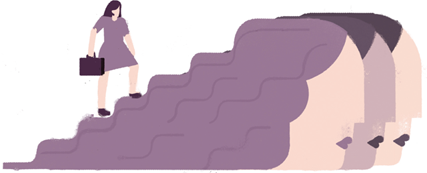
 (Illustration by Yarel Waszul)
Why can’t a woman be paid more like a man?
Popular career advice has tended to emphasize the need for women to be more forceful at work, especially when it comes to asking for raises. But learning to “lean in” on the job—as Sheryl Sandberg, COO of Facebook, urges in her bestselling book of that title—goes only so far. According to a study that covers data from 51 countries, the best strategy for achieving greater pay equity is likely to involve organized advocacy, union participation, and the formation of political alliances.
It’s a finding that will surprise some observers. “I don’t know if people think that activism really matters in terms of the pay gap,” says Maria Akchurin, a doctoral candidate in sociology at the University of Chicago. “But activism and collective action are absolutely crucial for making strides.”
Akchurin and her co-author, Cheol-Sung Lee, associate professor of sociology at the University of Chicago, drew data from the World Values Survey, the World Economic Forum’s Global Gender Gap Report, and other sources. They then conducted regression analyses to examine the connection between degrees of pay equity, on the one hand, and 13 social, economic, and political variables, on the other hand. They found that variables such as level of democratization, GDP per capita, and the presence of international women’s NGOs have no effect on wage equality. Instead, they discovered, the decisive factor is whether women engage in certain kinds of organizing.
Gender pay equity, according to the study, is higher in countries where the percentage of women who belong to feminist advocacy organizations and professional associations is higher. (In the United States, advocacy groups include the National Organization for Women, and professional groups include the National Association of Lawyers.) Wage equality is highest, though, in countries where women combine participation in advocacy organizations with membership in labor unions and progressive political parties. Organizing through all three of those channels, according to the researchers, enables women to bring issues like paid parental leave and child care into collective bargaining and into debates over government policy.
Scandinavian countries (Sweden, Denmark, Iceland, and Finland) rank highest in wage equality, with an average female-male pay ratio of 75 percent. That ranking corresponds to the strong traditions of women’s advocacy, unionization, and welfare-state-oriented political organizing that mark the region. Next come various Central and Eastern European nations, which have an average pay ratio of 62 percent. In those countries, women’s activism is relatively weak, but the legacy of state socialism has left in place a moderate level of pay equity. The next tier includes Canada, the United States, and various Western European countries; in those nations, the average pay ratio is 59 percent. The bottom tier consists of Middle Eastern and North African countries, where women on average earn 29 percent of what men earn.
Michael W. McCann, professor of political science at the University of Washington and author of a landmark book on pay equity, calls the study “smart” and “well defined.” He also notes that some of its findings contradict conventional wisdom. “This is strong evidence that women need to organize,” he says. “Today, much of the policy debate has gone in an individualistic direction. The study is answering the argument that says we need more competition and less government, and that the market is the solution.”
Still, the researchers don’t discount the value of either individual or collective action. “There are things you can do in your daily life,” says Akchurin, who cofounded an informal group for women in sociology at the University of Chicago. But “to say that [individual “leaning in” activity] makes collective action unnecessary is a mistake.”
Read more stories by Jessica Seigel.