


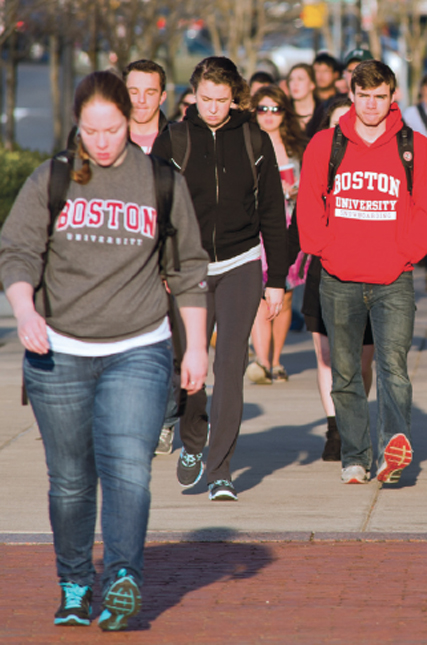
 Boston University students can soon get paid internships with local nonprofits. (Photo courtesy of Boston University)
In his four years as a health sciences major at Boston University (BU), Michael Parello (Class of 2015) has managed to squeeze in three internships. All were unpaid, which meant that he also had to hold down paying gigs. “I’m not the kind of student whose parents put money in my bank account every week,” he says. When he compared notes with classmates who could afford to spend their summers working as full-time, unpaid interns, Parello realized that he was missing out on some intangibles. “Other students were getting career advice, mentoring relationships, building that kind of capital,” he notes.
To provide better out-of-the-classroom opportunities for needy students and also bring youthful energy into Boston’s nonprofit sector, BU is launching the Yawkey Interns program. Funded by a $10 million endowment from the Yawkey Foundations—an organization established by the former longtime owners of the Boston Red Sox—the program will place up to 100 undergraduates annually in paid positions with Boston-area nonprofits.
“A lot of students would like to participate in an internship but need to be paid for it,” says Leslie Pohl, vice president of enrollment and student affairs at BU. “We also know that many of our students really want to change the world. The nonprofit space appeals to them. We wondered: How could we enable greater access to internship opportunities by taking some of the financial considerations off the table?”
The solution emerged from discussions between BU and Yawkey. “What these nonprofit organizations need, often, is more capacity,” says Maureen Bleday, executive vice president of programs and operations at Yawkey. “Our trustees saw a chance to help meet BU’s career development goals and also help the nonprofit community.”
The first Yawkey Internships will start this summer, and a more extensive rollout will take place in 2016. Recruiting, according to Pohl, will focus on students with need-based scholarships who want to get “practical, hands-on work experience where they’re applying their academic knowledge in the nonprofit space.” Students will need to invest effort in the program, she adds: “We’re not going to find internships for students.” Instead, prospective interns will have to enroll in a specially created non-credit class that helps them polish their career skills. “Part of this new course involves finding a quality position,” Pohl explains. “Then there’s the reflective piece, where [students] think about what they want to get out of the experience, what they have to contribute. This has to be more than a résumé builder.”
BU announced the program in September, and people from nonprofits began calling the university soon afterward. “Managing expectations is going to be part of this,” Pohl acknowledges. “Some internships turn out to be about answering the phone or doing ‘gofer’ work. Our obligation is to make sure our students are learning.” Bleday echoes that point: “Students will compete for these spots, and so will the nonprofits.”
One Boston nonprofit that already appreciates the value of paid interns is the Pan-Mass Challenge, a cycling event that raised $41 million for the Dana-Farber Cancer Institute in 2014. Planners for the event rely on as many as five paid college interns to expand their small staff during the busy summer months leading up to the ride. “We size up their skills and interests and then give them full responsibility for different projects,” says Bill Alfano, director of marketing and sponsorships for the Pan-Mass Challenge. Some students have an interest in event planning or sponsor recruitment. Others are eager to tackle logistics challenges. “It would be a waste to bring in someone really bright and have them get coffee for you,” Alfano says.
The Yawkey program is coming along too late for Parello, but he has insights to share with future applicants. “My best internship treated me as someone with a valuable perspective to offer. I had a seat at the table,” he says. “In my worst one, I sat at a desk with a stack of reports and never saw anybody. These experiences help steer you in the direction of what you want to do—and also what you don’t want to do. I’ve been able to cross a few things off my list.”
Read more stories by Suzie Boss.