


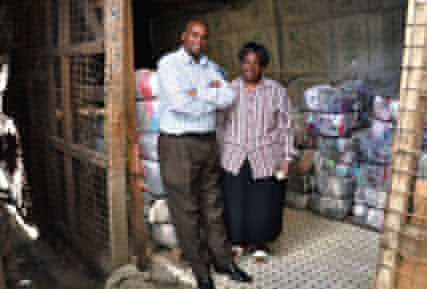
 Pius Ndegwa, a clothes
wholesaler in Nairobi,
received a bank loan after
taking the EFL test. Sales
tripled in 2011. (Photo courtesy of Entrepreneurial Finance Lab)
Pius Ndegwa, a clothes
wholesaler in Nairobi,
received a bank loan after
taking the EFL test. Sales
tripled in 2011. (Photo courtesy of Entrepreneurial Finance Lab)
Walk into the crowded Kariakoo market in Dar es Salaam, Tanzania, and you’re likely to see 25 traders in a row selling similar goods. If you’re a banker with money to loan to a small business, you naturally want to pick the one most likely to make repayments. But without formal credit histories to compare, says Dennis “DJ” DiDonna, chief operating officer of Entrepreneurial Finance Lab (EFL), “how can you tell which one has the grassroots skills to be successful?”
This mystery has hamstrung entrepreneurs who fall into the so-called “missing middle” of finance—too big for microfinance and too small to attract attention from most commercial lenders. To help banks assess risk of first-time borrowers in developing countries, EFL has devised a psychometric test that can be administered on-site at spots like Kariakoo, using a tablet computer or mobile phone.
After several years of academic research followed by trials around the globe, the test is now rolling out in a big way. Standard Bank, South Africa’s largest bank, has contracted to use the EFL test in 15 countries across sub-Saharan Africa during the next two years. That could unlock as much as $1 billion for borrowers “who wouldn’t have been lent to otherwise,” DiDonna says. Individual loans, which start at about $5,000, are typically short term and unsecured.
More pilots are under way in Mexico, South America, and Pakistan, with Southeast Asia the next likely market. Across these diverse cultures and contexts, EFL assesses a core set of traits to identify bankable entrepreneurs. “Business ideas are important, but what matters more is the person behind the idea,” says Colin Casey, emerging market analyst for EFL. “We look at the jockey, not the horse.”
To carry out its assessment, EFL has crafted a large pool of short-answer and multiple choice questions, deliberately written to prevent applicants from gaming the test. Scoring assesses two broad criteria. “Willingness to pay is about ethics and honesty. Ability to pay looks at optimism, drive, intelligence, and business skills,” says DiDonna.
There’s no magic wand preventing default, he cautions. Instead, the test provides data enabling lenders to assess risk, even when traditional credit information is lacking. EFL estimates that its test enables banks to cut default rates by an estimated 25 to 40 percent, compared with more traditional loan approval processes.
EFL began as an academic research project by Bailey Klinger and Asim Khwaja of Harvard Kennedy School’s Center for International Development. With early funding from Google.org, they were able to turn existing research on entrepreneurship into a psychometric test—similar to a pre-employment screening—that takes from 30 to 45 minutes to administer. DiDonna joined in 2010 to help spin off EFL Global as a for-profit enterprise, funded primarily by licensing the test to bank clients.
EFL is also attracting attention from nonprofits working to boost the fortunes of small- and medium-sized entrepreneurs as a development strategy. A winner in the G-20/Ashoka Finance Challenge competition in 2010, EFL has found interested partners in organizations such as TechnoServe, which trains entrepreneurs in the developing world.
Andrés Rico of TechnoServe says his organization has partnered with EFL in entrepreneurship development efforts in South America, Africa, Central America, and Mexico. In TechnoServe’s business plan competitions, the EFL test now accounts for 15 to 25 percent of the total score in the first round of entrepreneur selection. For example, Rico says the test has helped TechnoServe evaluate dairy farmers in northern Mexico “in an effort to understand their commitment and capability to fulfill financial obligations.”
Read more stories by Suzie Boss.