


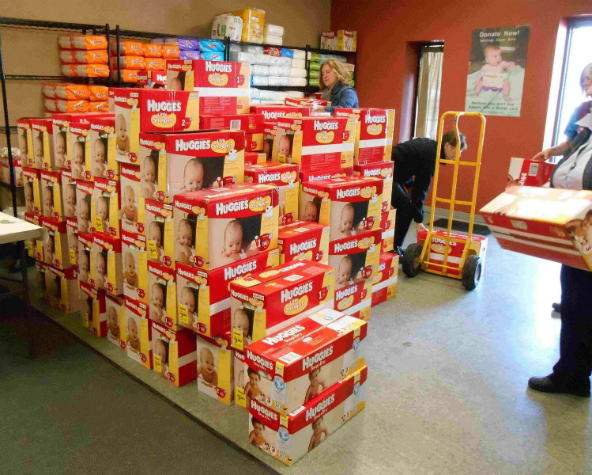
 Boxes of donated diapers arrive at Nestlings Diaper Bank, which serves western Michigan. (Photograph courtesy of Nestlings Diaper Bank)
A baby needs 3,000 diaper changes each year. But one third of parents in the United States struggle to afford diapers for their infants, according to studies by Yale University researchers and the Huggies diaper brand.
Addressing that need is the goal of the new Community Diaper Program, announced by President Obama on Mother’s Day this year. The partnership with diaper manufacturer First Quality and e-commerce startup Jet allows nonprofits to buy Cuties brand diapers for up to 25 percent less than the normal price, thanks to simpler packaging that holds more diapers and Jet’s efficient shipping system. The initiative also aims to raise awareness of the issue and encourage donations to diaper banks around the country.
That may not sound very glamorous. Generally speaking, “When we talk about poverty from a policy standpoint, we talk about the big picture,” says Joanne Samuel Goldblum, executive director of the National Diaper Bank Network, one of the main nonprofits benefiting from the program. “We shy away from the concrete realities.” But diaper expenses can take a real toll on families.
Unlike wealthy parents, poor ones often don’t have the means to buy diapers in bulk, so they end up paying much more over time. According to the White House, poorer families spend about $936 per child on diapers each year, or on average 14 percent of their income. “If a parent doesn’t have access to an adequate supply of diapers, they can’t drop their kids off at day care,” Goldblum says. “Diapers can be the difference between a mom or dad being able to work.”
The national effort to address the problem started when a White House staffer tweeted the idea to Jet’s corporate account. The e-commerce company responded positively, and the initiative quickly took shape. Since Obama’s announcement, scores of tweets using hashtags such as #diaperneed and #diapergap (referring to poor families’ unequal access to diapers) attest to heightened awareness of the problem.
“We sort of convened the thing, but it’s not running through a government program,” President Obama said at the popular tech conference South by Southwest in March. He held up the initiative, instead, as a successful collaboration with private sector groups. Still, “the White House has been able to really bring in industry partners that might not otherwise have known about the issue,” says Goldblum.
That’s especially important because federal programs like Medicaid don’t currently cover diaper costs. A bill before Congress proposes to fund states to provide hygiene products through the Temporary Assistance for Needy Families program. But for now, cross-sector partnerships like the Community Diaper Program are meeting the need more nimbly than national legislation.
The program is certainly helping out nonprofits. Take Bare Necessities, a member of the National Diaper Bank Network. Beth Serra Loud helped start the organization last November after a working mother asked her where she could get diapers for her 9-month-old daughter. As a registered nurse, Loud knew that emergency rooms often have to care for babies with urinary tract infections and sores because families don’t have enough clean diapers. In December, Bare Necessities began distributing diapers for just six babies. But the launch of the Community Diaper Program helped the organization scale up dramatically.
“It’s extremely simple. We put our first order in and we received our diapers in two days,” Loud says. “The average cost of a Cutie diaper is 13 cents. Before the Community Diaper Program, we were purchasing our diapers from Walmart for an average cost of 25 cents.” By June, Bare Necessities was distributing 9,000 diapers a month to 70 recipients.
Some local legislatures are making moves beyond the Community Diaper Program’s public-private effort. California recently exempted diapers from sales tax, potentially saving families with infants $100 a year, and instituted a $50-per-month diaper voucher program for low-income families. Last fall, San Francisco began the first municipal diaper subsidy in the United States, with the aim of serving up to 1,300 families monthly.
Still, the White House-supported initiative is bringing a new level of attention to the issue among policymakers, companies, and the social sector, says Matt Schneider, a New York City-based cofounder of City Dads Group, a meet-up and advice network for fathers. Schneider works to raise awareness about the diaper gap through the group’s Twitter account and a promotional partnership with Huggies. “Being led by dad-in-chief President Obama, it’s changing the conversation,” he says.
Read more stories by Jamie Stark.