


 A delegation of CHWs advocate for salaries, skills, and supplies in Liberia. (Photo courtesy of Community Health Impact Coalition)
Ten years ago, I (Sheringham) was going door-to-door, providing routine health checks, administering vaccinations, and managing cases of HIV, malaria, tuberculosis, and other debilitating diseases for residents of Mathare slum in Nairobi, Kenya. As I trekked across miles of dirt roads on foot, lugging a backpack full of supplies I had cobbled together, I wondered how much longer I could sustain this work without a steady paycheck. After all, I still had to care for my own family: my wife and three girls.
Fast-forward to 2022. I’m standing in the Kenyan Parliament shoulder-to-shoulder with 62 other community health workers (CHWs) from our Kenyan advocacy association, speaking to decision-makers in one unified voice with a clear demand: Pay us for our labor.

It worked: In 2023, Kenya announced it would provide monthly stipends, essential equipment, digital monitoring tools, and health insurance to me and 100,000 of my peers—a huge win for Kenya, one of the most populated and influential African countries, as well as for the global effort to formally recognize CHWs.
Getting to this pivotal moment in Kenya took years of effort: Our Kenyan association, as part of Community Health Impact Coalition (CHIC)’s global network, built power in communities, helped establish the evidence demonstrating the life-saving impact of well-supported CHWs, shared learnings across continents, and—together with others around the world—wrangled the global financing apparatus to make adoption feasible. In other words: collective action.
But there’s more to do. Most of the nearly 5 million CHWs around the world—with heavy concentrations in the Global South—remain unpaid for their critical work to bolster and extend the reach of health systems.
My peers and I in the CHIC network—along with many other social innovators and supporters like the Skoll Foundation—have been driving toward systemic change on this issue, from different angles, for decades. Together, we’re offering this case study to shed light on how innovative leaders are collaboratively building resilient health systems that can respond to future challenges—from pandemics to climate-related disasters—while expanding primary care access for all. Our goal is to provide tangible steps and lessons that other leaders might learn from and adapt to their own contexts.
A Proven Way to Strengthen Community Wellness
Community health as a model has existed in various forms for more than a century, ebbing and flowing with political shifts and gaining ground during health crises. Pioneering civil society organizations and social entrepreneurs (such as Skoll Foundation partners Muso and Living Goods, among others) have proved CHWs’ efficacy, particularly in reducing maternal and child mortality and responding to disease outbreaks. For example, CHWs played an integral role in reducing child mortality by a remarkable 63 percent in Mali. And, in many places, CHWs were responsible for mitigating the worst impacts of the COVID pandemic.
Despite their critical role, most countries do not formally recognize CHWs as part of their national health systems, and until recently, there were no guidelines from global institutions for how to do so. Yet research clearly shows that when CHWs are treated like the professionals they really are—that is, when they are salaried, skilled, supported, and supervised—they can reliably achieve these outstanding outcomes.
Thus, the movement’s focus now is on supporting country governments to fully integrate these vital health workers into their national health care systems, including assuming financial responsibility for their livelihoods. This means providing a regular wage and benefits, ongoing training, dedicated supervisors, and adequate supplies.
And we’re seeing momentum: Forty-four countries—and counting—now provide salaries and accreditation programs to professional CHWs, including Ethiopia, Liberia, Burkina Faso, South Africa, and Belize. Such progress not only improves health care delivery but also addresses broader global challenges. Professionalizing CHWs advances gender justice and labor rights, as 70 percent of the world’s CHWs are women and about 86 percent are currently unpaid. Moreover, as climate change intensifies, CHWs play a crucial role in combating the health impact of vector-borne illnesses, novel pathogens, natural disasters, and extreme heat.
Enabling Factors for Collective Action
A diverse coalition of stakeholders is working in concert to scale the professional community health worker (proCHW) movement. CHW leaders, social innovators, philanthropy, and other civil society actors are partnering with governments to ensure proCHWs are enshrined in national health policy. The coalition is conducting and sharing research with multilateral institutions to secure global guidelines and establish coordinated, robust financing streams. CHWs are uniting globally to achieve greater recognition. And, the movement is using improved evaluation and storytelling methods to increase support for this solution.
Here’s how the components in this collective action playbook came together:
Innovators joined forces to launch CHIC as a platform for collective action. Over the past two decades of supporting innovators of many stripes, the Skoll Foundation has been interested in learning what sets the boldest, most enduring solutions apart from the rest. Skoll has observed that successful social movements often share a “special sauce” that elevates their effectiveness: a system orchestrator.
 Margaret Odera, a community health worker and educator, speaks to a group of CHW advocates in Kenya. (Photo courtesy of Community Health Impact Coalition)
CHIC has emerged as a pivotal system orchestrator for the proCHW movement. Connecting dots among disparate actors, from funders to ministries of health, and coordinating efforts across and within sectors—government, civil society, philanthropy, and social entrepreneurs—CHIC channels resources to where they are most needed and marshals support for shared goals.
A global coalition of thousands of CHWs and aligned health organizations from 60+ countries, CHIC was born in a moment when authentic commitment among leading social entrepreneurs triumphed over competition. While they could have been deterred by the need to jostle for the same funding to support their own operations, several organizations instead joined forces in 2019 to address structural barriers standing in the way of community health reaching greater scale. The coalition’s founding members are Partners in Health, Living Goods, Last Mile Health, Muso, Possible, and Integrate Health.
Working at both the grassroots and grasstops, CHIC deploys its collective muscle to address the failures within the global health system that allow CHWs to remain unpaid and leave patients without health care. To tackle this, CHIC combines research to identify best practices with comprehensive advocacy and community-based power-building to alter the day-to-day experience for CHWs and their patients. By equipping governments with evidence-based guidelines, transition funding, and demonstrated public support, CHIC enables policy makers to confidently invest in proCHWs.
The movement emphasizes power-building for proximate leaders, with CHWs leading the way. In this field, community health workers themselves are the crucial agents of change. To support this, CHIC developed a free training program called CHW Advocates that equips health workers with advocacy and storytelling skills. The program, which Sheringham completed and 12,000 of his peers have begun, enables CHWs themselves to demand solutions to issues impacting the profession and their patients. Equipped with advocacy skills and now part of a global movement, CHWs are forming national associations, like the one in Kenya, to carry the advocacy work forward at national and regional levels.
A powerful tactic for social movements throughout history has been ensuring that those directly affected by policies lead their own advocacy efforts. This has been a core element of the proCHW movement.
In fact, the CHW coalition’s rallying cry is: Nothing about us without us.
A unified, authentic CHW voice not only influences policy more effectively in the short term, it also helps ensure continuity. Powerful local associations are a permanent constituency to whom governments must remain responsive, which helps to preserve wins and guard against policy rollbacks even when administrations change.
Ultimately, proCHW models can’t be sustained without country-level ownership, so the goal has always been for country governments to sustain these programs long-term. CHIC and its partners therefore support governments to establish policies and long-term plans to invest in CHWs. The lesson? Community health workers, and their social innovator partners, may be the ones doing the legwork, but they understand there’s no room for ego: It’s about doing the research, building the solution, and sharing the learnings to drive uptake of best practices far and wide, without concern for who gets the credit.
Coalitions used data-driven advocacy to secure global proCHW guidelines. One of the movement’s first critical steps was distilling a century of practitioner expertise into evidence-based guidelines for effective community health programs. This research and advocacy work resulted in the World Health Organization publishing its first-ever guidelines about CHWs, which shape policies in 194 countries—a monumental win. CHIC also helped secure landmark CHW policy changes at the Africa Centers for Disease Control, as well as major global health financing institutions: the Global Fund to Fight AIDS, Tuberculosis and Malaria; the US President’s Emergency Plan for AIDS Relief (PEPFAR); and the President’s Malaria Initiative (PMI).
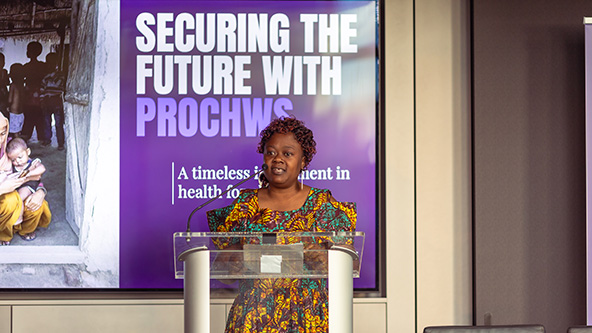 Margaret Odera, a community health worker and educator, speaks at a Community Health Impact Coalition side event during UNGA 2024. (Photo courtesy of Community Health Impact Coalition)
For example, the Global Fund codified its explicit intention to track the percentage of CHWs who are salaried, supplied, and regularly supervised in the 126 countries to which it provides funding. This is a notable shift from focusing primarily on short-term outputs, like the number of medications provided, to monitoring longer-term, more systemic outcomes. It also signals to other institutions the importance of examining not just what was achieved, but how it was achieved and whether systems are in place—like professional CHWs—to continue achieving positive outcomes over time.
These successes provide a clear lesson: Stories may win hearts, but clear, unbiased data wins minds. Investing in research and evidence dissemination is paramount for progress in any field. We at CHIC know that rigorous research is essential because patients deserve evidence-based health systems, not just good intentions. Testing and validating approaches ensures communities receive proven, effective care.
Allies aligned and leveraged global investments. Perhaps the greatest barrier to the professionalization movement is insufficient, fragmented funding. Recognizing that countries need substantial startup resources to transition to a system in which salaries, supplies, supervision, and training are provided for CHWs, stakeholders developed innovative financing pathways that leverage private capital, unlock global funds, and position governments to invest in and lead their health systems.
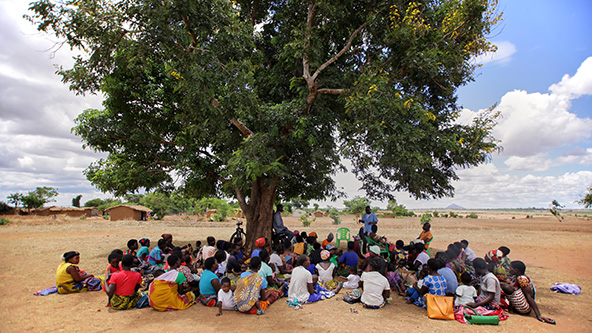 A CHW conducts a community engagement session in Malawi. (Photo courtesy of Community Health Impact Coalition)
Africa Frontline First (AFF), a collaborative to transform health financing in support of Africa’s CHWs, exemplifies this approach. After the COVID-19 pandemic, CHIC, the Financing Alliance for Health, and Last Mile Health came together to launch the initiative, which then joined forces with the Global Fund, the Johnson & Johnson Foundation, and the Skoll Foundation to create the Africa Frontline First Catalytic Fund (AFF-CF). The fund mobilized $100 million in catalytic seed funding, including contributions from philanthropy as well as a one-to-one match from the Global Fund, to support 220,000 CHWs who care for about 146 million people in eight African countries.
Perhaps even more powerful is the domestic funding this initiative helps to mobilize: Crucially, this initiative unlocked full country match funding in all participating nations, setting them on a path to sustainably finance and support CHWs at scale.
These examples illustrate the power of building seemingly unconventional partnerships, with each party ceding some level of control to catalyze and unlock the power of the collective. And, as recent news of scaled-back government and multilateral resources shows, the need for innovative financing structures and collective financing approaches has never been greater. By breaking down silos and aligning diverse stakeholders in powerful collaborations, the proCHW movement has created a replicable approach for mobilizing resources for policy transition and driving systemic change in global health financing. While we are proud of what AFF-CF has accomplished thus far, much more financing is needed to support proCHWs globally.
Innovators refreshed their evaluation and learning methods to tell better stories about systems change. As a sector, it has been exceedingly difficult to measure systems change via traditional monitoring and evaluation practices, which favor attribution rather than the many contributions that add up to transformation. As a step in the right direction, CHIC has developed a public-facing dashboard on proCHW policies. The dashboard tracks which countries have community health policies expiring within 18 months, highlighting crucial policy windows so the movement can concentrate funding and advocacy resources in those areas. In so doing, the tool serves as both a simple scorecard for the movement’s progress as well as a strategic plan.
The dashboard’s ability to simply visualize complex data enhances advocates’ storytelling efforts, offering an effective model of open-source monitoring and evaluation for those across the social sector seeking to demonstrate impact and guide future efforts.
Philanthropy Can Double-Down on Supporting ProCHWs
Despite recent momentum in community health, some philanthropies are growing impatient with the long timeline to impact, and many countries are signaling a decline in overall global health funding. With looming threats of disease outbreaks, from mpox to bird flu, and a projected shortfall of 10 million health workers by 2030 worldwide, now is the time for philanthropy to keep its foot on the gas pedal.
Multiple studies have confirmed that CHWs reduce the impact and death toll of outbreaks. The world learned the hard way during the COVID pandemic that you can’t build trust within a health system during a crisis; we must build those relationships now before the next pandemic or climate disaster.
While government must be the long-term payer for proCHW programs, there are several catalytic roles for funders and their partners in the social, private, and public sectors to play.
- Invest in collective action. Philanthropy can resource the critical work of coalition-building, system orchestration, and radical collaboration across continents. The Bridgespan Group found that funding movement-building at this altitude is one of the most catalytic investments philanthropy can make. While CHIC is one example, another option is to simply provide unrestricted, multi-year funding to existing partners to support field-building work.
- Support systems-level financing. The Africa Frontline First Catalytic Fund demonstrated how philanthropic and private-sector funding can serve as a much-needed incentive for institutional funders and governments to come to the table. Contributions to AFF continue to punch above their weight, as the initiative aligns disparate pools of funding and channels them in support of a shared, streamlined plan for community health. With declining global resources for development, there’s an opportunity for all funders—from smaller family foundations to large institutional foundations, country governments to global financing bodies—to align their capital to transform systems for the better.
- Back frontline innovators. Philanthropy can provide much-needed support to high-performing innovators around the world who are holding the torch and demonstrating what is possible while translating local learnings globally. These exemplars include the more than 30 members of CHIC, which are incredibly worthwhile, high-impact investments, particularly for funders with less flexibility or a specific country or regional focus. We suggest supporting organizations with strong local leadership and buy-in, a sharp focus on impact and learning, and a scalable model with strong government partnership.
- Fund grassroots advocacy. Funders can support grassroots advocacy associations of CHWs, like the one in Kenya featured in this article. These groups are incredibly lean and play a direct role in enacting reform at the country level by engaging with governments, influencing the policies that govern whether millions of CHWs can sustain their livelihoods and whether billions of people receive primary health care.
In an increasingly interconnected world, each of us is better off when health care professionals can efficiently deliver lifesaving treatments and limit the spread of disease outbreaks. If we can marshal the right resources at the right time, the next pandemic or climate emergency might just be addressed by well-trained, well-paid, and well-supported community health workers checking on their neighbors and providing care—one knock on the door at a time.
This short film, a collaboration between Freethink and the Skoll Foundation, highlights the incredible power of CHWs to save lives and explores the movement to scale this transformative model.
Read more stories by Sheringham Odhiambo, Madeleine Ballard, Ben Pyne & Kathryn Harrison.