


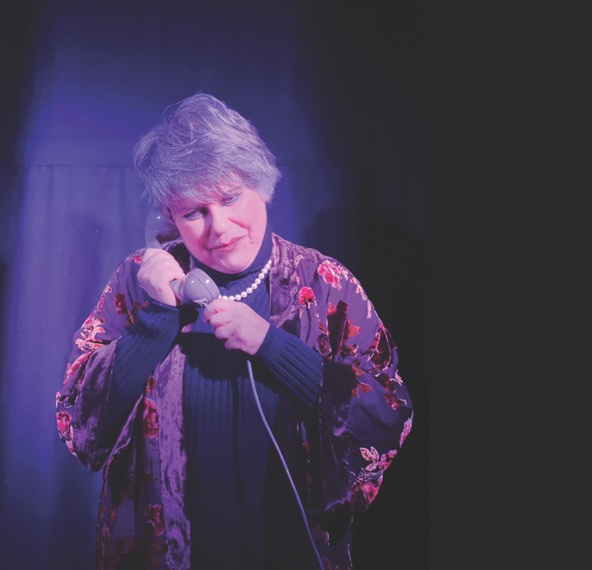
 A Foyer ’97 actress performs in the Teatro Edicola under sophisticated stage lighting. (Photo by Luciano Magaldi Sardella)
On the morning of March 27, 2026—World Theatre Day—something unusual happened in the Piazza Municipio of San Severo, a midsized town in Italy’s southern Puglia region. A rusted iron newsstand that had sat empty for years, its metal shutters faded by sun and neglect, opened its window to reveal not newspapers or cigarettes, but a performer. Six chairs had been squeezed inside. Every 15 minutes, a new audience entered and took their seats.
The Teatro Edicola (“Newsstand Theater”) had opened for business.
Francesco Gravino, artistic director of the Foyer ’97 Teatro, a nonprofit theater company he has led in San Severo for nearly three decades, is not someone who typically thinks small. Over the years, Foyer ’97 has mounted ambitious productions, cultivated local audiences, and navigated the perpetual resource constraints that characterize the performing arts across Southern Italy, where public funding for the arts is limited and populations skew older and more dispersed.
But when Gravino looked at the abandoned newsstand in the town center, he saw something different from what most people see in a derelict kiosk in a provincial square. He saw a provocation.
“A newsstand used to be the place where people stopped every morning to connect with the world,” he says. “It was the original social medium—physical, local, and democratic. The disappearance of these newsstands disrupts the urban fabric.” He wanted to ask, “What if the next thing you find there is a story, told live, just for you?”
What followed was a months-long process of negotiations with the local municipality, structural modifications to the kiosk, script development tailored to the format’s radical constraints, and logistical choreography worthy of a production in its own right. The result—officially recognized as the world’s smallest theater by dimensions and seating capacity—is a structure measuring just four square meters, with a performing area of less than two. Its inaugural season ran for only three days. Every performance sold out.
Creative Use of Space
Across Italy and much of Western Europe, performing-arts organizations face the same compound pressures that arts-philanthropy leader Diane Ragsdale identified in the United States over a decade ago: declining attendance, rapidly aging audiences, eroding public investment, and a growing cultural distance between institutional theater and the communities it is meant to serve.
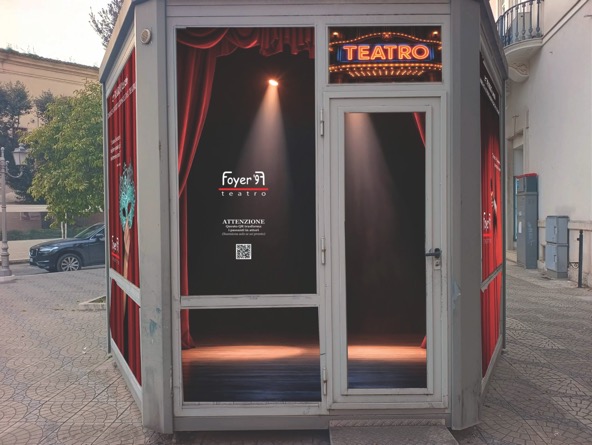 The Teatro Edicola is a converted public kiosk that sits on Via Matteo Tondi in the central piazza of San Severino. (Photo by Luciano Magaldi Sardella)
In Southern Italy, these dynamics take on additional texture. Municipalities like San Severo—population roughly 50,000, historically dependent on agriculture, and marked by limited economic diversification—retain rich theatrical and folk traditions, often undervalued. But their physical and social infrastructures, including squares, markets, and former commercial spaces, have been hollowed out by the same digital and demographic forces reshaping cities everywhere.
“People in small towns often feel that real theater, real art, happens somewhere else,” Gravino says. “In Rome. In a big venue. For educated people. The Teatro Edicola turns that logic upside down. The theater comes to the street where you walk every day. You can’t feel like a stranger in a place you pass every morning.”
Teatro Edicola is not primarily a statement about smallness for its own sake, but a hypothesis about proximity, intimacy, and access as drivers of cultural participation.
In a conventional theater, the distance between performer and audience is architectural, social, and psychological. Ticket prices signal who belongs. Even when no longer formally enforced, dress codes and etiquette leave residual forms of exclusion. The anonymity of the darkened hall renders the encounter with art structurally impersonal.
In a six-seat newsstand, none of these dynamics are possible. There is nowhere to hide—for performer or spectator. Actor and audience share the same air. Eye contact is unavoidable. The experience is, by its very structure, relational rather than transactional.
This is not accidental. Francesco Gravino and his team made deliberate dramaturgical choices: Short-form pieces range from five to 12 minutes, designed as concentrated emotional encounters rather than extended narrative arcs. Scripts are written specifically for the space, prioritizing presence over spectacle. A 15-minute rotation means that on a single afternoon, more than 60 people can experience the same work, often more than many small-theater performances reach in a week. Asked what the minimum spatial requirement is for a genuine theatrical experience, Gravino’s reply was, “Less than you think.”
Beyond the artistic experiment, Teatro Edicola represents a potentially replicable model of creative urban regeneration that is strikingly low-cost and high-impact, relative to more capital-intensive approaches. Across Italian and European cities, thousands of small commercial structures—newspaper kiosks, tobacco shops, phone booths—have been left vacant by the decline of print media, the digitization of retail, and the erosion of physical social infrastructure. Many municipalities have responded with efforts to repurpose these spaces, often for artisanal businesses or civic services. The performing arts, however, with their minimal infrastructural demands and flexible tenancy requirements, remain an underutilized option.
Teatro Edicola required only a modest municipal permit, a temporary concession on the kiosk, basic structural modifications, and the artistic capacity of a company already embedded in the community. The pilot cost less than $3,000. Yet on World Theatre Day, it reached more than 60 direct spectators, exposed hundreds of passersby to live performance, and generated national media coverage that carried San Severo’s cultural initiative well beyond Puglia.
“We are not trying to replace big theaters,” Gravino says. “We are trying to reach people who would never walk into a theater. That is a different mission, and it requires a different space.”
Challenges and Lessons
The theater experiment, while showing promise, faces significant challenges in scaling. The first is sustainability: A single-day activation, however successful, does not constitute a program. Foyer ’97 is currently in discussions with the municipality of San Severo about a longer-term concession that would allow for seasonal programming—weekends from spring through autumn, potentially with a rotating roster of local and regional companies. The emerging economic model involves a hybrid of municipal support, modest ticket revenue (proposed at €5 [$5.80 US] per person), and small private sponsorships from local businesses.
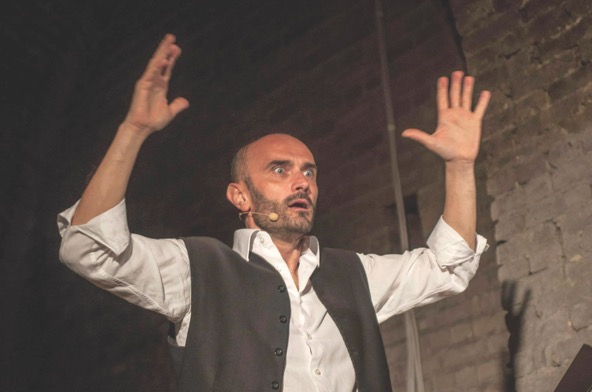 Francesco Gravino, artistic director of the Foyer ’97 Teatro, commands the stage. (Photo by Luciano Magaldi Sardella)
The second challenge is replication without dilution. Teatro Edicola works in part because of the deep local roots of Foyer ’97 and the specific urban texture of San Severo’s historic center. Transplanting the concept to other cities or disused structures would require not just a physical kit but a community-building process that is harder to export than a design.
“The newsstand is not just a box,” Gravino says. “It is a relationship between a company and a neighborhood. Without that, it is just a box.”
The third challenge is institutional recognition: In a national cultural funding landscape where grants are typically allocated to organizations with established venues, stable programming, and predictable output metrics, a project that is explicitly experimental, hyper-local, and deliberately impermanent is difficult to assess—and therefore difficult to fund. Italy’s Ministry of Culture distributes a significant share (more than 10 percent) of performing-arts support through the FNSV (Fondo Nazionale per lo Spettacolo dal Vivo), relying on criteria that can systematically disadvantage micro-initiatives. Gravino and others in the Italian small-theater ecosystem are increasingly calling for differentiated funding instruments capable of recognizing impact at a smaller community scale. Teatro Edicola may be a made-in-Puglia story, rooted in the social geography, cultural history, and urban morphology of a particular Southern Italian town. Nevertheless, its core insights travel well beyond San Severo’s piazza.
In any community where cultural institutions struggle to reach younger, more diverse, or economically marginalized audiences, the lesson of proximity applies: Meet people where they already are, in the spaces they already inhabit. Municipalities wrestling with the social costs of abandoned commercial infrastructure must take into account that the cost of cultural activation is often lower than the cost of continued neglect.
And in organizations navigating the tension between artistic ambition and democratic access, the lesson of constraint as creative force is clear. The limitations of the newsstand do not diminish the theatrical experience—they intensify it.
“We called it an edicola [newsstand],” Gravino says, “because a newsstand is where you stop for a moment, pick up something you didn’t expect to read, and carry it with you through the rest of the day. That is exactly what we want theater to do.”
In a field urgently searching for new formats, new audiences, and new reasons for people to show up, that may be the most practical insight a six-seat kiosk in Southern Italy has to offer.
Read more stories by Luciano Magaldi Sardella.