


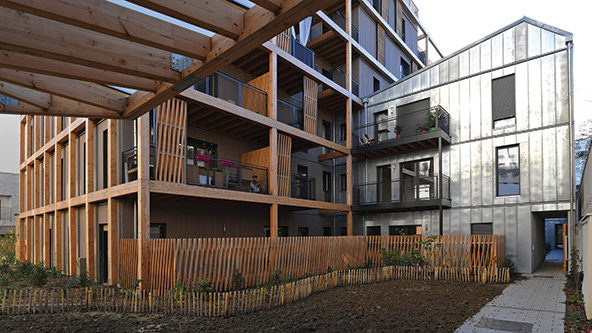
 Paris’ city housing conversion has resulted in a former outdoor garage being transformed into 149 housing units, at a cost of £24 million and opened in 2021. (Photo courtesy of Jean-Jaures 2022 Paris Habitat/Frédéric Achdou)
For most Parisians, buying an apartment has become almost impossible. To acquire a property in the City of Light, a first-time buyer needs to earn roughly £97,500 ($106,000) per year—more than double the average annual salary of a white-collar worker—and have the 10 percent down payment to qualify for a mortgage.
It is unsurprising, then, that approximately 10,000 people leave Paris each year because they can no longer afford to live there. Paris is the fourth most population-dense city in the European Union, so it has little space to build more housing.
Housing conversion has become an increasingly popular approach to the housing shortage in the French capital, garnering support from public-housing companies and local politicians alike, including Paris mayor Anne Hidalgo. Since the Institut Paris Région began registering conversion projects in 2013, every year empty nonresidential buildings are turned into a quarter of the city’s new housing units.
Now a decade in, the once emerging trend has become a revolution. “We’re living in a sort of golden age of social housing,” says Stéphanie Jankel, an urbanist at Apur, a nonprofit Parisian urban-planning workshop.
Yet as with any revolution, the effort has come with challenges, particularly that of design.
“We can’t plan just as we like; there’s a lot of technical work beforehand to find out how many units we can produce,” says Hélène Schwoerer, deputy general director of project management at Paris Habitat, a social-housing company that has managed the city’s public-housing conversions for more than a decade.
“If a garage is deep, we need to know how much floor space to keep as living space and how much floor space to have for common use, so as not to weigh too heavily on the tenants,” she explains.
The housing-conversion process varies according to ownership and zoning laws but always entails a collaboration between the government and private entities. For example, if the city owns a building it has identified for conversion, it will commission a company like Paris Habitat directly to oversee the conversion process. If the city does not own the building, it will mandate the conversion work, and then companies can apply for the commission.
Landlords present another challenge, since they prefer to lease their properties as commercial offices rather than as residences, and the city government has no power to force landlords of commercial or nonresidential property to sell or rent to companies that convert properties into housing. Only the national government has the authority to regulate real estate, but it does not have the power to force an owner to sell an empty building. In 2020, Apur estimated that 128,000 of Paris’ housing units had been empty for more than two years.
Expenses of money and time present additional challenges. According to companies that manage housing conversion, it’s more expensive to convert a building than to construct one from scratch. For Paris to meet its target of making 40 percent of its housing affordable to low-income residents, it provides financial assistance to housing companies of up to £2,500 per 2 meters ($3,215 per 6.6 feet) of floor space. In the northeastern section of Paris, Caserne de Reuilly—military barracks dating back to 1847—was turned into a multiuse complex, including rental accommodation for middle-class and low-income families, a kindergarten school, and a medical practice.
“When you build a city, you don’t build it for 5, 10, or 15 years—the cost and payback take decades,” Jankel says.
After years of experimentation, local public authorities have honed the building-conversion process and are now seeking to shorten the time between design, construction, and conversion to more quickly recover costs. Their expertise has shaped the buildings under construction for the 2024 Olympic Games on the outskirts of Paris. They were designed not only to accommodate tens of thousands of athletes and journalists but also to be rapidly transformed into housing, offices, and even a university dormitory by the end of the year.
It remains to be seen whether this ambitious project will meet its objective, however, given that it is already behind schedule for its first use.
Read more stories by Chloé Rouveyrolles.