


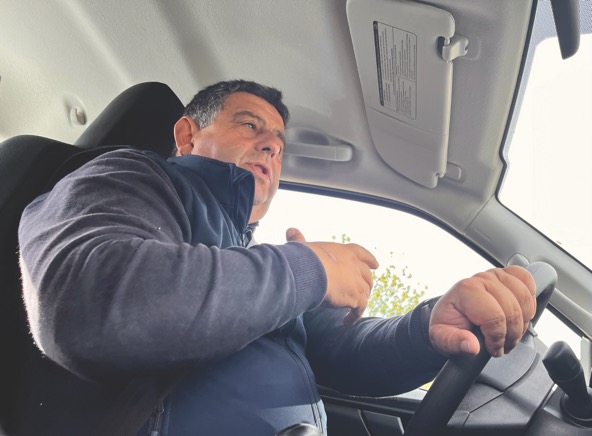
 Pedro Fians, agricultural technician and cheesemaking trainer, drives a truck to municipal grazing land. (Photo by David A. Taylor)
Fundão’s narrow streets feel ancient. For decades, this small city of 27,000 people in central Portugal has experienced a gradual decline. Since 1960, its population has nearly halved as residents left for larger cities in search of work, a pattern reflecting broader national trends. Between 2010 and 2020, Portugal’s population fell from roughly 10.6 million to 10.4 million, marking the first significant downturn since the country’s transition from authoritarian rule in the 1970s.
Fundão, however, has charted a different course. At the city’s migration center on the outskirts of town, director Filipa Batista described how local officials reimagined migration: not as a burden but as part of a broader strategy to rehabilitate abandoned farmland. This shift has been accompanied by investment in land-management infrastructure. Left untended, these lands have heightened the risk of wildfire, a danger intensified by the extreme weather of recent years.
Batista once followed the migration trajectory she now helps oversee. She grew up in Fundão, then left for university, followed by work in Lisbon and two years in Barcelona. She was drawn back to her hometown to help lead the migration center alongside Fundão’s longtime mayor, Paulo Fernandes.
Fernandes, 54, has been a progressive force in local politics since entering public life in 2002. Before joining the city council, he cofounded an association of forestry producers focused on integrated development. “Increasingly, issues are decided on multiple scales: local, regional, national, European, and global,” he says. His background in international relations has reinforced his conviction that effective policy must be rooted in the specificities of place. In Fundão, he has championed fair pricing for farmers in the region’s cherry-growing sector and advocated for treating immigration as a central component of the city’s future.
In 2016, Fundão began engaging both seasonal workers and local residents around the premise that sustaining the city’s renowned cherry production—responsible for half of Portugal’s stone-fruit harvest—required not only high agricultural output but also fair labor practices and educational opportunities. To that end, an agricultural association partnered with local officials to develop and implement best practices.
Two years later, in 2018, the city expanded this approach in response to a humanitarian crisis at sea. That summer, the Aquarius, a search-and-rescue ship operated by SOS MEDITERRANEE and Doctors Without Borders, rescued 629 migrants in Mediterranean waters but was denied entry by Italy and Malta. Spain ultimately allowed the ship to dock, and Portugal offered to receive several dozen of those on board. That same year, the International Organization for Migration documented more than 2,000 migrant deaths along Mediterranean routes to Europe.
In an unusual step, Fundão went further, entering into a bilateral agreement with Lampedusa, Italy, a major arrival point for migrants to Europe. Fundão became one of the first cities in Portugal to join the Lampedusa Charter, a local initiative advocating for refugees’ “right to move” and the decriminalization of migration. The city also established a migration center on the former campus of the Seminário Menor do Fundão, a Catholic institution that closed in 2014. The site can accommodate up to 230 short-term residents and serves as a hub for integration into the local community. As the mayor put it, anyone who comes to Fundão becomes a Fundanense—a local.
A Bridge for Migrants
Portuguese media described Fundão’s agreement with Lampedusa as a bridge between the “door of Europe” and the “heart of the interior.” In this framing, migration was a process shared by both ends of that bridge. Italian coverage cast the initiative as a potential pilot for Europe more broadly, noting Fundão’s rare willingness to depart from the prevailing “fortress Europe” rhetoric.
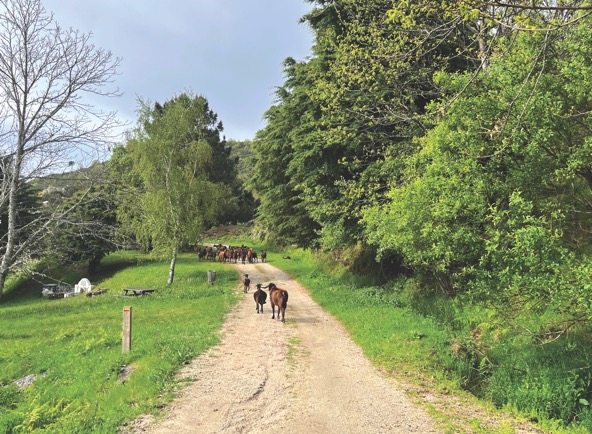 A herd of municipal goats make their way to graze. (Photo by David A. Taylor)
Under the agreement, Fundão officials visited Lampedusa to study first-response techniques, while their counterparts traveled to Fundão to examine its model for long-term integration. From 2018 to 2025, the program welcomed refugees from more than 70 countries, helping them secure housing, employment, skills training, and the documentation needed to participate in what officials describe as a “healthy ecosystem.” By late 2025, Fundão had assisted some 4,000 people, or nearly 20 percent of the city’s population.
In May 2025, Batista showed me around the center, which at the time was hosting a dozen recent arrivals. I asked whether locals had expressed any resistance. “No, people accept it,” she replied. “We need people.” As an example, she pointed to the local retirement facility: Of the entire night-shift staff, only one worker was Portuguese. “They have nurses, doctors, and social workers all from other nationalities,” she said. “We need them.”
The welcome services were comprehensive. A program called “Welcome to School!” helped new families settle in and their children adapt to school. Managed by the Psychology and Guidance Service (SPO), it aimed to strengthen social and interpersonal skills, reducing isolation and encouraging active participation. The Ministry of Education recognized the program as a best practice for schools nationwide, Batista told me, and incorporated it into the Portugal Social Innovation network, a government initiative for promoting social innovation nationwide.
Another initiative trains city workers who interact with new arrivals across social and financial services, education, and health care. Even if you speak only Portuguese but want to help migrants, she said, “we have a process.” Launched in 2024, the certificate course—offered in partnership with a nearby university—provides legal information and ready-to-use translation tools. Part of a two-year regional pilot program, it had trained some 200 public servants by early 2026. Alumni went on to create a WhatsApp network to support officials across 20 municipalities from southern to northern Portugal. “Every day we connect with one another,” she said. “Imagine someone in Algarve asking for help from someone in Porto.”
Wireless Land Connections
On the outskirts of Fundão, in front of the seminary-turned-migration-center, rows of cherries climb along arbors. Pedro Fians, a local agrotech advisor, highlighted them. “We’re the biggest producer of cherries in the country,” he said, “so we wanted to plant cherries here because of their importance.” The site also demonstrates sensing equipment used to monitor pests and plant health.
Although the cherries are a source of local pride, they remain threatened by the shortage of farmworkers and accelerating climate change.
Sara Otero, a rural program officer for international philanthropy Aga Khan Foundation, pointed to the scale of Portugal’s rural challenges. Sketching a quick map, she indicated the country’s midsection, a long, sparsely populated stretch from north to south. “We’ve lost 60 percent of the people in this section,” she said of recent decades. The result is a patchwork of abandoned land and fragmented ownership records. Unmanaged wooded areas accumulate undergrowth that becomes fuel for fires. With climate change, only a few more dry, hot days per year are enough to raise the risk of uncontrollable blazes.
Previous Aga Khan Foundation programs in Portugal helped migrant communities access early-childhood education and health services, laying the groundwork for an approach to reinvigorating rural areas that centers people rather than land, Otero said. By expanding access to these services, the program encourages newcomers to embrace rural life.
Fundão has paired this people-centered approach with investments in technology and land management. Fians described one initiative as “an open Wi-Fi network for everyone in the municipality.” The Long Range (LoRa) network provides reliable, low-power connectivity across 700 square kilometers. While it isn’t designed for data-heavy uses such as sharing images, it effectively links users to sensors and irrigation systems scattered across the mountainous terrain.
The Wi-Fi network also supports livestock management. Fians held up a green collar designed to rest lightly on a goat’s neck. “These are all connected to the local Wi-Fi for sheep and goats, instead of shepherds having to pay the phone company,” he explained. The collars collect health information and track grazing intake, giving farmers real-time data on their animals.
As we climbed a steep mountainside to the municipal pasture in his pickup, Fians described the cheesemaker training program. Fundão partnered with Aga Khan Foundation to reinvigorate local shepherding traditions while introducing updated skills in range management, techniques, and business. Prize-winning local cheeses, such as Castelo Branco, made from a mix of sheep and goat milk, have held protected status since 1996. The training program aims to attract new energy from migrants and recent graduates. Otero calls it Cheesemaker 4.0, a name that sounds more like a startup than a rural skills initiative.
With a European Union grant, the Transforming the Landscape program has helped managers break up monocultures of pine plantations by interplanting vineyards, strawberry fields, and olive trees. Because fires spread quickly through uniform crops, these mixed plantings act as natural “speed bumps,” slowing the advance of wildfires.
At the top of the mountain, Fians introduced me to members of the municipal goat herd and their herding dog. When the first group of Cheesemaker trainees completed the two-month course that summer, each of the half-dozen graduates received several goats to get started.
Fernandes left the mayor’s office that fall, having reached the statutory term limit, though his party still won the election. But the backlash against immigration across Europe has also touched Portugal. In January 2026, Batista reported that the Lampedusa protocol “is no longer in force,” since Portugal had opted to “contribute financially rather than relocate asylum seekers” under the EU Pact on Migration and Asylum. Through a “solidarity” mechanism for member states to share the burden, Portugal would pay €8.44 million ($9.71 million) instead of taking in 420 asylum seekers.
That fall, extreme weather battered the region, triggering dangerous wildfires, followed by severe flooding in December. Batista messaged me that the migration center was serving meals, providing beds, and supporting those displaced.
After a decade, Otero sees Fundão’s dual approach to migration and land management as a model for national and international responses to climate change. The community represents a microcosm of southern Europe, grappling with these issues in new ways.
“This is so important,” Otero insists. “Together we know we can do this, and it can spread farther in the world.”
Read more stories by David A. Taylor.