


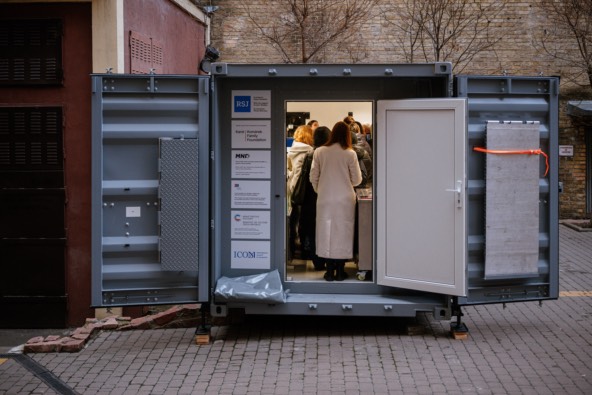
 The Ark I mobile preservation unit arrives at the Yaroslav Mudryi National Library of Ukraine in Kyiv to preserve books and documents damaged during the war. (Photo by Jan Hromádko)
On January 27, 2025, the Ark I mobile preservation unit—a high-tech solution for restoring war-damaged documents and books—rolled into the parking lot of the Yaroslav Mudryi National Library of Ukraine in Kyiv, Ukraine’s capital city, on the open platform of a Czech semi-tractor trailer.
The gray shipping container belies its state-of-the-art contents: a mini-laboratory filled with vacuum driers and cleaners, microscopes, thermal cameras, chemical cleaning agents, and other equipment. The Czech-designed unit’s purpose is first to rescue, then protect and conserve thousands of precious Ukrainian books—from libraries, institutes, churches, and museums—that the Russian assault on Ukraine has threatened. Preserving Ukraine’s cultural memory is a race against time, as Russia’s war machine relentlessly seeks to obliterate it.
“The Ark for Ukraine project was created as a direct response to the cultural devastation caused by the war,” says Luboš Veselý, director of the Karel Komárek Family Foundation, a Czech philanthropy that cofunds the project. Veselý sees it as part of Ukraine’s wartime defense. “If the culture survives, the nation survives,” says Veselý, quoting Jan Viktor Mládek, a Cold War-era Czech-American diplomat and patron of Central European art.
The destruction has already been enormous. The Russian Army willfully bombs cultural monuments, sets libraries ablaze, and loots museums. In response, Ukraine’s library and museum staffs have fought to preserve their holdings as best they can. Collections have been moved into cellars and safe warehouses or stored in neighboring countries for safekeeping. The Kyiv national library now holds most of the collection from the Kherson library, which is under Russian occupation.
The idea for Ark for Ukraine was born in the Czech Republic, where extreme flooding had threatened its own historical collections. Restoration archivists at the National Library of the Czech Republic reached out to Ukraine in 2023 with an offer to help by raising money for cutting-edge cultural-restoration technology. A Czech team traveled to Kyiv with the equipment and trained 18 library staff from across Ukraine. Since then, librarians in teams of four have been working day in and day out to clean, dry, and stitch together damaged manuscripts.
“Those at the top of the list are the most damaged texts, not manuscripts judged most rare or valuable,” says Oleg Serbin, director of the national library in Kyiv. To date, 150 manuscripts have been restored—and dozens of librarians from other cities trained. For security reasons, most of the work transpires indoors rather than in the targetable shipping container itself.
Ark for Ukraine’s second and third legs are currently without complete funding. But stage two will involve the digitization of Ukraine’s written heritage, namely the creation of digital copies of tens of thousands of documents and books. The Mobile Digitization Unit for 2D Objects, or Ark II, is a large van that contains advanced scanners, computer units, software to process and manage scanned data, and portable storage. This will reduce the risk of losing original materials and allow broader access to these resources, both in Ukraine and beyond.
The project’s third leg will be a mobile 3D digitization station that can capture artifacts found in endangered museums and galleries across Ukraine. This high-tech hardware—one scanner installed inside a van, the other portable—will create “digital twins” of the objects, using a powerful mobile photogrammetry pipeline that can capture images and generate photorealistic 3D models.
Serbin, the Kyiv library’s director, underscores the immensity of the task at hand, just for the damaged manuscripts: “I might have an end date for the project in mind if the war were to stop today and every library in Ukraine had an Ark I.”
Read more stories by Paul Hockenos.