


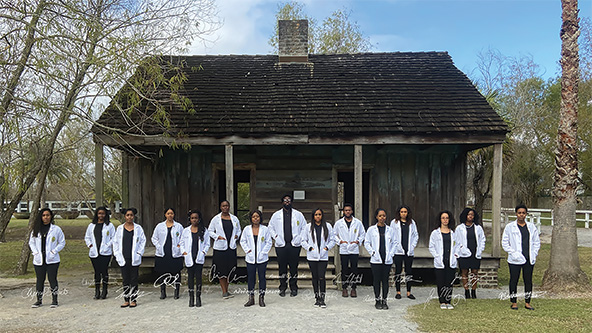
 The 15 White Coats was founded in December 2019, shortly after this photo of 15 Tulane University School of Medicine students was taken by one of its cofounders, Brian Washington, at the Whitney Plantation in Edgard, Louisiana. (Photo courtesy of The 15 White Coats)
A growing body of research shows a positive correlation between the racial diversity of doctors and health outcomes for underserved communities. Yet 2022 data from the Association of American Medical Colleges reveals a significant disparity in representation across US racial demographics: While 13.6 percent of the US population are Black or African American, only 5.2 percent of doctors are; 6.3 percent of doctors identify as Hispanic, Latino, or of Spanish origin, compared with 19.1 percent of the population; and 0.3 percent of doctors are American Indian or Alaska Native, compared with 1.3 percent of the population.
“We have to diversify medicine in a way to make it look more like our patient population, but no one tells you how to do that,” says Sydney Labat, MD.
In 2019, Labat and fellow medical school students Russell Ledet and Rachel Turner (now doctors), and Brian Washington (now medical student) set out to help close the racial gap in the profession. They cofounded the nonprofit The 15 White Coats (The 15WC) to support and encourage racially marginalized students who want to become physicians at all school levels.
The quartet’s vision for The 15WC started with a photo that Washington took of the three other cofounders and 12 of their Black classmates at Tulane University’s School of Medicine wearing their white coats in front of slave cabins at the Whitney Plantation in Edgard, Louisiana. The photo was made into a poster and distributed to more than 100,000 classrooms across the country to show African Americans’ progress in the health-care profession despite centuries of systemic oppression.
In November 2023, The 15WC launched the Funding the Future Physicians (FFP) Initiative to help 50 underrepresented students from historically Black colleges and universities (HBCUs) and Hispanic-serving and Indigenous-serving institutions prepare for medical school. The initiative is a six-month program that provides MCAT prep, tutoring, mentorship, writing assistance with medical-school applications, and financial aid to college students. Participants also get to meet with deans and professors to discuss medical school and careers.
Labat points out that while scholarships are commonly believed to be the solution to improving racial diversity in medical school, the first significant challenge is performing well on the MCAT. The total cost of medical-school applications alone can be thousands of dollars, in addition to the expenses of visiting schools and the challenge of navigating the whole process.
FFP’s sole funder is the South San Francisco-based biotech corporation Genentech, Inc. “Our support for [FFP] advances our goal of building a diverse, inclusive, and thriving medical workforce that is accountable to all patients,” says Emily Lepner, senior manager of giving and social impact at Genentech. “Historically, organizations led by people of color have not benefited from the vast majority of philanthropic resources. That’s why we prioritize support for leaders like Dr. Ledet whose innovative programs are addressing entrenched policies and practices within the health-care system.”
Ledet and Labat have witnessed how important it is to their patients that they are Black doctors. Recently, Ledet walked into a hospital room to treat a child, and, he recalls, “the first thing the mom said [to her son] was, ‘Wow, your doctor has dreads, just like you!’ The kid was like, ‘Man, I want to become a doctor, too. I’ve been thinking about this all my life, but I’ve never seen someone who looked like me become a doctor.’ And it just lit up the room.”
FFP’s larger aim, by working to increase racial diversity in medicine, is to improve health outcomes of underrepresented communities.
“It’s been proven that when you share identities with your health-care providers, there’s more adherence to treatment, there’s more trust—there’s more everything,” says Bennetta Horne, the assistant dean for equity, diversity, and inclusion at Tulane University School of Medicine, who helps FFP students craft their personal statements.
Labat sees a ripple effect. “How many people can we touch with one underrepresented doctor?” she says. “I can only imagine the amount of people we’ll reach with this cohort of kids.”
Read more stories by Allison Torres Burtka.