


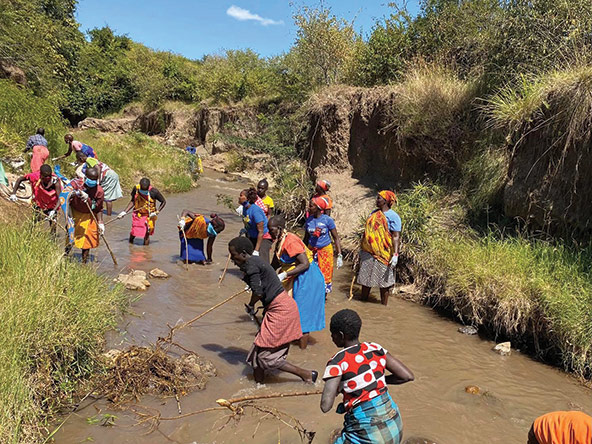
 Nashulai women remove non-biodegradable waste as part of the Sekenani River Restoration Project. (Photo courtesy of the Nashulai Maasai Conservancy)
Nelson Ole Reiyia remembers a childhood without fences. His family’s goats and cattle, central to their pastoral Maasai community’s culture, grazed freely on the sweeping savannas they shared with lions, giraffes, and elephants.
“All Maasai land was communal land,” says Reiyia, who grew up near Kenya’s Maasai Mara and Tanzania’s Serengeti, two contiguous national parks with some of the densest and most diverse populations of large mammals in the world. “It was beautiful to be able to live right next to the wildlife—that’s symbiosis. That common usage of the land between all the different players was very important to me.”
But Reiyia began to notice things changing by the time he reached adulthood, in the 1990s. Each year brought more fences: first, cobbled from felled acacia trees; then, constructed from barbed wire. Not long after, electric fences proliferated the land.
The fences were installed for multiple purposes: enclosing farms, protecting grasslands from overgrazing, bordering growing roads, and demarcating lucrative parcels of land that had been repeatedly subdivided during a decades-long push to privatize and commercialize once-communal lands. In most cases, the fences were meant to keep wild animals inside conservation areas and Indigenous people like Reiyia out.
Some days he’d wake up in the morning to find wildebeest and zebras strung up on the wires—they had been electrocuted overnight.
“That was the moment of obligation for me to step in to see what we could do together as a community to reverse this trajectory and return the land into common ownership and common usage once again,” Reiyia says.
That realization led him to cofound the Nashulai Maasai Conservancy in 2016 with Canadian social innovation expert Eric Young. It is the first Maasai-owned and -operated wildlife conservancy in Kenya, and, some experts believe, the only genuinely community-run conservancy in the region. The conservancy’s 6,000 acres are leased from community members, who sign a 10-year contract and are paid $16 USD an acre annually with an 8 percent increase each year. In exchange, they agree to the communal use of their land for livestock grazing, tourism, and daily life. Everyone agrees to adhere to traditional sustainability practices, such as rotational grazing, and not to subdivide, sell, or fence the land for the duration of their lease.
It’s dramatically different from how conservation has traditionally worked in the region. And Reiyia thinks it could be their best and last shot at protecting a precious ecosystem that has experienced tremendous harm throughout the decades, largely from commercial practices related to land subdivision and fencing. For example, the number of wildebeest migrating from the Serengeti to the Maasai Mara was slashed by 73 percent between 1979 and 2016. Maasai Mara contains a quarter of Kenya’s wildlife, and its animal populations have been reduced to under a third of what they were in the 1970s when Reiyia was a child. Migration routes have been interrupted by fencing, livestock grazing, a wildly unregulated tourism industry, poaching, and climate change.
An additional concern motivated Reiyia’s effort: Despite having lived on the land sustainably for generations, his people have been excluded from efforts to conserve it.
“We wanted to make the first Maasai conservancy because we wanted to be on the land. We didn’t want to be pushed out so that tourists can come in,” Reiyia says. “The community was willing to share every inch of their space with wildlife, but they would not be removed from their land.”
Rethinking Conservation
Maasai history is one of dispossession. They were forced to relocate multiple times, first by British colonizers, and then by “Fortress Conservation.” Pioneered in the early 20th century by US naturalist John Muir, this now globally dominant conservation model identifies Indigenous inhabitants as incompatible with conservation, consequently evicting them from the land to build national parks and reserves.
Tourism is Kenya’s cash cow, raking in $1.61 billion in 2019 alone—much of it from the safari and conservation industry in places like Maasai Mara. It is a starkly segregated world with camps and reserves owned and operated almost entirely by white Europeans, Americans, and Kenyans, as well as a small handful of the wealthiest and most politically connected Black Kenyans. Any local employment makes up the lowest rung of the conservation ladder—poorly paid jobs as cooks, cleaners, or guides. Nearly 67 percent of the residents live in poverty.
Reiyia’s opportunity to change these trends and turn his vision into reality came when he met Young at a conference on Indigenous issues in 2013.
At that time, Reiyia was running one of the first Maasai-owned safaris, Oldarpoi Maasai Safari Camp, which he had established after studying and lecturing on tourism and hospitality management in Nairobi. He sold his cows to afford some used tents and solicited money from community elders to cobble together a bare-bones safari camp.
Reiyia invited Young to visit the camp, and from there a partnership sprung. Their first challenge was persuading the community to lease their land to the conservancy. This was a tough bargain for poor landowners with families to feed who could make money quickly by renting their land to corporate safari companies.
“If we want to preserve the land for future generations, we need a conservancy,” says Jacob Kiok, who was one of the first community members to agree to lease his land to the conservancy, in 2016, and who is now its community liaison. While Kiok initially found it a difficult decision, he says that communal land means he can have more cows and once-blocked sacred land is now available again.
“If we hadn’t come together to form a conservancy, we wouldn’t all have access to those secret places, and that’s where we have our culture,” he explains.
Within a few months, Reiyia had persuaded almost 70 landowners to join.
The second hurdle was funding. Young agreed to donate money to pay initial leases (he declined to share how much money or how many leases), but as interest grew, he says, it wasn’t nearly enough.
Young had connections in the philanthropy world, but something stopped him from going down that path. “We felt that if we became the canvas for their ideas for what conservation should be, we would be giving up our DNA, the heart of our story, even before we started,” he recalls.
Instead, Young and Reiyia turned to crowdfunding and donations from family and friends. Nearly 55,000 donations poured in from around the world on the global activism campaign website Avaaz, providing them enough money for leases and for hiring and training park rangers. Pairing those funds with donations that Young solicited from friends, they created more than 30 community jobs and took down over 20 kilometers of fencing to foster migration.
By 2017, community members reported that Nashulai’s grass covering was replenishing, and the number of animals was increasing. Further, the steady payments from the leases helped disrupt the vicious cycles of poverty that the community had known for decades. Maggie Reiyia, director of Nashulai’s family, gender, and education program, says that all 70 landowners have opened bank accounts for the first time.
“When you have an empowered community, it’s like a flame burning—nothing can stop them,” Maggie Reiyia says. “They have tasted the fruits of conservation, and you can’t take that away from them.”
Preserving History
One of Nashulai’s biggest challenges as it moves into its next stage of growth will be scaling without sacrificing its community-run model, especially as its efforts gain wider recognition.
Indigenous groups from Samburu and Laikipia in Northern Kenya recently visited the conservancy to learn how to replicate the model. In 2020, Nashulai won the United Nations Development Programme’s Equator Prize, which recognizes “outstanding community efforts to reduce poverty through the conservation and sustainable use of biodiversity.” The $10,000 award has brought it international visibility and acclaim.
The conservancy recently conducted another round of crowdfunding through Avaaz to mitigate the devastating effects of lost tourism revenue due to the COVID-19 pandemic. A trio of grants—$25,000 from the McLean Foundation for a regenerative grazing project, $40,000 from the Summa Foundation for a river restoration project, and a similar grant from the Trolltech Foundation—also helped to sustain it throughout last year.
Nashulai will need to fill its coffers to accomplish its ambitious plans for the future—especially given that their 5,000 acres is still a drop in the bucket compared with the 23 national parks and 26 national reserves that make up 8 percent of Kenya’s land (more than 11 million acres).
The conservancy plans to build a stories café, where elders can document and tell their knowledge about living sustainably to younger generations, by the end of 2021. This passage of knowledge is vital, Reiyia explains: “If an elder dies without sharing their story, it’s like a whole library burning down.”
Because information sharing is essential to the community’s knowledge about the conservancy, they are also planning to expand the Nashulai Cultural Training Centre, where 100 Maasai youth are already learning skills without having to travel to Nairobi or abroad. Young sees the training center acting as a kind of innovation hub that can pioneer environmental solutions led and managed by Indigenous people, especially as demands for solutions to climate change ramp up and eyes inevitably turn to land-rich Africa for things like carbon sequestration. Young and Reiyia also know they’ll need strong future leaders if there’s any hope of genuinely disrupting a multibillion-dollar industry reliant on current conservation models.
Ensuring that there is a future generation living in Maasai land, Reiyia believes, already marks a dramatic victory.
“They have been able to save their land for their children and future generations,” Reiyia says of the Maasai. “This is the land where their ancestors’ bones are buried. It contains their songs. It contains their folklore.”
Read more stories by Abigail Higgins.