


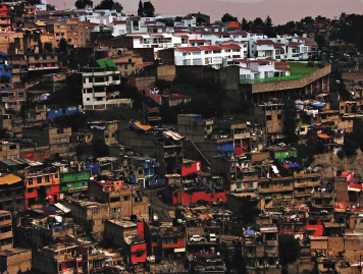
 High-income housing sits atop a slum in Mexico City, which has the eighth largest GDP of any city in the world.(Photograph
by Monica Alexandra Terrazas Galvan)
High-income housing sits atop a slum in Mexico City, which has the eighth largest GDP of any city in the world.(Photograph
by Monica Alexandra Terrazas Galvan)
Aid is increasingly focused on the “bottom billion” in extremely poor, mostly African, nations. But according to a new analysis, most of the world’s poor no longer live in these countries.
The 960 million poorest people on the planet—or three quarters of the 1.3 billion who make less than $1.25 per day—are now in middleincome countries, says Andy Sumner of the Institute of Development Studies in Sussex, United Kingdom. What happened is that “most of the world’s poor live in a relatively small number of countries, countries like India and Nigeria, which have become richer in average terms” and recently graduated from low-income to middle-income status, Sumner says. “But at the same time, poverty doesn’t seem to have fallen much.” The new wealth hasn’t been broadly distributed.
Back in 1990, it was true that poor people (93 percent of them) lived in poor countries. In such a world, ameliorating global poverty is more straightforward, Sumner says: “It’s about aid and resource transfer.” But when most poor people live in countries with substantial domestic resources, giving money isn’t enough. It “pushes development in ultimately a more political direction,” he says.
Traditional donors and international NGOs may move “toward thinking about how they can support progressive forces of change,” Sumner says. It is now even more important to “build up and support the expansion of local civil society in developing countries, so that local NGOs can call their own governments to account.”
Fragile middle-income countries such as Nigeria and Pakistan may still benefit from development assistance, but governance and domestic taxation and redistribution policies are becoming more important. Emerging powers such as China and India (which give aid to other countries) are less and less likely to need or even want aid, and more likely to be concerned with coherence in policies on trade, migration and remittances, climate negotiations, and tax havens.
Sumner’s analysis broadens the question of how to ensure a better world, says Nancy Birdsall, founding president of the Center for Global Development in Washington, D.C. “As fewer and fewer countries are poor in average terms and house fewer and fewer of the world’s poor, should what used to be aid money go toward what are now increasingly called global public goods?” Perhaps the next step is “dealing with problems like climate change, or the need for more agricultural research, or health technologies that could be deployed in poor countries but less poor countries as well,” Birdsall says.
A careful look at world poverty throws a lot of conventional wisdom into question. To really help the poor now, says Sumner, “the first thing is to think about development way beyond aid.”
Andy Sumner, “Global Poverty and the New Bottom Billion: What if Three-Quarters of the World’s Poor Live in Middle-Income Countries?” Institute of Development Studies, 2010.
Read more stories by Jessica Ruvinsky.