


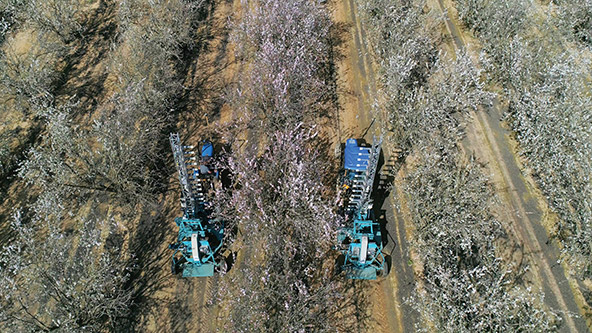
 After harvesting pollen, two of Edete’s mechanical pollinators disperse dry pollen on almond trees. (Photo courtesy of Edete)
A third of humans’ diet, according to the United States Department of Agriculture (USDA), is reliant on plants pollinated by insects. And bees do most of that work.
But honeybees are in peril. Parasitic mites, pesticides, and the collapse of colonies without apparent cause—called Colony Collapse Disorder (CCD)—are causing poor bee health and population decline worldwide.
In an effort to save the bees and buttress the global food supply, Edete, an Israel-based agricultural technology company, has set out to reduce the strain on bees by assisting them with crop pollination. Since its founding in 2016, Edete has developed and tested an artificial pollination process using mechanical pollinators that can operate day and night.
“We believe humanity should do everything within its power to preserve insect populations,” says Edete cofounder Keren Mimran. “However, as long as more agricultural land is needed to support the constant growth of the world’s population at the expense of the natural habitat for insects and other animals—as well as the use of pesticides and herbicides, which are harmful to bees and insects—our food security needs a technological replacement.”
Edete’s artificial pollination process includes both pollen harvesting and pollen dispersal. First, flowers are mechanically harvested; the pollen is carefully separated to maintain its capacity to germinate seeds.
“When it is blossom time, Edete’s mechanical pollinators disperse dry and electrostatically charged pollen on trees, following the contour of each tree using lidar [laser light] sensing and controlled air vectors, allowing fertilization to occur,” Mimran explains.
Based on four years of field tests, Edete has shown that its mechanical pollinators can secure and increase crop yield. It hopes its pollinators can prevent bees’ exposure to pesticides and herbicides and prevent beekeepers from needing to transport bees long distances—a journey that removes bees from established nutrition sources and distresses entire colonies.
Edete is funded by angel investors, a kibbutz collective community in Israel, and grants from the country’s Innovation Authority. In 2017, it expanded its testing in the form of multi-acre pilot programs in Israel and Australia. In August 2018, the company started working in Australia because it is second only to the United States in almond crops, and its location in the southern hemisphere also allows Edete to double its testing periods, since almond trees bloom only once a year in each hemisphere.
“We’ve succeeded to increase almond yield as a full replacement to bee pollination in small-scale field tests in Israel and succeeded to demonstrate increase in yield of almonds as a supplement to bee pollination in an orchard of a few acres in Israel,” Mimran says. Edete produced a pollen bank for the first time in Australia in August 2019 and had planned a full artificial pollination pilot in August 2020, but the pilot was postponed due to COVID-19. Despite the setbacks from the pandemic, Edete plans to turn to paid contracts with almond growers by 2023.
During the pandemic, Edete has measured its success by testing its proprietary technology, growing the scale of its testing from branches to full trees to half acres and now to full acres, and showing repeating results of yield growth.
However, caveats and uncertainties arise from new technology. Simon Fraser University biologist Mark Winston, who has spent his career studying bees, says new agricultural practices are often introduced before side effects have been studied.
One concern is bees’ sensitivity to motion. “Predator-sized machines that buzz around would disrupt bees foraging on flowers,” Winston notes. An overreliance on technology could have its pitfalls, too. “Bees have coevolved with flowers for pollination for more than 100 million years. In that time, their pollination services have been perfected,” Winston says. “Perhaps a better strategy would be to shift toward more sustainable agricultural systems that integrate healthy bee populations with crop management.”
Unsurprisingly, the market for securing and improving crop yields is vast. In California’s Central Valley alone, honeybees produce a summer harvest that leads to more than 80 percent of the world’s almond supply. In 2018, California produced more than $5 billion worth of almonds, according to the state’s food and agriculture department.
And that is just one crop. Edete’s artificial pollination process could potentially be used to pollinate cherry, apple, and pistachio crops—sparing, and saving, thousands of bees in the process.
Read more stories by Luke O’Neill.