


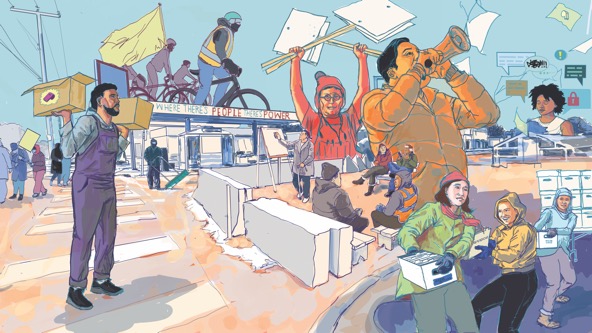
 (Illustration by Mike Hoyt)
Community Infrastructure in Minneapolis
SERIES: When Minnesota’s Civic Gyms Stayed Open
SSIR partnered with the McKnight Foundation to publish a series about the response to the federal immigration-enforcement surge in early 2026. Authors shared “lessons about civic infrastructure, mutual aid, democracy, and the role of philanthropy in moments when fundamental rights and community well-being are under threat.”
- “Minnesota’s network of caring and activism has been built over many decades,” reader Sheila Ehrich added. “One factor that made the interaction between smaller organizations and well-funded nonprofits possible is how the Council for Nonprofits and [the Joint Religious Legislative Coalition] and others have worked over the years to look for community organizations and faith communities to partner with ... We all do better when we all do better together.”
- Another commenter, Amy Eich, emphasized how philanthropy can support the grassroots: “Funders should carefully consider how much they are asking back from their recipients. I work in Minnesota school district Community Education, and we intentionally include our smaller community organizations in our grant-seeking efforts, because the administrative burden that comes with grants is often unreasonable for their labor capacity. We take on [those] data/reporting tasks for them, so they can focus on their good work.”
- Writing in Proximate Press, columnist Tirrea Billings commented: “The series centers communities in the narrative and focuses on the immigrant-led groups, volunteers, and mutual-aid organizers as the ones taking action, leading, and safeguarding their neighbors. Philanthropy-focused media outlets should replicate this form, though it’s worth noting that a foundation funded the series, and the lessons are still aimed at [funders].”
A Fundraising Alarm
ARTICLE: Who Will Raise the Money When the Money Raisers Are Gone?
- In a recent article, SSIR contributor Mark Dobosz flagged a “quiet crisis” facing the nonprofit sector: “Senior fundraisers are retiring. Not only are we not replacing them, but we are failing to attract young professionals into the field. And as the pipeline narrows from both ends, the transactional, quota-driven, relentlessly metrics-obsessed culture we have built is accelerating the exodus of those still in the middle.”
- “We often talk of donor pipeline health, while the fundraising professional pipeline is plugged,” Scott Decksheimer commented. “Each [organization] needs to help build this, in partnership with the fundraising professional organizations.”
- “The numbers shared in the article are hard to ignore,” Candace Richter wrote. “What stands out to me is the article’s suggestion that the nonprofit sector can learn from other professions that have also faced burnout and retention challenges. If [we] want stronger fundraising results, we also need healthier, more sustainable fundraising roles.”
- Hernán Nadal added: “As president of AEDROS, the Latin American fundraising association, I can tell you that the situation in the region is more complicated when it comes to salaries, but much better in terms of the number of young professionals who do not want to enter the corporate world and choose the third sector to develop their careers.”
Conversations About Effective Giving
PODCAST: Giving With Impact
In a new season of the Giving With Impact podcast, SSIR editor Barbara Wheeler-Bride speaks with experts across the philanthropic ecosystem about impact investing, humanitarian aid, collaborative funding models, and what it will take to get donors to move more money, more quickly.
Read more stories by SSIR Editors.