


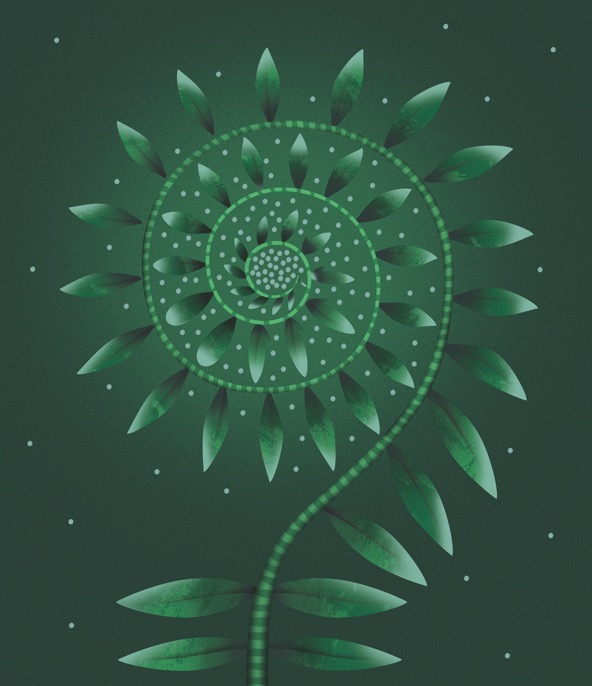
 (Illustration by Vicki Turner)
How do we scale transformative change? It is often understood as both a bottom-up and top-down process, with success measured by the number of people engaged, organizations involved, or governments committed. Whether we are talking about sustainable behaviors, environmental policies, social mobilization, or international action on climate change, there is an assumption that “bigger” and “more” are essential to sustainability transformations.
But numbers tell only part of the story. We also need to pay attention to the patterns created through our actions and relationships. Political scientist Erica Chenoweth’s research shows that, historically, significant political change has resulted when roughly 3.5 percent of a population participated in nonviolent protests. Sociologist Damon Centola’s work suggests that when 25 percent of a social network adopts a new norm, cascading effects can lead to tipping points1. Research on social contagion and diffusion similarly shows that we are continually influencing—and being influenced by—those around us. When we switch to renewable energy, for example, our friends and neighbors may be inspired to do the same. When we act passionately to protect nature, our conversations, stories, and actions can ripple outward, inspiring others in turn.
These studies demonstrate how a relatively small but committed group can catalyze change. Yet transformative change involves more than a group’s size or commitment. Scaling change is not simply about reaching more people; it is about cultivating life-sustaining and regenerative patterns across all scales. I use the term fractal agency to describe the capacity to intentionally contribute to such patterns. Fractal agency recognizes that the values we embody in our everyday ways of being, doing, and relating can help shift patterns across multiple spheres of influence. It helps us see individual, collective, and systems change not as separate processes, but as interconnected expressions of transformative change.
The Paradox of Mattering
We know that humans are having a global impact on the planet. When it comes to climate change, pollution, and biodiversity loss, our actions are contributing to human vulnerability and the degradation of nature2. Yet when we talk about solutions to these global challenges, many people feel their own actions are insignificant, dismissed as trivial on the grounds that meaningful change depends on transforming the norms, institutions, incentives, power relations, and economic systems that reinforce the status quo. This framing treats individual, collective, and systems change as separate spheres, rather than recognizing how they shape one another through the values and shared meanings that are expressed and reproduced in everyday relationships.
Unless we see immediate and measurable results, we may assume that our actions do not matter. Yet our actions are part of larger patterns that tend to be reproduced across scales. Recognizing these patterns can strengthen our collective capacity to transform inequitable and unsustainable systems.
Social Fractals
Research across multiple knowledge systems shows that individuals, groups, and systems are not discrete entities but relationally connected. Across cultures and traditions, people have reported experiences of profound interconnectedness with nature, other people, and life itself. Psychiatrist Dan Siegel uses the term “intraconnected” to describe a reality in which individuals are both distinct and fundamentally connected to one another and nature. From this perspective, our agency is neither purely individual nor purely collective. We are relationally entangled.
When we slow down and become more aware of the world within and around us, we begin to notice recurring patterns. Nature offers beautiful examples: Our lungs, Romanesco broccoli, a fern, the branching of a tree, or a bird’s-eye view of a river basin all reveal patterns that repeat themselves. These self-similar, recursive patterns are known as fractals. Fractal patterns repeat across scales, with each part reflecting characteristics of the larger whole.
Just as nature generates repeating patterns, we can create fractal patterns in our personal and societal relationships and interactions. A social fractal is a context-specific pattern that reproduces itself from individual to global scales and beyond. Yet social fractals are more than repetitions. They describe how relationships organized around the same values and principles can generate similar dynamics across different contexts and scales, or what Monica Sharma describes as a conscious full-spectrum response model.
This way of thinking has parallels in Indigenous knowledge, development work, sustainability science, and approaches to healing collective trauma. We can also think in terms of fractal politics, urban fractals, and fractal approaches to scaling sustainability transformations. When we understand ourselves as both distinct and deeply connected, caring for both the “parts” and the “whole” becomes essential.
What Spreads
Not all self-similar patterns are life-affirming. We tend to prioritize what matters to us, even when doing so comes at the expense of others, particularly those we regard as “other” or imagine abstractly as “future generations.” History shows that exclusionary ideologies, exploitative practices, and oppressive relationships are often reproduced across scales. The 2024 Intergovernmental Platform on Biodiversity and Ecosystem Services (IPBES) Transformative Change Assessment, for example, identified three deep social and cultural patterns underlying biodiversity loss and the degradation of nature. These patterns perpetuate exclusion, extraction, exploitation, and oppression in ways that fragment and fracture society:
- separation from and domination over nature and people;
- concentration of wealth and power; and
- prioritization of short-term, individual, and material gains.
Shifting these patterns requires embodying values that can guide our relationships with both parts and wholes. The IPBES report identifies “principles of transformative change,” including equity, justice, pluralism, inclusion, and respectful and reciprocal relationships between humans and nature.
These values express an ethic of care for humans and nature. When we consistently embody and enact them, patterns are transformed across scales. Creating new patterns, however, takes practice.
Cultivating Fractal Agency
We can enhance our transformative potential through regular practices such as meditation, contemplation, reflection, journaling, forest bathing, yoga, and bodywork. We can also develop it through relational activities, including deep listening and creative practices such as writing, dance, and music. These practices can deepen our awareness of our relationships with the Earth and one another, helping us recognize that our actions are always connected to the larger whole.
Cultivating fractal agency begins with awareness. As we become attentive to how we think, act, and relate, we can ask: What values are we expressing? What patterns are we reinforcing or helping to transform?
By disentangling ourselves from the social and cultural patterns driving nature’s decline, we become more attuned to the world around us. We can expand our circle of care to include other sentient and nonsentient beings, as well as future generations, grounding our relationships in equity, dignity, and compassion. Whether in relationship with ourselves, our families, our communities, our workplaces, our nations, or the world, we can generate context-specific social fractals across multiple spheres of influence.
Focusing on awareness and values does not mean withdrawing from collective action. Rather, it can deepen our capacity to engage strategically in transformative change, helping us recognize what is missing, envision alternatives, build new relationships and institutions, and contribute to movements that transform the systems of which we are a part. Fractal agency invites us to recognize both the unity and diversity of human-nature relationships. This capacity is key to promoting, accelerating, and scaling transformative change.
Fractal Change in Practice
If a small proportion of people can catalyze broader transformations, their role is not only to embody new values individually. It is also to translate those values into collective strategies and actions that help overcome barriers to change.
Twelve years ago, I cofounded cCHANGE, an organization that works with individuals, groups, organizations, schools, and municipalities to translate research on transformative change into action and results. cCHANGE helps people realize their potential to contribute to transformative change in ways that are equitable, ethical, and sustainable.
One of our programs, cCHALLENGE, is a 30-day change experiment for groups in which each participant chooses one small change to focus on. Through reflection questions, participants identify patterns in themselves and in society related to that change and explore the relationship between individual and systems change.
Participants are encouraged to consider how these patterns operate across three spheres of transformation: practical, political, and personal3. The practical sphere includes the habits, routines, and logistical choices we most often associate with behavioral change, such as bringing a reusable shopping bag or taking public transportation. The political sphere relates to the systems and structures that shape or constrain these choices, including policies, markets, infrastructure, and social and cultural norms. Reducing plastic use, for example, depends not only on individual choices but also on the manufacturing and packaging systems that determine which options are available. The personal sphere encompasses the values, beliefs, and worldviews that shape how we show up in processes of change. As one participant, Maria, noted, “cCHALLENGE has changed my awareness. It is all about making time for the self, to pause a little, ponder a little.” The experiment helps participants experience how these three spheres are interconnected.
A fractal perspective emphasizes the idea that changes happen across scales, from individuals and families to communities, organizations, cities, and societies. When we enter the transformative space through values that apply across these scales, we disrupt old patterns and generate new ones. As one participant put it, “We’re the solution. And we, ourselves, have to figure out how to be a part of that solution. I didn’t quite have the courage to believe this before, but now I actually think it might work.”
Organizations, too, can become powerful fractals of change. GRID-Arendal, for example, is an environmental organization committed to driving transformative change through collaboration, innovation, and the courage to challenge existing paradigms. Managing Director Karen Landmark recognizes the connection between inner and outer change: “Changing the patterns within ourselves and within our organization goes hand in hand with transforming patterns embedded in the projects, organizations, and institutions that we work with globally.”
Whether understood spiritually, psychologically, or relationally, an awareness of our connectedness can help us cultivate a form of agency capable of reshaping ourselves and everything around us. Fractal agency is grounded in the recognition that we are entangled through values, identities, and meaning-making, and that individual change, collective change, and systems change are one.
What’s (Y)Our Role?
What does all of this mean in everyday practice, both personally and professionally? The questions below can help individuals and groups approach transformative change from a fractal perspective.
- What do you deeply care about, not just for yourself or your group, but for all? Your answer points to the values that shape the patterns you create.
- What practices help you embody those values? These practices might include contemplative practices, deep listening, or tools described in Radical Transformational Leadership: Strategic Action for Change Agents, by Monica Sharma.
- What patterns do you notice in the practical, political, and personal spheres of transformation in your daily life? You can explore these patterns by conducting your own 30-day cCHALLENGE experiment. Choose one small sustainability-related change that stretches you, and pay attention to your successes, struggles, frustrations, and impacts, not least by sharing your stories with others.
- Which societal and cultural patterns need to shift for you and all others to thrive, both now and in the future? Come up with a list of actions you can take to contribute to fractal change, based on what you care deeply about for all.
Scaling transformative change is not only about reaching more people. It is about cultivating patterns of being, relating, and acting that support human and planetary flourishing across individuals, communities, organizations, and institutions. Every relationship and interaction is an opportunity to cultivate those patterns. The question is not whether we influence the future, but how we can use our fractal agency to create the future.
Read more stories by Karen O’Brien.