


 Find a Protest, a site that helps people find protests, rallies, and solidarity events in their area, receives support from Tech for Palestine.
Big tech companies have played an outsize role in the war on Gaza since October 2023—from social media companies, which have been accused of systemic censorship of Palestine-related content, to Microsoft, Google, Amazon, and Palantir signing lucrative contracts to provide artificial intelligence and other technologies to the Israeli military.
Concerned with the industry’s role in the attacks on Gaza, Paul Biggar, founder of Darklang and CircleCI, a start-up turned billion-dollar technology company, founded Tech for Palestine in January 2024. The organization serves as an incubator, helping entrepreneurs whose projects support human rights for Palestinians develop and grow their businesses. “Our projects are, on the one hand, using tech for good, and on the other hand, addressing the systemic challenges around Israel in the tech industry,” Biggar says.
He got an insider’s look at how the technology industry equips the Israeli military during more than a decade as CEO and board member of the companies he founded. He was removed from the board of CircleCI after writing a blog post in December 2023, condemning industry bigwigs for “actively cheer[ing] on the genocide” in Palestine. At the time, the official death toll in the territory exceeded 18,600 people. The official death toll has since risen to over 60,000 people, and in August 2025, a United Nations-backed panel declared that famine is underway in the enclave.
Since its launch, Tech for Palestine has grown from a community of tech workers and other volunteers loosely organized on the communication platform Discord to a grant-making nonprofit that employs five full-time Palestinian engineers and supports 70 projects. It became a 501(c)(3) organization in December 2024, enabling it to solicit large private donations and source smaller donations through a donation link on its website, with the goal of scaling up to supporting 100 projects by the end of 2025.
Tech for Palestine’s most ambitious projects include Boycat, an app and browser extension that helps users identify products from companies that profit from human rights abuses in Palestine, and UpScrolled, an Instagram alternative that promises no shadow banning, no biased algorithms, and no favoritism. Meta, which owns Instagram and Facebook, has been found to censor content in support of Palestine on its platforms, according to an audit conducted by Human Rights Watch.
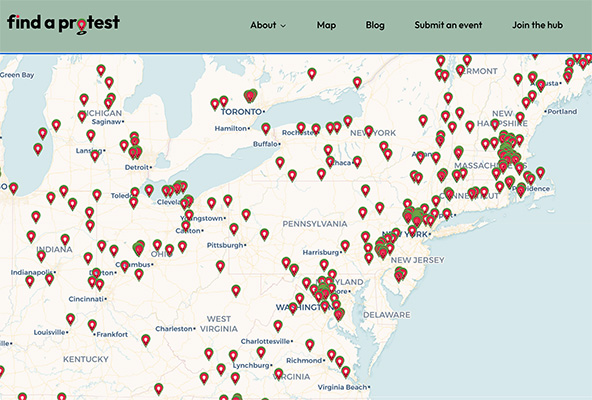
Another of Tech for Palestine’s most successful projects is Find a Protest, a site that helps people find organized actions, such as demonstrations or teach-ins. Hannah Lynn started the site in February 2024 to help friends find events in their area. She began receiving support from Tech for Palestine in May 2024 and has since scaled up the site to more than a quarter of a million visitors per week. Find a Protest also offers an organizer platform to support organizers in listing and amplifying their events through the site. “It’s been tough because it’s hard work, but the motivation from Tech for Palestine has been incredible, and they provide so many resources,” Lynn says.
Tech for Palestine also offers one-on-one mentorship with experienced start-up founders, regular drop-in conference calls where new founders get live support from mentors and fellow incubator members, webinars to upskill participants in sales and marketing, support from volunteers who sign up via the organization’s Discord, and access to as much as $300 per month in grant funding. The organization plans to distribute $800,000 in this first year of its grant program and scale up its grantmaking function in the future according to need.
“Our theory of change is that in the pro-occupation, pro-apartheid ecosystem, there are tens of thousands of projects, and our role is to be a catalyst to launch, in the end, tens of thousands of projects [to counter that ecosystem],” Biggar says. “We’re trying to change [the tech industry] into something that’s pro-freedom, pro-liberation, and pro-human rights.”
Read more stories by Marianne Dhenin.