


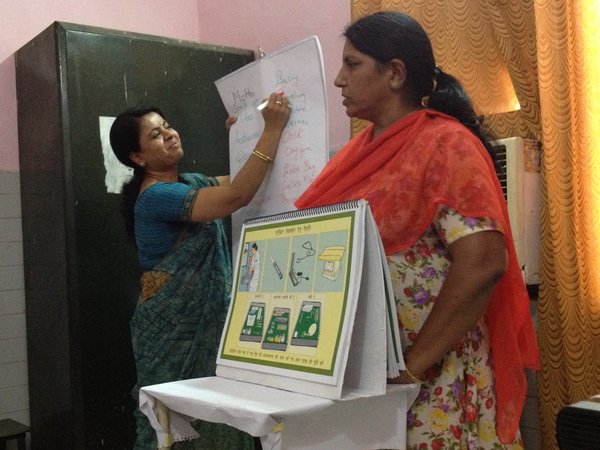
 Coaches in the BetterBirth program review a list of supplies to be used in a training session for birthing attendants. (Photograph courtesy of Ariadne Labs)
In Uttar Pradesh, the most populous state in India, the neonatal mortality rate is high—about 44 deaths per 1,000 live births. In theory, that rate would go down if more births took place in health clinics where pregnant women could receive assistance from professional care providers. So in 2005, the Ministry of Health and Family Welfare in India introduced a conditional cash transfer program that encourages women in Uttar Pradesh to deliver their babies in accredited clinics.
Since then, the number of women who use such facilities has increased substantially. Yet outcomes haven’t improved much. “We were not seeing decreases in neonatal and maternal mortality [that the government] hoped for with higher rates of facility-based delivery,” says Katherine Semrau, an epidemiologist who serves as director of the BetterBirth Program (BBP). “We believe it may have to do with the quality of care that’s provided.”
BBP, which targets neonatal care, is a project run by Ariadne Labs in collaboration with the Bill & Melinda Gates Foundation, Population Services International, the governments of India and Uttar Pradesh, and other entities. Ariadne is a center operated jointly by two Boston-based health care institutions: Brigham and Women’s Hospital and the Harvard T. H. Chan School of Public Health. Atul Gawande, a surgeon at Brigham and Women’s and a professor at Harvard Chan School, founded Ariadne in 2012 and serves as its executive director. (Gawande is also a staff writer at The New Yorker and the author of several best-selling books on health care.)
Ariadne differs from most traditional medical research centers. Instead of developing new treatments, people at Ariadne work to identify areas where health-care workers and institutions could be—but aren’t—deploying proven interventions. Then they develop programs that can bridge the gap between knowing what works and doing what works. The Serious Illness Care Program, for example, coaches clinicians on how to have difficult conversations with patients. In the Safe Surgery Program, the center collaborates with healthcare organizations to implement the Safe Surgery Checklist, a method that Gawande helped to develop.
A crucial element of Ariadne’s work is its emphasis on evidence-based assessment and adaptation of specific interventions. BBP, for example, is built around implementing and testing the Safe Childbirth Checklist (SCC), a system that Gawande developed under the sponsorship of the World Health Organization (WHO). The SCC is a 30-item list of best practices that have been clinically proven to decrease the primary causes of maternal and neonatal death. But the checklist is just the starting point for BBP. “The program focuses on how you actually introduce that checklist—at the front line, at the facility level—and provide improved care,” Semrau explains. Ariadne is now conducting a large-scale randomized controlled trial of BBP in Uttar Pradesh.
With efforts like BBP, Ariadne is working to make the use of checklists and other high-impact methods a matter of institutional habit at medical facilities everywhere. Its goal is to show that improvements in care can—and must—take place at a systemic level.
Checking a List
In 2006, WHO recruited Gawande to lead a project to reduce patient deaths during surgery. Eventually, he settled on a practice that involves using a simple checklist—a set of actions that are known to decrease the likelihood of medical error and other negative outcomes. The list includes steps such as finding out before surgery if a patient has any known allergies and confirming that a patient has received appropriate medications. Gawande’s work on the WHO project resulted in the creation of the Safe Surgery Checklist. (Gawande discussed this work in his book The Checklist Manifesto.)
Over the past decade, the use of checklists has become a widely adopted practice in health-care settings. By prompting healthcare workers to perform critical steps in a given procedure, a checklist improves communication and coordination within a team or across an institution. “The checklist ends up becoming an agreement about what the whole organization is working toward,” says Jeff Brady, director of the Center for Quality Improvement and Patient Safety at the US Agency for Healthcare Research and Quality.
But even the most effectively designed checklist will do little to improve outcomes if no one uses it. Persuading health-care workers and their institutions to adopt a checklistbased practice is itself a complex endeavor. “Independent practitioners who have been working for decades don’t, in their minds, need any help to improve outcomes,” says Bryce Taylor, chief surgeon at the Toronto General Hospital, who oversaw the introduction of the surgery checklist at that institution. “Getting people to change is a challenge.”
Instead of issuing a top-down mandate to use the checklist, Taylor and his colleagues at Toronto General adopted a grassroots approach: They encouraged certain surgeons and nurses to become checklist “champions” who would promote the system among their peers. In addition, they engaged in a concerted effort to make checklist usage a visible part of the hospital’s culture. “As chief surgeon, I went into every operating room every day for a month and said, ‘How did it go?’ If they hadn’t done it, I asked them to stop the operation, and we did the checklist,” Taylor recalls.
Testing a Model
Ultimately, Ariadne leaders have concluded, the checklist model works best when healthcare organizations complement it with a robust support infrastructure that includes dedicated coaching personnel. That’s the principle that underlies BBP.
In the early stages of a BBP intervention, coaches—who, in most cases, are trained nurses—visit a health-care facility twice a week to show birth attendants and other support staff members how to administer the SCC. The coaches also track usage of the SCC and share usage data with attendants. When a problem in using the checklist arises, the coaches work collaboratively with attendants to implement solutions. “The goal isn’t just immediate behavior change. It’s sustained behavior change,” says Lisa Hirschhorn, director of implementation and improvement science at Ariadne. “The coaches are there to get birth attendants to think creatively about how to overcome challenges. So the next time [birth attendants] hit a problem, they won’t need to look to their coach to solve it. They’ll know how to fix it themselves.”
To ensure the long-term sustainability of their efforts, BBP coaches work with each facility leader to appoint a “childbirth quality coordinator”—a facility employee who will be a site-based advocate for the SCC after the program concludes and the coaches discontinue their visits. “It’s very important to have an internal champion of the checklist,” says Semrau. “We train [these champions] on how to sustain checklist use by motivating frontline workers and sharing problem-solving solutions.”
A commitment to monitoring and evaluation has been a core feature of BBP from the inception of the program. Today, with its large-scale randomized controlled trial in Uttar Pradesh, Ariadne hopes to prove that consistent use of the SCC will improve outcomes for mothers and infants. But even before undertaking the trial, the BBP team conducted smaller-scale tests to gauge whether BBP has a positive effect on clinicians’ behavior.
Testing of the SCC actually predates the creation of Ariadne. In 2010, Gawande and his colleagues collaborated with WHO to conduct a pilot study of SCC implementation at a single facility in the Indian state of Karnataka. The study showed that on-site coaching could indeed raise the likelihood that clinicians will follow SCC practices. But the BBP team didn’t rely on that finding when it began developing the trial in Uttar Pradesh. Instead, the team took time to conduct two small-scale tests at several facilities in that state. “We knew that Karnataka and Uttar Pradesh are very different in terms of culture, context, and provision of care at the facility level,” says Semrau. “We wanted to learn what adaptations would be necessary in this new context.”
In both the Karnataka test and the first Uttar Pradesh test, physicians led the coaching teams that introduced birth attendants to the SCC. But in the Uttar Pradesh test, BBP monitors noted that SCC-related behavior changes had not occurred at a significant rate. In Uttar Pradesh, the relationship between physicians and nurses is more hierarchical than in Karnataka, and the monitoring team suspected that this structure impeded the training process. So for the second Uttar Pradesh test, the team switched to a model in which nurses coached birth attendants.
Such modifications had a big impact. In the first Uttar Pradesh test, monitors recorded use of the SCC by birth attendants in 10 percent to 39 percent of observed care interactions. In the second Uttar Pradesh test, they recorded use of the SCC in 76 percent to 88 percent of observed care interactions. By the time Ariadne began the large-scale trial in Uttar Pradesh, its method for implementing the SCC had evolved considerably.
Ariadne began the full-scale trial in 2014, and it will continue through the first quarter of 2017. It covers 120 clinics, and it will track outcomes for 116,000 mother-infant pairs who are receiving care at those facilities. Of the 120 clinics, 60 are implementing and receiving support for the SCC, and 60 are serving as a control group. About 20 coaches and team leaders are supporting the 60 centers in the treatment group.
The goal of the trial, Semrau explains, is to demonstrate a 15 percent reduction in the composite incidence of maternal mortality, maternal morbidity, stillbirth, and neonatal mortality. If the Ariadne team meets that goal, it will implement the SCC model in other parts of India and ultimately in other countries as well. And if the team falls short of its goal, it will know that further adaptation and testing are in order.
Transforming the quality of health care is a long-term proposition—one that involves the hard, slow work of changing human behavior. But Ariadne leaders believe that health-care professionals will embrace systems that help them get better at getting better. “I’ve never met a clinician who wakes up in the morning and says, ‘Today I’d like to deliver bad care,’” Hirschhorn says.
Read more stories by Greg Beato.