


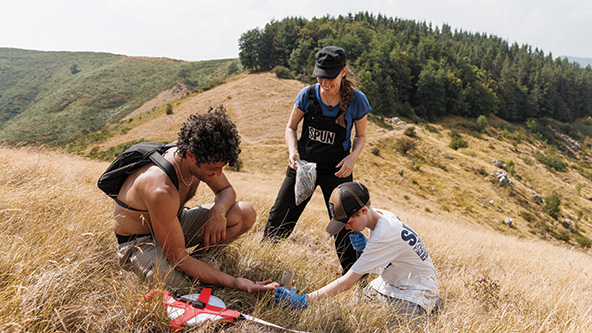
 SPUN team members collect fungi samples from Italy’s Apennines as part of their global research. (Photo by Seth Carnill)
Fungi have been one of Earth’s most vital organisms for more than 1 billion years. The species of fungi are estimated to number between 2 million and 4 million, with mushrooms and molds being the most well known.
Fungi, and specifically an underground type known as mycorrhizal fungi, are instrumental in the decomposition process of organic matter, which provides plant roots with nutrients like phosphorous and nitrogen. Fungi also supply plant roots with water and in return receive carbon to grow and expand their networks. This exchange prevents excess carbon from entering the atmosphere—a useful mechanism against climate change.
“These are the living nutrient highways that run under our feet,” says Toby Kiers, the executive director of the Society for the Protection of Underground Networks (SPUN). Founded in late 2021, the Amsterdam-based nonprofit promotes mycorrhizal fungi conservation through soil analysis and digital mapping. These fungi are connected to 90 percent of the world’s plants, Kiers notes. This percentage is also how much of the world’s fungi population is estimated to be undiscovered.
Kiers, a professor of evolutionary biology at Vrije Universiteit Amsterdam, is one of 14 scientists, specialists, and advisors who make up SPUN’s core team. The group is assisted by 20 board and council members, including famed ethologist Jane Goodall and billionaire British investor Jeremy Grantham, whose foundation, dedicated to global environmental health, contributed $3.5 million to SPUN’s launch.
In addition to the Grantham Foundation, the Schmidt Family Foundation—cofounded by former Google CEO Eric Schmidt—is a founding partner. “We face a crisis of soil erosion around the world, expedited by the impacts of climate change,” says Wendy Schmidt, the foundation’s cofounder and president. “We are pleased to support SPUN in its work to combine scientific knowledge with local Indigenous wisdom to map, examine, and restore fungal networks.”
SPUN has relied on research from the open-source database GlobalFungi and the Zurich-based climate change organization Crowther Lab to sketch a map of 18 global locations. These locations are possible high-priority hot spots for mycorrhizal fungal conservation efforts.
SPUN has created algorithms to analyze soil samples collected by its researchers on expeditions to these hot spots. The samples will be tested alongside those from GlobalFungi, Crowther Lab, and other collaborators to determine the accuracy of its hot-spot predictions.
“The technologies that we use to sequence the DNA of organisms in the soil are getting cheaper and easier,” says mycologist Merlin Sheldrake, a SPUN board member. “The kind of work that used to be very expensive, particularly on a small scale, can now take place on a global scale.”
SPUN’s goal is to produce a first-ever map of the world’s mycorrhizal fungal networks, which Kiers hopes will spur local communities and policy makers to undertake conservation efforts where environmental threats are severe. “What we’re trying to do is let people visualize [fungi] for the first time and then start to protect them,” Kiers says.
As a first step, SPUN is amassing 10,000 fungi samples, helped largely through its partnerships with other biodiversity organizations as well as the team’s expeditions, which have included trips to the Patagonia region of Chile and Italy’s Apennines. In 2023, SPUN is planning an expedition south of Hawaii to Palmyra Atoll, cosponsored with The Nature Conservancy.
Kiers believes that since mycorrhizal fungi exist out of sight, they are privileged less in conservation efforts compared with aboveground ecosystems like forests.
Mycologist Nicholas Money, a professor of biology at Miami University, believes SPUN faces obstacles analyzing samples, including the incredible diversity of fungi and the large amounts of DNA within their cells, which can result in errors. And, he adds, “identifying them doesn’t really tell us much … about the importance of a particular fungus in that environment.”
Kiers welcomes the challenge. “We need to quantify uncertainty to the same level that we need to quantify biodiversity,” she says. “We want to be able to say how confident we are about our biodiversity predictions, because that’s really important for conservation.”
Read more stories by Kyle Coward.