


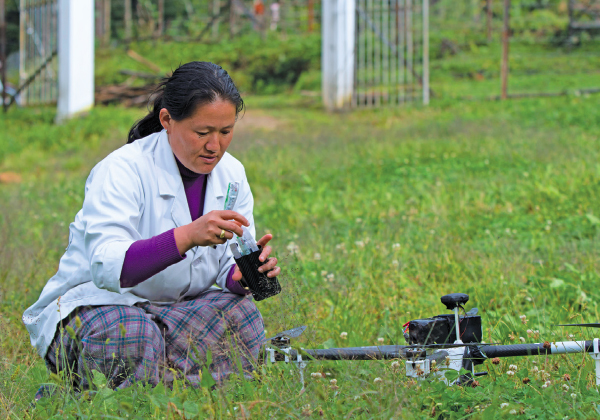
 In Bhutan, a doctor stocks a drone with medical supplies. (Photo by Dani Grant, courtesy of Matternet)
A new force for growth is emerging in some of the world’s poorest regions, and it leverages some of the world’s most advanced technology. The Internet of Things (IoT)—a model that uses networks of Internet-enabled devices that often operate without human intervention—might appear to have limited applicability to the world’s least-developed economies. But many elements of the IoT model, such as cheap sensors and wireless technologies, are remarkably well suited to conditions in poor countries. Organizations of all kinds are creating and using IoT networks to deliver new solutions that can increase living standards, and they are doing so without the need for large financial investments or the heavy involvement of state bureaucracy.
Drawing from interviews, published reports, and other sources, we have investigated the global potential of IoT technology. In the course of that research, we have identified three ways in which IoT capabilities can promote economic growth.
Compensating for poor infrastructure | Lack of infrastructure is a significant barrier to economic growth in many poor countries. But IoT technology provides a relatively inexpensive way to overcome that deficit.
IoT systems, for example, offer an alternative to traditional telecommunications infrastructure. That kind of solution can be particularly effective for tracking weather changes. “Developing countries lack the weather monitoring infrastructure that we take almost for granted in the United States and Western Europe today,” says Bob Marshall, CEO of Earth Networks, a company based in Germantown, Md. Every year, he notes, severe weather kills more than 20,000 people in developing areas—from fishermen on boats to farmers who are tending crops. Conventional meteorological monitoring relies on radar systems to measure cloud cover and rainfall. But it’s hard to apply that approach in many parts of the world. “Radar is costly and time-consuming to implement and requires advanced training and resources to maintain,” Marshall says.
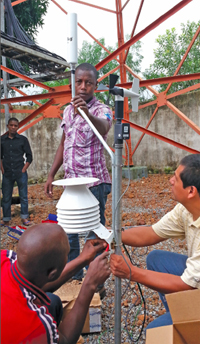 In Guinea, workers install weather-sensing equipment.
(Photo courtesy of Earth Networks)
Meteorologists have long known that certain patterns of in-cloud lightning provide advance warning of severe weather. Earth Networks has used this knowledge to design a cheap, reliable IoT-enabled weather monitoring system. That system, now in use in countries such as Guinea and Haiti, deploys lightning-detection sensors to predict extreme weather conditions—heavy rains, for example, or cloud-to-ground lightning. It then automatically warns people about those conditions via texting to mobile phones. The system can sound an alarm roughly 30 minutes before an extreme weather event occurs. (In the United States, which has an advanced weather infrastructure, the lead time for such notifications is often considerably shorter.)
Another common infrastructure weakness in poor countries is a paucity of grid-based electricity. Especially in rural parts of the developing world, people often have no option but to install expensive and environmentally hazardous diesel generators. Bboxx is a London-based company that offers a solution to that problem. It provides hardware that uses kits of solar cells to generate electricity. Customers are now using Bboxx products in countries such as Nepal, Rwanda, and Uganda.
Solar kit technology isn’t new. What’s novel about the Bboxx approach is the practice of remotely monitoring the condition of solar kits. Batteries are an important part of this technology, but they are highly prone to failure. By connecting each solar kit to the Internet, the Bboxx system can detect battery flaws that may not be obvious to the kit’s user. Christopher Baker-Brian, chief technology officer of Bboxx, explains how the system works: “We record data such as battery voltage, current, and temperature, and those data are sent to us every four hours.” Whenever the system identifies a problem, Bboxx relays that information either to its customer or to a local technician. Leveraging IoT capabilities in this way has allowed the company to develop ambitious goals. “We want to provide 20 million people with electricity by 2020,” says Baker-Brian. By the end of 2015, he adds, the company will reach about 400,000 customers.
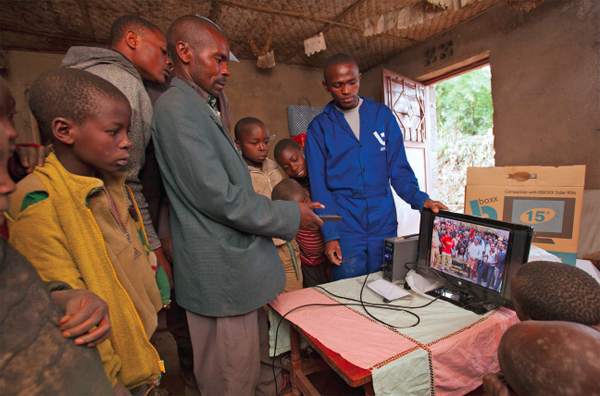 In Rwanda, a user tests the TV component of a solar grid
product. (Photo courtesy of Bboxx)
In Rwanda, a user tests the TV component of a solar grid
product. (Photo courtesy of Bboxx)
Transportation poses yet another critical challenge in many less-developed countries. Matternet, a company based in Palo Alto, Calif., is testing a drone delivery network in Bhutan with the goal of circumventing that country’s weak conventional transport system. Bhutan has only 3 physicians for every 10,000 people, and many Bhutanese who live in mountainous areas find it hard to obtain the medical care that they need. Matternet uses quadcopter drones to bring payloads of medical supplies to remote villages. The drones transmit their location in real time, and each drone carries up to four pounds of supplies and can travel over a range of about 12 miles. To extend the reach of its drones, Matternet plans to build stations where they can land and recharge their batteries.
Serving hard-to-reach markets | Companies that use IoT technology can sometimes find radically new ways to bring goods and services to underserved markets. Take insurance. Many farmers in poor countries have no financial protection against accidents or extreme weather conditions. Because they often work land in areas that are difficult to reach, insurers cannot easily validate their claims in the conventional way—that is, by employing inspectors who make on-site visits to assess damage. As a consequence, insurers are often unwilling to assume the costs and risks of taking on these customers.
A project called Kilimo Salama (which means “safe agriculture” in Swahili) aims to solve this knotty problem. Kilimo Salama—a partnership of the Syngenta Foundation for Sustainable Agriculture, UAP Insurance, and Safaricom began in Kenya in 2009 and subsequently expanded to Rwanda. The project provides crop insurance to farmers who would otherwise be unable to buy it. The Kilimo Salama system uses a network of weather sensors that connect to a database via cellular and satellite technology. The sensors record climate data every 15 minutes, and the system matches that information to other available weather data. If the data indicate that a specific farm has been subject to adverse conditions, such as drought or excessive rain, the farm’s owner automatically receives a payout. The system bases that payout on variables such as the difference between actual rainfall and the seasonal rainfall needs of a given crop. There’s no need for an insurance adjuster to inspect the farm or to determine the amount of loss.
IoT platforms can also significantly increase access to essential services such as health care. Many poor countries suffer from a severe shortage of qualified medical workers. But through technologies that enable remote patient monitoring, even people in rural areas can gain access to specialized medical treatment.
The Supporting LIFE project—a consortium of health care experts from eight countries—seeks to reduce the child mortality rate in Malawi. (The under-five mortality rate in that country is 133 per 1,000 live births.) The initiative assists health care workers who have limited training with the diagnosis and treatment of children who suffer from diseases such as malaria, infantile diarrhea, and pneumonia. Using a combination of smartphone technology and wireless body-area sensors, local providers enter patient data into a mobile app and immediately receive advice on how to detect and manage such conditions. Providers can also send patient information to a central database; by doing so, they help to generate accurate real-time disease statistics for a given area.
Boosting productivity | Less-developed countries are often resource-poor. But IoT technology allows people in those countries to get more out of the resources that they have. Networks of smart sensors, for example, can enable farmers to achieve higher yields from their land. Crop Performance, based in Cambridge, England, deploys such networks to track air and soil temperature, precipitation, relative humidity and wind speed, and soil moisture-holding capacity. The Crop Performance system sends these data via wireless network to farmers so that they can manage their crops remotely. “Growers can leverage IoT networks to inform spray recommendations for irrigation, nutrients, and crop protection,” says Stephanie Race, CEO of Crop Performance. By enabling farmers to monitor location-specific irrigation and fertilizer use throughout the growing season, the system results in lower input usage and increased profit per acre.
IoT technologies can also make the use of transportation assets more efficient. In developing countries, delivery and logistics companies have to deal with an array of hazards: theft, driver inefficiency, data-entry errors, vehicle breakdowns, and the like. But efforts are under way to reduce or eliminate these problems. An Atlanta-based company called Roamworks, for example, is bringing IoT-based fleet management to Tanzania. The Roamworks solution enables trucking and logistics firms to link fleet data to legacy enterprise systems. Through cellular and satellite technology, moreover, customers can keep track of fleets in remote parts of the country. Using a mobile app developed by Roamworks, managers can reschedule shipments and monitor driver behavior in real time; they can even immobilize a vehicle in the event of theft.
Despite the formidable challenges faced by the world’s poorest nations, the Internet of Things is already igniting economic development in several of those countries. To replicate these early successes, entrepreneurs should keep in mind the three Ns of making an IoT project work: needs, networks, and novelty. First, they should start with a needs-based view of market potential and avoid the temptation to focus on products or services that companies are already comfortable with selling. Second, in order to unlock capital and other resources, they should tap into networks that link businesses with local community organizations, development agencies, and governments. And third, they should embrace novelty—both in the technologies that they use and in the business models that they adopt—as a means of thriving in difficult environments.
Read more stories by Ladan Davarzani & Mark Purdy.