


 (Illustration by iStock/erhui1979)
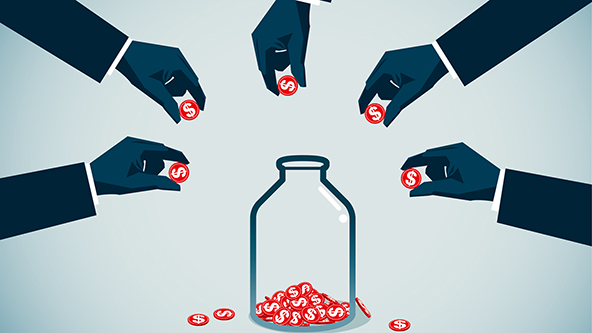
Ever since Vanessa Patrick, a marketing professor at the University of Houston, published a landmark study a decade ago about the ways people say no to requests, researchers have focused on the effects of semantic framing, or how subtle shifts in language carry different connotations that produce different responses. A new paper by Lei Su, a professor of marketing at City University of Hong Kong; Jaideep Sengupta, a professor of marketing and business at the Hong Kong University of Science and Technology School of Business and Management; Yiwei Li, a professor of marketing and international business at Lingnan University, Hong Kong; and Fangyuan Chen, a professor of management and marketing at the University of Macau, investigates the language of crowdfunding appeals. Do crowdfunders seeking donations see different results depending on the phrasing they use?
Mining some 10 years of data from crowdfunding platforms GoFundMe and Kickstarter that included more than 200,000 campaigns, the researchers analyzed two common ways of framing requests: “I want your help” and “I need your help.” Crowdfunding requests typically assume one of two forms: donation-based appeals that rely on the altruism of donors, or reward-based appeals, which promise a gift or perk in exchange for monetary support. GoFundMe is a donation-based platform, while Kickstarter offers rewards for donations.
The researchers hypothesized that each linguistic frame would yield different outcomes, depending on the type of appeal and the goal of the donor. For GoFundMe, “I need your help” delivered more donations, the researchers found, while for Kickstarter, “I want your help” did. “Need” and “want” contained cues that changed donor perceptions, and by disentangling those perceptions, the researchers figured out what messages worked better, and for whom.
“The phrase ‘I need your help’ signaled greater dependency,” Sengupta says. “As a result of greater dependency, there was the perception that the person making the appeal was more vulnerable and more desperate. This made the request more effective in the context of donation-based appeals, where the only reason to donate is a desire to help out.” By contrast, the phrase “‘I want your help’ signaled greater independence, at least compared to saying ‘I need your help,’” Sengupta explains. “The perceptions of confidence and competence that this created led donors to respond more favorably to reward-based requests that were framed as a ‘want.’”
Appeals framed in terms of “need” pulled at the heartstrings of donors, succeeding most when the requester seemed desperate and highly dependent on raising funds. But a chef seeking to open a new restaurant, for example, whose campaign says, “I want your help, and in exchange, you will receive five free meals,” appears relatively independent, leading donors to believe in her competence, and thus the prospect of a successful restaurant, with the additional benefit of five meals on the house.
“For organizations that use crowdfunding, the message here is a simple but important one,” JoAndrea Hoegg, a professor of marketing at the University of British Columbia, says. “Think carefully about the language used in crowdfunding appeals. Given that such organizations are asking for money, telling funders that the firm ‘needs help’ in the appeal seems logical. However, if the crowdfunding appeal involves rewards, indicating that the organization ‘needs’ help might backfire.”
The researchers ran tests with student participants, creating their own appeals while following four conditions: “need,” “want,” reward, and donation. Measuring what students were willing to contribute to a documentary series on Antarctic nature, a career-counseling app, and a cultural and sports event in Hong Kong, the researchers focused on dependency as the mechanism that shaped perceptions. Taken together, their five studies provided overwhelming evidence that communications of dependency, vulnerability, confidence, and competence drove different funding amounts.
“We not only found that many crowdfunders were doing it wrong, but we also looked beyond reward and donation,” Sengupta says. “We saw that when funders started thinking about profit versus nonprofit, the same effect kicked in. A for-profit company prompts the funder to think in terms of ‘What’s in it for me?’ So, want works better. But for a nonprofit, where potential donors think ‘How can I help?’ need works better than want.”
Lei Su, Jaideep Sengupta, Yiwei Li, and Fangyuan Chen, “‘Want’ versus ‘Need’: How Linguistic Framing Influences Responses to Crowdfunding Appeals,” Journal of Consumer Research, forthcoming.
Read more stories by Daniela Blei.