


In 1776, Spanish explorers established a fortified outpost on the northern edge of what would become San Francisco. Over the next 200-plus years, this outpost, dubbed the Presidio, was a military base—first under Spain, then under Mexico, then under the United States. In all that time, the forces based at the Presidio never fired a shot in anger. Then, in 1989, the Pentagon announced that it was planning to close the Presidio as a military post. According to legislation enacted by the US Congress in 1972, the Presidio would eventually pass into the jurisdiction of the National Park Service (NPS).
It was at this point that the Presidio turned into a battlefield. The combatants have included members of Congress, federal agencies, advocacy groups, environmentalists, and billionaires with art collections that they want to share with the world. At issue: How to maintain a 1,491-acre park—a large tract of open space and developed land that features historic architecture and iconic views of the Golden Gate Bridge—in a way that honors its past, serves present users, and remains financially viable in a political climate where Congress often trims NPS budgets with an unsparing hand.
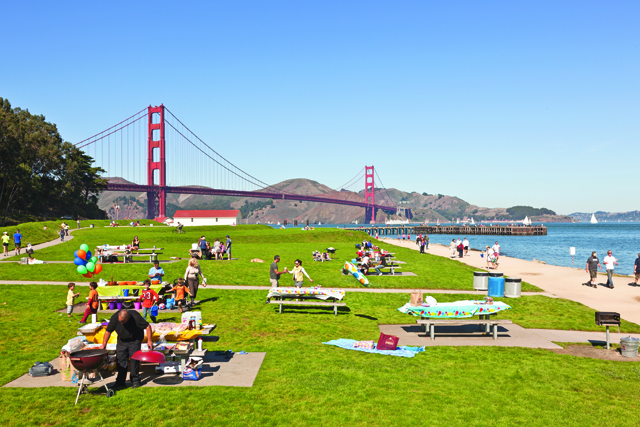 Golden Vista: Crissy
Field, known as the “front
door” to the Presidio, has
become a popular spot
for picnickers. (All photos courtesy of the Presidio Trust)
Golden Vista: Crissy
Field, known as the “front
door” to the Presidio, has
become a popular spot
for picnickers. (All photos courtesy of the Presidio Trust)
For nearly two decades, an entity known as the Presidio Trust has played a central role in the Presidio saga. Created by Congress in 1996, the trust is a corporation wholly owned by the federal government that manages most of the parkland at the Presidio. Congress gave the trust a mandate to “increase revenues to the Federal Government to the maximum extent possible,” and many onlookers worried that this provision would doom the Presidio to a bleak future as a heavily privatized business park—a place where corporate logos would bloom like wildflowers. “There were elements to what Congress did that made the trust threatening to the National Park Service,” says Craig Middleton, who signed on as the trust’s first employee in 1997 and became its executive director in 2001. “The trust reported to the President of the United States, not the Secretary of the Interior. It had lots of flexibility relative to hiring and firing, contracting, all the things that [other] government [agencies] complain about.”
In fact, the NPS had taken part in developing the trust model for the Presidio. Yet NPS leaders viewed the Presidio Trust cautiously once it came into existence. “We were really suspect,” says Middleton, who announced in February that he would be leaving the organization after serving there for 18 years. “People were saying, ‘What does this mean for the parks? Does this mean that Yosemite is next—that they’re going to privatize that?’”
So far, no multinational has managed to purchase naming rights to any part of the Presidio. To be sure, the trust has replaced some old buildings with new ones, and a film production company and a sporting-goods retailer now occupy space where soldiers once spent their days. But that’s only part of the story. The trust has rehabilitated hundreds of structures, built or rebuilt trails and scenic overlooks, and cleaned up landfills and toxic-waste areas.
Perhaps most remarkably, the Presidio hasn’t received or required federal funding since 2012. When Congress created the trust, it imposed a strict deadline: If the Presidio wasn’t financially self-sufficient within 15 years, the General Services Administration would take possession of the land and dispose of it by means that could include selling it to private developers. That didn’t happen. And today the trust brings in revenues that exceed its operating costs by about $30 million a year.
The battle over the future of the Presidio has not ceased. But the Presidio Trust, in part by organizing its work around cross-sector partnerships, has demonstrated the feasibility of one model for funding and managing a large public park.
Marking a Transition
Along with being a strategic location for Army operations, the Presidiowas a favorite post among high-ranking officers who looked forward to winding down their careers by battling the sand traps of its 18-hole golf course. Local politicians loved the post, too, because it poured millions of dollars into the San Francisco economy without requiring many services in return. It had its own police force, its own fire department, and its own utility systems. The Presidio also had a long history as de facto parkland for San Francisco’s civilian population. “The Army would put on a parade or an artillery demonstration, and thousands of people would come out and sit on the sand dunes and have picnics,” says Whitney Hall, a retired US Army colonel who served as the Presidio’s commandant from 1978 to 1981.
In 1972, Congressman Phillip Burton drafted legislation that would eventually create the Golden Gate National Recreation Area (GGNRA), a non-contiguous area that covers about 28 miles of coastal lands north and south of the Golden Gate. Although the future of the Presidio as a military post seemed fairly secure at the time, it was situated amid what would become GGNRA land. So Burton included a provision that would have far-reaching consequences: When the Presidio was “determined by the Department of Defense to be excess to its needs,” it would transfer to the jurisdiction of the Secretary of the Interior and become part of the GGNRA.
Ultimately, it was a simple economic truth that determined the Presidio’s fate. “The cost to support each uniformed person at the Presidio was the highest of any Army post,” Hall explains. As early as 1979, the Army began to explore the possibility of divesting itself of the Presidio. A decade later, in 1989, the end of the Cold War prompted a large-scale restructuring of US military facilities, and the Presidio turned up on a list of imminent base closures.
Parks advocates in the San Francisco Bay Area rejoiced at the possibility of adding the Presidio to the GGNRA. But they also faced an immediate practical consideration: How much would it cost to operate as a park? By NPS standards, the Presidio is tiny. Yellowstone National Park could contain 1,488 parks as big as the Presidio within its borders. But over more than two centuries, the Presidio had developed a robust infrastructure that included 870 buildings—barracks, single-family residences, hospitals, a bowling alley, a golf course, and more. Maintaining all of those structures, hundreds of which were subject to the National Historic Preservation Act (NHPA) and to California preservation laws, would be quite expensive. “No one knew exactly what the numbers were, but it was believed that the Army had been spending $70 million a year to run the place,” says Middleton. The NPS didn’t have that kind of money. Even the “crown jewels” in its system, such as Yellowstone and Yosemite, were not nearly so costly to maintain. (In 1995, the appropriation for Yellowstone was $18.3 million.)
Building (a) Trust
The Army did not plan to leave the Presidio until 1994, so the NPS had five years to figure out how to pay for its new park. The agency turned to a local nonprofit, the Golden Gate National Parks Conservancy (GGNPC), which had formed in 1981 to raise funds to benefit the GGNRA. The GGNPC advised the NPS to create a stand-alone advisory group—the Presidio Council—to help determine the park’s purpose, its features, and, most important, its funding model. The council recruited the consulting firm McKinsey & Co. to work on the project. “They donated hundreds of hours of volunteer time to look at management models around the country that were dealing with sites that involved a combination of public, private, and nonprofit talent and funds,” says Greg Moore, president and CEO of the GGNPC. “Their research was the foundation of the Presidio Trust idea.”
At the heart of the trust idea lay a critical insight: The problem of funding the Presidio contained its own potential solution. All of those buildings were costly to maintain, but all of those buildings could generate rental income, too. “The Park Service people who were involved on the ground realized that their legislative authorities were insufficient for this,” says Moore.
Historically, the NPS has operated on an appropriations basis. Each year, the agency as a whole submits a budget to Congress, and Congress allocates the funding that it deems appropriate. In turn, individual parks must submit most of the user fees that they collect to the US Treasury. Over the past two decades, Congress has modified that structure, and parks are now able to retain some user fees for their own purposes. But in the early 1990s, every dollar that a park collected went to the Treasury. As a result, the NPS had little or no institutional capacity for enabling parks to maximize their revenues.
What McKinsey and the Presidio Council recognized, however, is that the Presidio would require an organization that possessed both special administrative powers—such as the ability to retain its own revenues—and a more entrepreneurial mindset. It would need managers who had experience in borrowing capital, crafting partnerships, negotiating leases and other contracts, managing facilities, and cultivating private donors. And that would mean tapping private-sector expertise.
The NPS accepted this solution, at least in part. In October 1993, it published “Creating a Park for the 21st Century,” a document that presented its “grand vision” for the Presidio. The agency envisioned the new Presidio as “a national park unlike any other,” a place where nonprofit tenants would join forces to pursue work on “sustainable design, global climate change, environmental cleanup, resource protection, biological diversity, and other significant environmental concerns.” In partnership with the NPS, a “federally chartered partnership institution” with “new legislative authorities” would manage the Presidio. The site would be divided into two sections. Area A, which the NPS would oversee, would consist of 323 mostly undeveloped coastal acres. Area B, which the new institution would govern, would encompass the remaining 1,168 acres.
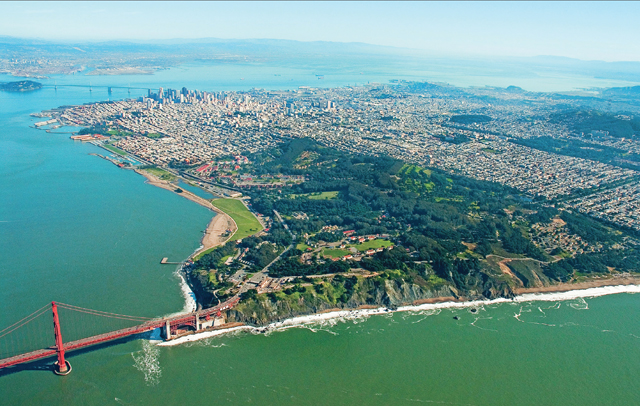 Prime Location: The
Presidio lies at the edge of
the Pacific Ocean, just a
few miles from downtown
San Francisco. (Photo by Robert Campbell)
Prime Location: The
Presidio lies at the edge of
the Pacific Ocean, just a
few miles from downtown
San Francisco. (Photo by Robert Campbell)
The NPS plan assumed that the new entity would be able to generate considerable revenue on its own. Even so, the plan called for annual appropriations of up to $25 million. At the time, the federal debt stood at $4 trillion, and Congress had no appetite for additional spending. Convinced that the Presidio would “drain money from every other park in the Nation,” Rep. John Duncan, a Republican from Tennessee, introduced legislation to sell the Presidio. So did Senator Pete Domenici, a Republican from New Mexico. Domenici even put a price tag on it: He said that sale of the land could yield as much as $550 million.
But other members of Congress—including Nancy Pelosi, a Democrat from California whose district includes the Presidio—continued to push for the creation of a new federal agency to manage the Presidio. Eventually, that side won the debate. In 1996, Congress voted to establish the Presidio Trust. It also agreed to provide the trust with annual appropriations that would start at $25 million. But each year thereafter, those appropriations would decrease. And in 15 years, they would stop entirely.
Conserving Authority
In some respects, the structure of the Presidio Trust mirrors the conservancy model that has grown in popularity over the past few decades. Across the United States, private citizens have formed nonprofit organizations—the Central Park Conservancy in New York City, for example, or the GGNPC—that help fund and maintain parks and other public spaces. In this model, a city or other government entity typically owns the parkland in question, but the conservancy ends up playing an integral role in daily park operations. The GGNPC, which has raised more than $300 million for the GGNRA, also oversees restoration projects in GGNRA parklands, manages six native plant nurseries, operates eight gift shops, organizes a wide range of volunteer and outreach programs, and leads tours. The rise of conservancies, not surprisingly, has generated concerns about the danger of privatization and the possibility that the public will lose control of public assets.
The Presidio Trust was designed to provide the kind of entrepreneurial orientation and private-sector expertise that conservancies often bring to park management. Yet it differs from a conservancy in significant ways. For one thing, it’s wholly owned by the federal government and thus wholly accountable to the government. Empowered by an act of Congress, the trust can potentially be dissolved by an act of Congress. Equally important, having a statutory foundation gives the trust a crucial measure of authority. If its legitimacy had derived only from an informal agreement or even from a memorandum of understanding, it might not have lasted in its original form.
Indeed, in the early days of the partnership between the trust and the NPS, the two organizations clashed repeatedly. “There is a section in the Presidio Trust Act that gives the NPS a formal role with respect to interpretive functions for visitors,” says Toby Rosenblatt, who served as the first chair of the Presidio Trust Board of Directors. “Other than that, in terms of uses and budgets and every other operating aspect of the Presidio, it had no jurisdiction, and the Trust Act made that really clear.” Still, the NPS often tried to assert its institutional preferences. “They [NPS leaders] were never great believers in the trust having its independent operations and budget,” Rosenblatt says. “So they kept saying, ‘You’ve got to do things the way we do them.’ And the trust’s board and staff, with the help of attorneys, said, ‘No, that’s not what the Trust Act says.’” Congressional authority gave the upstart agency the ability to move quickly and boldly—even when a much larger and more established agency pushed back.
Saying Yes
In 1999, two years after it launched, the trust needed to summon all of the authority that it could muster. That’s when it announced that it was moving forward on a proposal by the filmmaker George Lucas to build a new corporate headquarters for his company, Lucasfilm, on the site where the Letterman Army Medical Center (LAMC) and the Letterman Army Institute of Research (LAIR) then stood. Those structures, built in the late 1960s, were not particularly beloved. (“It was a big ugly high-rise and a wretched-looking research center,” says Moore.) But the plan to demolish them and replace them with new construction of comparable square footage—about 900,000 square feet—drew howls of protest from nonprofit watchdog groups, including the Sierra Club, the National Trust for Historic Preservation, and dozens of other organizations.
Amy Meyer, a longtime Bay Area parks advocate who served on the Presidio Trust board from 1997 to 2003, recalls the reaction that the Lucasfilm decision prompted. “People were saying, ‘What is this anomaly, this ‘trust’? It’s supposed to be taking care of a national park, and now we’re going to have Star Wars on it?’” For many trust skeptics, the deal appeared to signal that the Presidio was on the verge of becoming, as the San Francisco Bay Guardian put it, “an intensively developed office complex.”
The NPS, in its 1993 plan, had suggested that “replacement construction” of LAMC would be necessary. Yet the NPS also took issue with the trust’s plan for the site, characterizing the “overall size, scale, materials, detailing, and siting” of the Lucasfilm project as “incompatible with Presidio’s status as a National Historic Landmark District.” Although the NPS had envisioned the Letterman Complex as a site of fairly extensive development, it had proposed to fill the space with tenants “devoted to scientific research and education focusing on issues of human health.” The licensing department of a billion-dollar movie production company wasn’t what the agency had in mind.
The terms of the Presidio Trust Act did not support the grandness of the original NPS vision. The act specifically charged the trust with finding “tenants that enhance the financial viability of the Presidio.” And in this case, that meant finding a tenant that could finance the Letterman Complex renovation on its own. The act enabled the organization to borrow up to $50 million from the US Treasury, and Congress was providing annual appropriations of about $25 million. But this one project would cost at least $200 million. In the judgment of the trust’s board, the Lucasfilm proposal was the best available option. Lucas’s company would cover the costs of renovation in return for a long-term lease, and when it moved into its new building, it would start paying about $5.8 million annually in rent. As a result, the trust would gain some of the capital that it needed to continue renovating other parts of the Presidio.
Tactically, though, it was a risky proposition. Choosing to make Lucasfilm a marquee tenant gave the trust’s critics a high-profile target around which to organize their protest efforts. “It was a very a controversial deal,” Middleton notes. But saying yes to Lucas brought substantial benefits that went beyond the direct revenue that resulted from the deal. “Those first few years, we were practically having to beg [non-residential tenants] to come out here,” says Middleton. “It was too far away. Nothing had been repaired yet. If you were lucky, the lights went on when you turned the switch. Lucas gave others the confidence that somebody had really placed a big bet on the Presidio—so they could, too.”
Engaging All Sectors
The trust, in other words, regarded Lucasfilm as an anchor tenant that would help draw other potential tenants to the park. That kind of synergistic approach has been typical of how the trust operates. Indeed, the Presidio Trust Act put a strong emphasis on collaboration. It specifically encouraged the trust to “maintain a liaison with the Golden Gate National Park Association,” for example. (That was the original name of what’s now the GGNPC.)
In addition, the act laid out clear guidelines for selecting a board of directors that would bring a variety of perspectives to the endeavor. Although the Bay Guardian claimed that the trust’s founding board was “made up largely of big business leaders and real estate developers,” the board was in fact fairly diverse. It did include Don Fisher, founder of the Gap; Toby Rosenblatt, a San Francisco developer; and May Murphy, a real estate lawyer. But the remaining members were Meyer, a parks advocate; William K. Reilly, a former administrator of the Environmental Protection Agency; Edward Blakely, dean of the School of Urban and Regional Planning at the University of Southern California; and John Garamendi, a high-ranking official at the US Department of Interior (who is now a US congressman).
The range of viewpoints that the original board embodied set the course for a culture of collaboration. “The fundamental magic of the Presidio comes from the trust’s ability to take a cross-sector approach, to combine public funding and public expertise, nonprofit funding and expertise, and private-sector funding and expertise to achieve a public vision and a public mission,” says Moore. As an example, Moore cites the effort to restore Crissy Field, the onetime airport of the Presidio. Moore’s group raised funds for the project, attracting $36 million from local foundations and other donors, and the NPS managed the restoration. “Together, we created this landmark site, beautiful and popular, and that made the buildings around it more leasable,” Moore says. “In every case, it’s been one improvement helping to leverage the other.”
The structure of the trust also provided a framework for philanthropic investment. Most important, it reassured donors that the Presidio had a future as a public place. “For philanthropists, there was a practical realization that the restoration of historic buildings for leasing was a business proposition,” says Moore. “It was important to get done, because without self-sufficiency, there wouldn’t be a Presidio national park.” By focusing on building restoration, meanwhile, the trust created an opening for philanthropists to make an impact in other areas. “Crissy Field, the trails and overlooks, the restoration of Mountain Lake and the Presidio Forest, youth programs—that’s where private foundations and individual donors realized that they could contribute to the public dimensions of the Presidio,” says Moore. To date, private donors have invested about $150 million in the Presidio.
Leasing the Future
In the early days of the Presidio trust, both advocates and critics of a new federal agency assumed that most of its revenue-generating efforts would involve commercial leasing. Both the NPS and the trust, after all, assumed that successful redevelopment of the Letterman Complex was crucial to the Presidio’s long-term success. Many critics, meanwhile, worried that the place would become a vast office park where corporate fat cats would ultimately push out every other species.
To a large extent, however, it is residential leasing that has shaped the economic fortunes of the Presidio. “Jim Meadows, the trust’s first executive director, made the important recognition that the most valuable and marketable asset in the Presidio was the residences,” says Rosenblatt. “The early money that came from appropriations was all devoted to rehabilitating and upgrading the residential property and getting it leased.” The trust applied much of the $50 million that it was able to borrow from the US Treasury toward this end as well.
Investing most of its capital in residential real estate allowed the trust to generate significant returns very quickly. By 2001, the trust had 872 rentable housing units. In the wake of the dot-com bust and the recession that followed, its efforts to rent commercial space faltered. But its residential revenues continued to increase rapidly: They rose from $7.3 million in fiscal year 1999 to $21.3 million in fiscal year 2001.
The trust’s decision to use most of its available capital to develop residential housing also had a significant long-term impact. “There were two ways we could have approached residential leasing,” says Middleton. “We could fund it ourselves and then charge market-rate [rents] on short-term leases. Or we could do a deal where we gave someone a 50- or 60-year lease and then let them pay for the cost of fixing up their housing.” The trust had adopted the latter approach in the case of the Lucasfilm project because it didn’t have enough money to do otherwise. With its residential property, however, the trust was able to take the other approach—a move that proved to be extremely fortunate. “Rental prices in San Francisco have skyrocketed,” notes Middleton. By 2013, the trust was bringing in $44.2 million annually from residential leasing (compared with $19.6 million from non-residential leasing).
Renewing the Space
The trust has used its ample revenue to rehabilitate both the natural and the built environment over which it has responsibility. Today the Presidio is a cleaner, more beautiful, and more vital public place than it was when the trust took it over. The trust has dredged and purified the once-toxic Mountain Lake, removed hundreds of nonnative koi, carp, turtles, and other creatures that people had dumped into the lake over the years, and made the surrounding area safe again for native species like the chorus frog and the Western pond turtle. So many coyotes now inhabit the park that they have their own Yelp page. (They get mostly good reviews.)
To rejuvenate the Presidio’s 300-acre forest, the trust has removed aging trees and planted nearly 4,000 cypress and pine trees where those trees had stood. In May 2014, it completed a 20-year environmental remediation project to clean up waste that the Army had left behind. “There were 15 large landfills, hundreds of leaking underground petroleum tanks, toxic chemicals and materials, lead-based paint,” says Jan Blum, a longtime Presidio volunteer who helped with the cleanup process. “Over that 20-year period, more than 350,000 tons of contaminated soil were removed or, in some cases, capped to make it safe for everyone. It was a very big deal.”
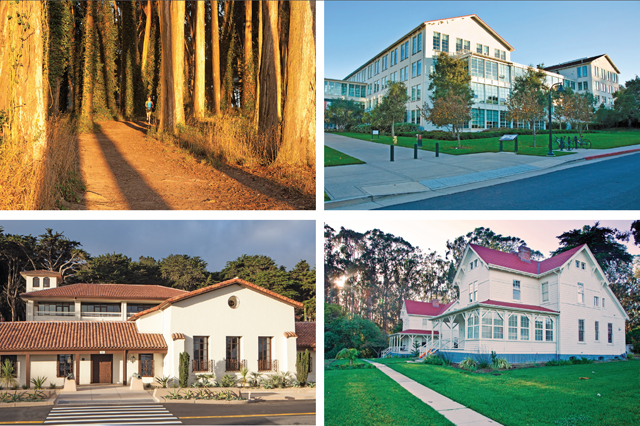 Throughout the
site, the Presidio Trust has
overseen the rehabilitation
of both natural and built assets.
Bay Area Ridge Trail (TL, Jay Graham), the Presidio Officers’
Club (BL), the
Letterman Digital Arts Center (TR), and various housing units (BR).
Throughout the
site, the Presidio Trust has
overseen the rehabilitation
of both natural and built assets.
Bay Area Ridge Trail (TL, Jay Graham), the Presidio Officers’
Club (BL), the
Letterman Digital Arts Center (TR), and various housing units (BR).
Working in concert with the NPS and the GGNPC, the trust has constructed eight scenic overlooks in the park and added or improved 22 miles of trails and 15 miles of bikeways. It has also rehabilitated the vast majority of its 433 historic buildings. In September 2014, the trust completed a $30 million makeover of its historic Officers’ Club. The club, a 37,000-square-foot structure that stands on the site where Spanish soldiers first set up a permanent residence in the late 1700s, features portions of adobe walls from that era, along with meeting rooms, a restaurant, and other modern amenities. In addition, there is a museum exhibition space where uniforms, weapons, and other artifacts from the Presidio’s period as a military post are on display. Other recent building efforts include the Inn at the Presidio, a 22-room boutique hotel, and the Military Intelligence Service Historic Learning Center, a project of the National Japanese American Historical Society.
Fielding Criticism
The scope of what the trust has accomplished is impressive. Yet the fight over the best use of Presidio land continues. People cherish the Presidio in different ways and from different perspectives. So it’s not hard to find critics of the trust. Blum, for example, says the trust has done a great job with building restoration but that it could do more to showcase the Presidio’s ecological attributes. “The Presidio is home to 16 different rare or endangered species,” she says. “It has over a dozen different ecological habitats. This park is really a biological treasure, but most of the public doesn’t know it.”
Others fault the trust for taking insufficient care of the Presidio legacy. “Restoring the Officers’ Club, restoring the Inn at the Presidio—we’re very happy with what the trust has done in both those places,” says Gary Widman, president of the Presidio Historical Association (PHA), a nonprofit advocacy group. “When it comes to new construction, that’s where they run away from their responsibilities under the Presidio Trust Act, part of which says that they have a responsibility to protect the Presidio from development.”
Two development proposals were especially controversial. In 2007, former trust board member Don Fisher put forth a plan to construct a new museum in the park. “He had an extraordinary modern art collection, and he wanted to build some place to show it off,” says Middleton. Fisher wanted to build in the most historic area of the Presidio, the Main Post, and he wanted to build big: His proposed structure would have had 100,000 square feet of space. Like the Lucasfilm project, this project has the potential to serve as a much-needed magnet for further development. “This was when the Main Post had almost nothing in it. All these buildings were empty, and nobody wanted to touch them because they were going to be so expensive to rehabilitate,” Middleton explains. But the scope and style of Fisher’s museum design sparked criticism. “It was a gorgeous building, but it didn’t fit with the rest of the site,” Middleton says. “People had a bad reaction to it, and we couldn’t overcome that.” In 2009, Fisher withdrew his bid and moved his collection to the San Francisco Museum of Modern Art.
During the same period, the trust also unveiled a plan to construct a lodging facility on the Main Post that would consist of 110 rooms in 14 buildings with 90,000 square feet of total space. The project drew complaints from the NPS, the National Trust for Historic Preservation, and the PHA. “Building a 14-building hotel in the middle of the single most historic piece of real estate on the Presidio is not protecting it from development,” says Widman. In 2012, the PHA and the Sierra Club filed a federal lawsuit in an attempt to block the project, claiming that it violates the Presidio Trust Act, the National Historic Preservation Act, and the National Environmental Policy Act. In 2013, a judge ruled in favor of the trust, but the PHA has appealed the case, which is now before the US Court of Appeals for the Ninth Circuit.
Another point of criticism is that the trust could do more to present and interpret the history of the Presidio. At present, Hall suggests, the Presidio functions well as a recreational space for the people of San Francisco, but it does too little to attract national and international visitors by highlighting features that make it a national historic landmark. “The history display in the back of the Officers’ Club [was] the result of years and years and years of being hounded and pecked at by neighborhood groups and others, who said, ‘Where’s the history? What is this place?’” Hall says.
Fulfilling Its Promise
None of the issues raised by critics is likely to fade anytime soon. In fact, as the trust continues to solidify its financial position, criticism of its actions will probably intensify. For much of its early history, the trust was able minimize expectations because it had to focus on the basics—repairing infrastructure, renovating buildings, cleaning up landfills. To a large degree, therefore, it deferred attending to the question that the NPS posed in 1994: What kind of park should the Presidio be? The trust has, in many ways, been more conservative in its stewardship than the NPS had intended it to be. The NPS, after all, had envisioned the Presidio as a new kind of service institution. It had wanted to create enough short-term lodging options to host as many as 720 people a night. (The trust has fallen far short of that goal.) Most of all, the NPS had aimed to create something that would be different from Yosemite or Gettysburg or any other park in the NPS system.
Now the Presidio Trust is in a position to explore such ideas. Leaders at the trust note that they’re entering uncharted territory. “With the Trust Act, Congress provided us with a very clear North Star,” says Joshua Steinberger, chief strategy and communications officer at the trust. “It offered a clear picture of what success or failure looked like. But there was less direction about what happens after 15 years.”
In 2013, the trust provided funding to launch the Presidio Institute, a nonprofit organization that seeks to promote leadership and service through a cross-sector fellowship program. That organization also uses office space at Fort Scott, a former Army training center. Developed in partnership with the White House, McKinsey & Co., and other entities, the institute echoes the original NPS vision of the Presidio as a global center for exploring social and environmental issues from a cross-sector perspective.
The trust is also pursuing a large infrastructure project called the New Presidio Parklands. For decades, a highway that connects downtown San Francisco to the Golden Gate Bridge has separated Crissy Field from the Main Post at the Presidio. Now the California Department of Transportation is constructing a series of at-grade tunnels that will replace the highway; above those tunnels, the Presidio Trust will be able to create a 13-acre landscape. As this project moves forward, familiar questions arise: How much new construction should there be? What are the best uses for the new parkland?
“The trust is in a transition from real estate development and financial sustainability into park-making,” observes Blum. “They say they want to ‘activate’ the Main Post. They want to ‘activate’ the Parklands. And they want to create a place that is welcoming to visitors from everywhere. But we already get 1.6 million visitors a year. How many people do we want to attract, and how will that affect the visitor experience? What is the ultimate goal?”
“The trust is in a transition from real estate development and financial sustainability into park-making,” observes Blum. “They say they want to ‘activate’ the Main Post. They want to ‘activate’ the Parklands. And they want to create a place that is welcoming to visitors from everywhere. But we already get 1.6 million visitors a year. How many people do we want to attract, and how will that affect the visitor experience? What is the ultimate goal?”
While Blum suggests that the Presidio might become too busy, others argue that the trust has fallen short in efforts to draw people to the park through programming. Currently, the trust spends about $6 million a year on presentations at the Officers’ Club, a weekend food truck event on the Main Post, and other fare of that kind. Over the next five years, the trust plans to increase that figure to $7 million. “That’s almost no increase at all,” complains Don Green, a retired economist who has been a member of various advocacy organizations with an interest in the Presidio. “The program budget should at least double, from $6 million to $12 million, because that’s what the trust is supposed to be doing—providing services to the public.”
Saying No
The NPS, which will celebrate its 100th anniversary next year, now faces an estimated $11 billion in deferred maintenance costs. All across the country, US national parks are filled with leaky water systems and crumbling buildings. But because Congress controls their purse strings, they can do only so much to fix those problems. The Presidio, by contrast, stands as a beacon of self-determination. The Presidio Trust—often criticized for leaving the Presidio vulnerable to commercialism and undue private-sector influence—has grown into a powerful mechanism for ensuring the park’s autonomy. Not only does the trust enjoy a strong financial position, but it’s able to choose (or not to choose) new projects as it sees fit.
Just ask George Lucas. In 2012, he and his team submitted a bid to build a new museum on a prime location within the Presidio. The site, which boasts postcard-worthy views of the Golden Gate Bridge and Alcatraz Island, now is home to a nondescript structure that once served as the Presidio’s commissary. (Its current lessee is a discount sporting-goods retailer.) For more than a decade, the trust has planned to develop “a cultural institution of distinction” at this location. Lucas proposed to build a museum on the site that would house his $1 billion collection of narrative art—a collection that includes works by illustrators like Norman Rockwell, along with works of animation and cinematic set design.
In many respects, it was an extraordinarily attractive proposal. Lucas was planning to pay the entire cost ($300 million) of building the museum. He was also going to create a $400 million endowment that would cover all operating costs in perpetuity. And he was ready to pay millions of dollars per year in rent to the Presidio Trust. Lucas’s high profile and the museum’s tourist-friendly content, moreover, would attract hundreds of thousands of visitors every year. There would be learning opportunities for children, research libraries for scholars, and meeting facilities for visiting artists. For all of these reasons, the project had won the support of California Governor Jerry Brown, Senator Dianne Feinstein, House Minority Leader Nancy Pelosi, San Francisco mayor Ed Lee, the director of the Smithsonian American Art Museum, and other luminaries.
When the Lucas team unfurled its sketches for the Beaux Arts-style building that it envisioned for the site, however, the designs prompted a wave of criticism. The proposed museum looked stolid and sepulchral, particularly in the context of the open space that it would inhabit. “People were calling it the museoleum,” says Meyer. It was also too tall and would potentially block views from the Main Post. Others noted the project’s lack of a thematic or historic connection to the Presidio.
In February 2014, the Presidio Trust board unanimously rejected the project, along with the two other proposals that it was considering for the site. According to the current chair of the board, Nancy Hellman Bechtel, none of the projects “quite hit the mark.” Many park advocates applauded the decision. “I give them a lot of credit for standing up to this push to bring a vanity project into one of the most beautiful sites in America,” says Blum. “That took a lot of courage.” But courage alone would not have been enough. The trust, thanks to its access to other sources of revenue, had reached a point where it could afford to say no—even to a $300 million museum.
Providing a Model?
Despite the success of the Presidio Trust, even many of its strongest allies are reluctant to vouch for the portability of its model. “If there are places like the Presidio that face the same challenges, maybe smaller in scale, I think the trust model is worth considering,” says Moore. “But when you look at Yellowstone or the Grand Canyon, or the majority of our national parks sites, they’re too different in their composition for an approach like this.” Rosenblatt sounds a similar note: “The NPS and some of the major Friends of the Park groups always worried that the Presidio Trust structure would be a precedent for other national parks. And we’ve always said, ‘You shouldn’t make that leap,’ because very few other national parks or monuments have so many leasable resources.”
In Middleton’s estimation, however, the trust does illustrate at least one important and broadly applicable principle. “The trouble with these big [government] systems is that they create policies that have to apply to everything equally. So whether it’s a little historic park or a much bigger park, they’ve got the same template,” he says. “The lesson here is to be flexible enough and autonomous enough to design for the place, instead of trying to impose the same solution throughout the system.”
Middleton also believes the trust stands as a powerful example of what government can do well. “It’s a demonstration of how the public sector can be really effective,” he says. “In our culture, the myth is that the only people who can innovate are in the private sector, and the people who stop you from innovating are in the public sector. In the Presidio, we’re the regulators and the safeguarders, but we’re also the implementers. And I love that.”
Read more stories by Greg Beato.