


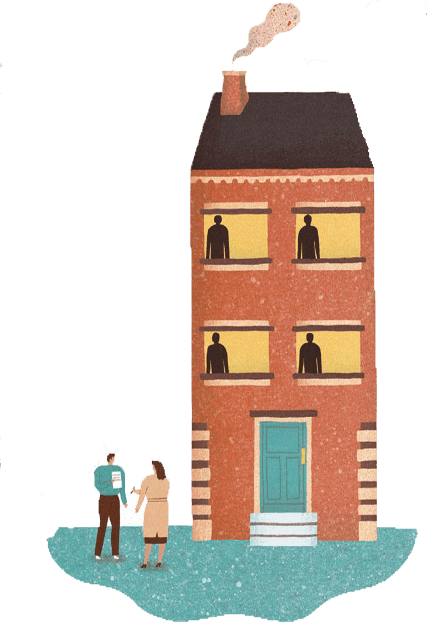
 (Illustration by Jacob Stead)
To help stabilize the electrical grid in their area, some customers of Pacific Gas and Electric (PG&E) have agreed to give up control over their air conditioners. PG&E, through its SmartAC program, installs a radio-activated switch on the customers’ thermostats, and that device adjusts air-conditioner use at times of peak demand for electricity. This past summer, the program helped avert three potential brownout or blackout events. To attract volunteers, the utility offers a small monetary reward.
But according to new research, more people would sign up for the program if PG&E offered nothing more than a way to improve their reputation. “Tapping into everyone’s implicit desire to be seen well by the members of their community can be a very powerful force for changing people’s behavior in a very cost-effective way,” says David Rand, a psychologist at Yale University. Rand and his colleagues have found that the best way to entice people into signing up for the blackout prevention program is to let their neighbors know that they’re doing so.
Working with PG&E, the researchers turned a routine marketing campaign for SmartAC into a multifaceted experiment. In standard marketing mailers, PG&E tells customers to sign up for the program online or by phone. But in this campaign, residents of multi-unit buildings received a mailer that instructed them to use signup sheets posted near their building’s mailboxes. In half of these cases, the sign-up process was anonymous, requiring customers merely to enter a code printed on their mailer. The other sign-up sheets asked residents to write in their name and unit number as well. “We expected that making it so that people’s neighbors could see what they did would make them more cooperative, but we were surprised by how big the effect was,” says Rand. The rate of participation was three times as high in cases when volunteers’ names were visible as in cases when they weren’t.
Some of the mailers distributed by the researchers offered a $25 reward; others didn’t. (PG&E has since increased the reward to $50.) PG&E leaders believed that the financial incentive would be more powerful than the reputational incentive. But, as it turned out, giving volunteers credit for their good deed was seven times as effective as giving them money.
One theory of why people sometimes act unselfishly emphasizes the importance of reciprocity: If you help others, then they in turn may be more likely to help you in the future. Of course, that dynamic works only if other people are aware of your behavior—and only if they believe that they’ll be interacting with you in a sustained way. In the SmartAC experiment, the researchers tested the effectiveness of the public signup method on customers who live in various kinds of dwellings. They found that the use of public sign-up sheets increased participation more in multi-unit buildings (where neighbors can easily see the sheets) than in row houses or single-family homes (where those sheets are much less visible to neighbors). The researchers also found that participation increased more in buildings where residents own their units than in buildings occupied by renters. (Turnover is less frequent, and thus relationships tend to be longer-term, in owner-occupied buildings than in rental-unit buildings.)
Scholars in many fields have established that people are more likely to cooperate when their reputation is at stake. “Your grandmother could have told you that,” says Daniel Fessler, an evolutionary anthropologist at UCLA whose own research shows that the mere suggestion of being watched makes people behave more generously. (In experiments, Fessler has demonstrated that briefly displaying the image of a pair of eyes will increase subjects’ inclination to be cooperative.)
But the blackout prevention study makes this finding practical by applying it to a real-world, policy-relevant setting. And that approach is spreading. “We’re working with people in the [US] Department of Energy to look at using the same sort of strategy to get people to do renovations that will make their homes more energy efficient,” Rand says. “There’s a really wide range of applications for this.”
Read more stories by Jessica Ruvinsky.