


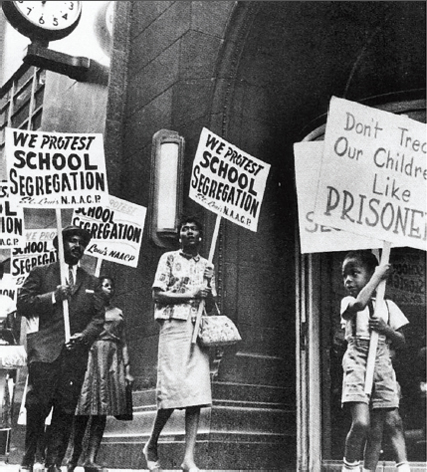
 Recent US court decisions cast doubt on the future of school integration—a major goal of civil rights marchers in the 1950s. (Photo courtesy of the US National Archives and Records Administration)
In the mid-20th century, one prominent means of effecting social change in the United States was use of the judicial system. In 1954, for instance, the landmark decision by the US Supreme Court in Brown v. Board of Education dealt a powerful blow against racial segregation in public schools. In the decades that followed, federal courts issued integration orders to scores of school districts, particularly in the South. By the early 1970s, the majority of black students in Southern districts attended integrated schools.
But what happens when the courts change direction? In the 1990s, the Supreme Court issued a series of decisions that made it easier for school districts to gain release from court oversight. Until recently, it wasn’t clear whether that shift had allowed some districts to undergo resegregation. A team of researchers led by Sean Reardon, professor of education and sociology at Stanford University, has now studied that question.
The team compiled a list of every US school district that had ever been under a court order to desegregate. That task, Reardon notes, “turns out to be harder than you’d think.” After gathering information from the US Department of Justice and from federal courts, he and his colleagues identified 483 school districts with more than 2,000 students that had been under court oversight as of 1990.
Next the researchers determined how many of those districts had been released from oversight. “We ended up calling hundreds of school districts and talking to their attorneys or superintendents,” Reardon says. Their extensive legwork led them to find that the courts had released 215 districts from oversight by 2009.
Reardon and his colleagues compared that set of districts with the set of districts that were still under court oversight. The degree of segregation had gone up noticeably in schools that belonged to the first group, they discovered, whereas the racial makeup of schools in the second group had remained stable.
Many districts had complied with earlier integration orders by busing students across neighborhood boundaries. After release from court order, these districts often returned to a neighborhood school system. Because patterns of residential segregation remain common in the United States, these districts have tended to experience an increase in racial segregation, according to the researchers.
Reardon and his colleagues are now exploring whether the shift toward resegregation has affected student achievement. Previous studies have shown that the educational outcomes of black students improve when they attend integrated schools. (For white students, meanwhile, the integration of schools tends to have no effect on outcomes.) “The worry is that if students become more segregated, then resources among schools become more unequal,” Reardon says.
On the whole, the recent move toward resegregation isn’t as dramatic as the transformation that occurred in the aftermath of Brown. “It’s not like it’s back to the pre-1954 South,” Reardon says. For that reason, he suggests, any change in achievement levels might not be as dramatic, either.
Read more stories by Corinna Wu.