


 (Illustration by Brian Stauffer)
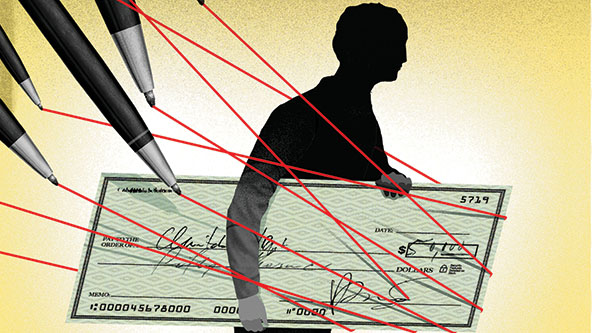
Raising large chunks of money from wealthy donors is a difficult enough task as it is. But it becomes doubly difficult when you factor in the risk that the person you are raising money from may turn out to be the next Jeffrey Epstein or Richard Sackler. This is the so-called dirty money problem.
Sometimes it’s clear that money is dirty. A good example is the Sackler family. But that is often easier to see in hindsight than when the money is given. In most instances, determining whether the source of the money is clean or dirty is much more ambiguous.
What about a bank that gives generously to the community, but some of its profits come from lending money or handling other financial matters for companies in industries you don’t like, such as oil firms? Do you decline money from JPMorgan Chase because it is one of the world’s biggest lenders to the fossil fuel industry? If the answer is yes, do you take money from a wealthy person who invested in Chase, or perhaps ExxonMobil itself? What about someone who worked at Chase or ExxonMobil—do you take their money?
Many people believe that Amazon is an evil company, but I didn’t hear of any organizations turning down gifts from MacKenzie Scott (Jeff Bezos’ former wife). Quite the contrary. People lavished praise on her and her giving, even though the source of that wealth was what detractors believe is the exploitation of Amazon workers and its monopolistic practices against other retailers.
And what about the money that is now handed out by foundations created by the earlier generation of robber barons like John D. Rockefeller and Andrew Carnegie? Is that dirty money?
Trying to discern what is “dirty money” can be a difficult endeavor. New York University assistant professor Lauren Taylor argues in “The Dirty Money Dilemma,” the cover story in the Spring 2022 issue of Stanford Social Innovation Review, that there is a better way to approach the issue. She believes that rather than focusing on the source of the money, one should focus on the terms of the exchange: What is the donor asking for in return for the money?
Sometimes big donors don’t want anything, in which case it’s often an easy decision—take the money. But most of the time, donors who contribute large amounts of money want something in return. Some want visibility. It may be something as simple as their name on a press release or as complex as their name on a building. Others want control. That may be a seat on the board or for the nonprofit to start a new line of work that the donor thinks is important.
Taylor is realistic about the world that nonprofits operate in. She doesn’t claim that all donor influence or recognition is bad, or that there can be universal rules that apply to all situations. What she does say is that nonprofits need to go into these relationships with their eyes wide open and dispassionately weigh the risks and rewards of the exchange for their own organization.
Read more stories by Eric Nee.