


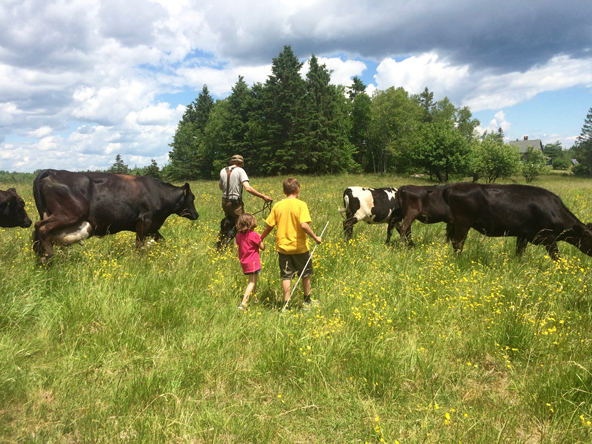
 Aaron Bell and two of his children tend to cows on Tide Mill Organic Farm in Maine. (Photo Courtesy of Jane Bell)
Seventeen years ago, Aaron Bell returned home after finishing college to work the land at his family’s farm in eastern Maine. Wanting to move the property in a more ecologically friendly direction, he and his wife, Carly DelSignore, successfully converted Tide Mill Organic Farm to organic, locally sourced production. Today they grow vegetables and raise dairy cows, pigs, and chickens on 1,600 acres perched along Maine’s rocky coast. But when Bell, an eighth-generation farmer, applied for loans to expand the business, several banks turned him down. “Most traditional lenders were not interested in collateral that involved live animals or farm equipment,” he says.
“There’s a financing gap for small farms,” says Scott Budde, a Portland, Maine-based impact investment specialist. “As agriculture has become bigger and more corporate in the United States, the financing structures have gone along with it.” Existing agricultural lenders, such as the US Department of Agriculture’s Farm Service Agency (FSA) and the Farm Credit Administration network, are tailored more toward large-scale, commercial farms. Although Bell has had some success getting loans from the FSA, he says that the agency is often unfamiliar with the financial needs of small farms, including the flexible financing structures that he believes are “critical to go up against the factory food system.”
Those wanting to take out loans for another type of green initiative—installing solar energy systems on their homes—also have problems finding financing from traditional lenders. The installation process can cost between $15,000 and $20,000 per house, more money than most lenders are willing to commit, says Blake Jones, a clean energy entrepreneur who cofounded the solar installation cooperative Namaste Solar in Boulder, Colo.
Various banks and credit unions readily offer up loans for specific industries and markets, such as new car or auto body shop businesses, but their services don’t extend beyond those particular areas. And green initiatives—including small farming and clean energy—are an unattractive niche for many lenders, since they require longer- term investments that can span 20 years and need competitive interest rates to be sustainable.
Interest rates for solar loans currently are far from competitive, since most funding comes from venture capital, says Jones. “So the prices are higher than they should be,” he says. “And we begged more than a dozen banks and credit unions to service the solar market … but they’re slow to adapt to changing markets.”
Now Budde and Jones are trying to fill this financing void by creating a special type of credit union that’s new to the United States. Budde is starting up the Maine Harvest Credit Project, which will specialize in loans and capital for small farmers and sustainable food businesses in the Pine Tree State. Jones is developing the Clean Energy Credit Union, which will secure competitive financing for clean energy projects such as solar power systems, electric vehicles, and home energy efficiency improvements across the United States.
Both “green credit unions” are nonprofit and memberowned, and Budde and Jones are partnering with other nonprofit groups in the sustainable farming and clean energy worlds: the Maine Organic Farmers and Gardeners Association, the Maine Farmland Trust, and the American Solar Energy Society. The new credit unions will offer membership to individuals in these existing organizations, allowing them to establish a base membership of people with allied interests.
So far, Jones’ team has raised about $1.3 million, has launched a crowdfunding campaign this year, and plans to launch the Clean Energy Credit Union by this summer. All of the credit union’s banking services will operate online, and members will be able to use ATMs at other credit unions as part of a shared services network, Jones says.
Meanwhile, Budde says that after five years in development, the Maine Harvest Credit Project is on schedule to open in early 2018. He’s raised more than half of the $2.4 million needed for startup costs, mostly from local and regional foundation grants. Three-quarters of this amount will go toward medium-sized loans (small farm mortgages of up to $500,000 and equipment loans of up to $100,000) on the day that Maine Harvest opens its doors. The remaining 25 percent will fund the credit union’s operating expenses. Budde anticipates that Maine Harvest eventually will be able to offer $10 million in future lending through member savings account deposits.
“Supporting small and independent farms and businesses is key to a diverse, strong, and resilient economy,” says Dorothy Suput, who serves on Budde’s advisory board and is executive director of The Carrot Project, a nonprofit that provides business advising, advocacy, and support for small farmers and food entrepreneurs in New England. “And we need places like Maine Harvest Credit because the existing financial institutions aren’t doing the job.”
Read more stories by Kristine Wong.