

A Women’s Movement on Wheels
The women-only transportation program in Papua New Guinea is challenging social norms about gender by improving women's economic lives and securing girls' education. A Field Report from the Winter 2020 issue.
Innovative ideas to help leaders of nonprofits and nongovernmental organizations work more effectively (more)
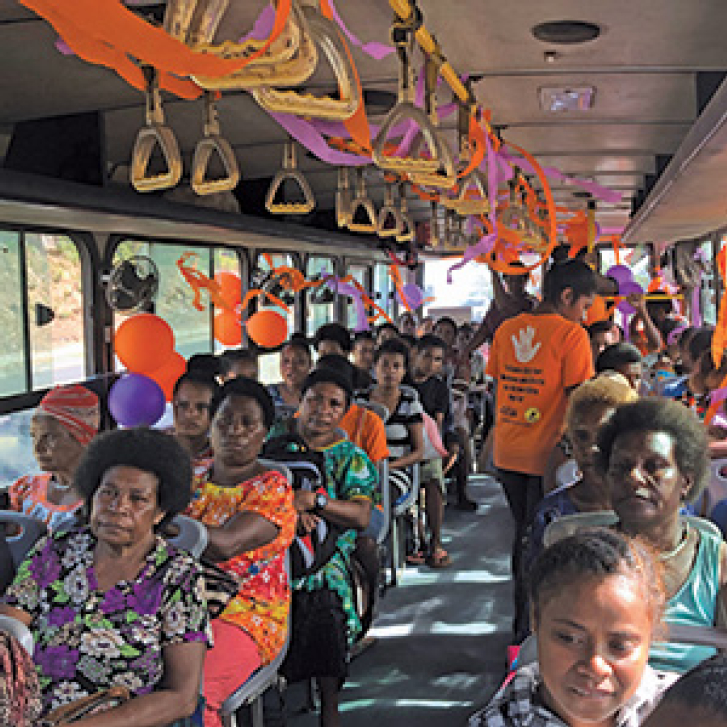
The women-only transportation program in Papua New Guinea is challenging social norms about gender by improving women's economic lives and securing girls' education. A Field Report from the Winter 2020 issue.

A new research paper reconstructs how an international children’s rights organization worked in Indonesia to disrupt child marriage, a guarded institution in the country. Research from the Winter 2020 issue.

Rather than a model with a fixed approach, as collective impact is, the community system solutions framework can be adapted to different types of situations. The Editor's Note from the Winter 2020 issue.

Three takeaways to establish the structural and institutional guardrails necessary to creating a serious, concerted, and holistic effort to address issues of power and inequality across civil society, government, and the economy. Part of the Winter 2020 issue's Realizing Democracy supplement funded by the Ford Foundation.

Despite growing pains, the pay for success funding model is finding renewed success in communities across the United States and is primed to evolve into an ever-more-powerful tool for social change.

By relying on academic research, organizations can understand where their communications will have the most impact. The final article in Humanitarian Innovation in Action, a series on innovation as a tool for change within complex institutions.

How organizations can create a culture that supports innovation, regardless of their size or complexity. The fourth of five articles in Humanitarian Innovation in Action, a series on innovation as a tool for change within complex institutions.

A pragmatic, “good enough” approach to experimentation in humanitarian contexts. The third of five articles in Humanitarian Innovation in Action, a series on innovation as a tool for change within complex institutions.

Two years after nearly a dozen India-focused organizations in the United States began discussing how they could combine forces, they have launched the India Philanthropy Alliance and revealed insights into making complex collaborations work.

By bringing diversity and inclusion to the forefront, even the most traditional organizations can enhance the design and implementation of social solutions. The second of five articles in Humanitarian Innovation in Action, a series on innovation as a tool for change within complex institutions.