


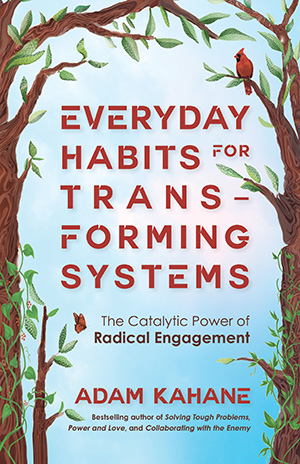
Everyday Habits for Transforming Systems: The Catalytic Power of Radical Engagement
Adam Kahane
200 pages, Berrett-Koehler Publishers, 2025
After 35 years working alongside leading changemakers around the world, I started to ask a fundamental question: How can each of us contribute to transforming the systems we are part of?
My answer is crystallized in the notion of “radical engagement” with a system. This doesn’t mean participating in that system distractedly, resigned, knowing it all, hierarchically, at arm’s length, with arms crossed, superficially, impatiently, saying take it or leave it. It means taking part in it alertly, with hope and curiosity, horizontally, leaning forward, hands-on, digging deep, persisting, and above all reciprocally and relationally. In my new book, Everyday Habits for Transforming Systems: The Catalytic Power of Radical Engagement, I’ve elaborated on this notion in terms of seven everyday habits. The fourth of this is “Working with Cracks.”—Adam Kahane
* * *
Systems are structured to keep producing the behaviors and results they are producing, and therefore often seem solid and unchangeable—but they are not. They are built, and they collapse. They crack and are cracked, which opens up new possibilities that some people find frightening and others find hopeful. Radical engagement involves looking for, moving toward, and working with these cracks—not ignoring or shying away from them. We do this by seeking out and working with openings, alongside others who are doing the same.
Searching for openings
Al Etmanski has pioneered the transformation of the living conditions of Canadians with disabilities, away from segregation, dependency, and second-class status toward connection, agency, and justice. I have spoken with him and studied what he and others have written about his decades of experience, and especially about how his strategy and approach have evolved and enabled him to make the contributions he has. He has advanced through repeatedly searching out and working with openings or cracks (breakdowns and bright spots) in the social-economic-political-institutional-cultural “disability system.”
Etmanski has spent most of his adult life as a community organizer, at the beginning as an educator, youth worker, and social housing planner. When his second daughter was born with Down syndrome, he became a parent activist in the disability movement.
I soon became head of the largest disability rights group in British Columbia (BC), and our activism produced a string of successes, including the closure of BC’s three large institutions for people with developmental disabilities, all its segregated schools, and many of its segregated classrooms and sheltered workshops. We blocked roads, sued government, and won an important right-to-treatment court case. This all gave birth to what is now called the community living movement.
For me these advances were tarnished by two realizations, one personal and the other cultural. First, my warrior mentality had taken its toll. I had become the very dragon I’d set out to slay. I left behind me a trail of busted relationships, particularly with government but also with some of my colleagues. Second, although the physical institutions were closing, an institutional mentality still occupied society’s collective psyche. People with disabilities were no longer segregated, but they were not part of their communities. Pity, charity, and low expectations dominated. Society neither recognized people with disabilities nor expected them to become contributing members of society.
Frances Westley is a leading scholar of systems transformation who has written about the evolution of Etmanski’s work.
Al Etmanski has spent his career working to try to find opportunities for disabled individuals. He started out, as many people do, with trying to create opportunities for his own child. He was an organizer in his early days, so he did the classic thing of getting a group of people together in his basement and thinking about what can we do to ensure that our children are safe and secure. They start to do that and they came up with this idea to create a kind of circle of support for people who were disabled, so it wasn’t just the parents that they were counting on. His model is very successful and, like in many voluntary or social sector organizations, at a certain point he and his partner Vickie Cammac were running faster and faster just to keep up with the demand. They were exhausted. There weren’t really more resources for them, and they were just having to do more themselves.
And so he finally realized that he could do this his whole life, but the system wasn’t going to change. In fact, if he wasn’t doing the heavy lifting, chances are the whole thing would collapse. So at that point, he made the choice to move to the system level.
He parsed it out, and one area was cultural: he began to bring in people who are cultural influencers, whom he engaged in dialogues with disabled people. And he tracked the extent to which this notion of belonging starts to appear in their work, and was quite successful in influencing them to get the message out for him.
But that wasn’t enough in itself, because he also needed to find a way to change the economic situation of disabled people. Canada has had generous support by some lights, but what it did was it treated disabled people as if they were welfare recipients. A welfare recipient earns just under the poverty line. And the law had it that you couldn’t get any additional money from other people without the government clawing it back. That really condemned the disabled person to a life of poverty.
Al said he would like to create something called a disability savings plan, to be created as an instrument where anyone who’s associated with the disabled person, or the disabled person themselves, can put money into a fund for this individual, and that individual can draw it back. And he said, on top of that I want the Canadian government to buy into this, to match this, so that every $1000 that we put in the government puts in $3000.
In order to do this, Al had to start dealing with a whole different group of people, including with people in the federal government. He had a method, which was whenever a new federal cabinet is appointed, he goes and finds out if anyone has a disabled family member, it doesn’t matter what cabinet position they’re in, but he contacts them and starts to work with them. And so then when he wants to get something into policy, he has an internal champion in the federal government that he can go to.
And they were successful. This disability savings plan went into effect, which meant that people who had a disability could now draw on funds without a reduction in their disability payments. He got all the big banks in Canada to sign on to this and the government agreed to match it. And it was very subversive because it started to undercut welfare law. Welfare law hasn’t changed yet, but there’s a growing momentum around the basic income movement in Canada, which I think is likely to be successful. And a lot of that was triggered by the softening and subversive effect of getting this particular legislation in for disabled people, because it questioned the rules.
Now, you know, you’re talking about him working over a 25-year period to go from that first stage onward. This didn’t happen overnight.
Etmanski has engaged radically, and by doing this succeeded in fundamentally changing the characteristic behaviors of the system. He has related with others (1) as actors whose actions are creating and re-creating the structure of the system as a whole (its institutions, laws, and culture); (2) as parties, including his sometime opponents in government, each of whom have their own political, economic, and social interests; and (3) as kin, attentive to the importance of family and community belonging and the need to strengthen it—not only for disabled people but for everyone. He has contributed to transforming the system by searching for and working with cracks at the system’s neglected periphery.
Cracks provide opportunities for transformation
The alternative to trying to transform a system quickly by charging at it, forcing it, or sledgehammering it is to work patiently with and on its cracks as these arise. Cracks present opportunities—leverage points at which we can usefully engage. “A crack,” Leonard Cohen sings, is “how the light gets in.” A rock climber ascends by using cracks or seams in the rock face for finger- and toeholds. The Japanese art of kintsugi repairs broken pottery with gold, highlighting rather than concealing the cracks.
A crack is an indication that the system is not as solid and seamless as it might seem—that, in at least in some respects or for some people, it is not working (it has weaknesses) and that, if it were transformed, it could work better (it has possibilities).
A crack is an opportunity for fundamental change, which some people will find hopeful and others frightening; people who want to maintain the status quo don’t like cracks and try to ignore or paper over them. In South Africa in the late 1980s, new economic pressures and the end of the Cold War created cracks in the apparently solid apartheid system and hence offered opportunities and risks, toward which Mandela, Trevor Manuel, then-president F. W. de Klerk, and others had the imagination and courage to move. They hospiced the old system and midwifed a new one, and by 1994 the country had, in fundamental ways, been transformed.
A crack can show up as a problem and/or as an emerging solution; as a wound and/or a site of healing. A crack often appears at the edge of a system or on an underlying fault line. It can start small and faint and be ignored, and can grow suddenly and quickly and then no longer be ignored. It can lead to the whole system collapsing and/or transforming.
Acting responsibly to transform a system (Habit 1) and engaging it in multiple dimensions (Habit 2) and from multiple positions (Habit 3) enable us to better notice and work with its cracks (Habit 4).
Westley describes the impetus for the founding of Etmanski’s organization, the Planned Lifetime Advocacy Network (PLAN), as a response to a crack: the disability system was not working for many people with disabilities and their families. “Like so many innovations,” Westley writes, “PLAN began with a sense that something had to be done. The system had failed them, but out of this failure the families took heart, not despair. There had to be a better way.”
She says that the work of system transformers unfolds through their seeing and choosing to move through such cracks (or, Westley puts it, doors): “Social innovators are not people who create more doors, or even people who are surrounded by more doors than other folks. They are simply people who see more doors. They believe in doors, if you will, and so doors are there.” When we engage radically, we are alert to cracks as opportunities for transformation.
The increasingly broad and deep system transformations that Etmanski has contributed to over the decades have grown out of a succession of cracks that he has noticed and worked with. He understands all of these to be symptoms of a broader and deeper crack in Canadian society: a weakening of belonging, solidarity, and caring. Such cracks are often ignored because the dominant system sees the status quo as solid and unchangeable and the cracks as illusory or irrelevant.
Our cracking systems
Our world is always changing, these days more quickly and fundamentally as we breach more ecological and social limits; clearly, many of our systems are cracking. But these systems, which we’re used to thinking of as solid and stuck, aren’t: they’re fluid, and we can transform them if we can work with the cracks and openings produced—sometimes purposefully and sometimes accidentally, often unexpectedly—by this fluidity.
Working with a system’s cracks means feeling for, discovering, and nudging them; making them visible and prying them open; and flowing, growing, or breaking through them. We can’t do this if we engage with the system inattentively, at arm’s length or superficially, rigidly, and always in the same way from the same direction, seeing and doing the same thing over and over. We can only do this if we engage it alertly, hands-on and under its surface, approaching it fluidly in multiple ways from multiple directions, learning about it and ourselves.
Moving toward cracks
A crack in a system is a sign that, at least for some people, it is not working. A crack offers a not-yet-realized opportunity to transform the system so that it works better for more people; it presents hope, but also disruption, confusion, conflict, and danger, so moving toward it requires courage.
Often we are afraid of cracks, so we ignore, deny, or avoid them. But engaging radically means doing the opposite. As civil rights activist and politician John Lewis said, “When you see something that is not right, not fair, not just, say something! Do something! Get in trouble, good trouble, necessary trouble.”
The fourth everyday habit of radical engagement, working with cracks, involves stretching to attentively move toward and through cracks, including by engaging with imaginative and courageous others—troublemakers, entrepreneurs, innovators, artists, visionaries, young people—who are doing the same.