


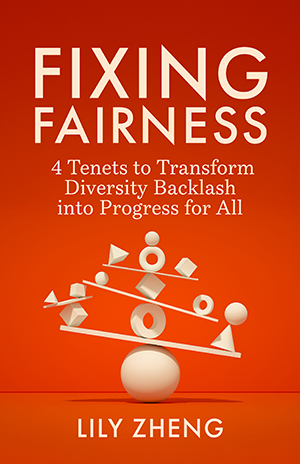
Fixing Fairness: 4 Tenets to Transform Diversity Backlash into Progress for All
Lily Zheng
168 pages, Berrett-Koehler Publishers, 2026
What proportion of Americans do you think agree with a pro-diversity statement like “racial diversity benefits the country”? In a study run by researchers at the University of Wisconsin–Madison asking participants to estimate agreement with 15 pro-diversity statements, they found that guesses clustered around 55 percent.
Now here’s the twist. The actual average amount of support for pro-DEI statements? A whopping 82 percent. The overwhelming majority of respondents simultaneously supported diversity themselves while worrying that they might hold a minority belief.
I could not make up a more hopeful fact than this one. To allow the minority of those committed to hate and exclusion to sow division, reverse progress, limit our potential, and create a future that 82 percent of us object to is absolutely unacceptable.
There’s a good chance that if you’re reading this, you’re a member of that 82 percent. You might not agree with every initiative under the DEI umbrella, or believe that all work calling itself DEI has been executed well. But you certainly don’t believe in the discriminatory, unequal, and cruel vision that right-wing extremists put forth.
Where the work gets hard, though, is what happens after that starting point.
A Pew Research Center survey in 2024 found that support for workplace DEI had dropped to just above 50 percent among Americans. A Post-Ipsos study that same year found that while 69 percent of their respondents supported the work of diversity, equity, and inclusion when given a definition, support fell to 61 percent when respondents evaluated just the acronym of “DEI” on its own.
What these studies tell us is that even though support for the goals of diversity, equity, and inclusion may be widespread, the way workplaces pursue DEI is very much still contentious. Many advocates make the point that popularity shouldn’t be the primary factor behind whether organizations support or do DEI. I agree—it’s effectiveness that matters most. And when it comes to effectiveness, workplace DEI in its current form has a troubling track record.—Lily Zheng
* * *
Imagine you were encouraged by your doctor to seek out a medical procedure that promised to improve your quality of life. And yet, in a review of nearly a thousand scientific studies on the procedure, numerous researchers found that the quality of life for those who had undergone the procedure was no different from that of people who had chosen not to. Other researchers found that depending on how the procedure is undertaken, patients might see benefits for a few days—but any gain would dissipate soon afterward. Still other researchers found that undergoing the procedure might make your quality of life worse.
If I had this information and heard that request, I’d be looking for the nearest authority to report malpractice.
This is the sobering reality behind standalone DEI training, the “unit” of most organization’s approach to DEI: despite its overwhelming prescription in organizations across industry and sector, in study after study, researchers find that it changes neither people’s behaviors nor organizations’ realities for the better.
At best, it leaves attendees no better off than those who don’t attend or it creates lingering benefits that fade in days. At worst, it strengthens stereotypes about marginalized groups, reduces empathy in people with at least one socially “privileged” identity, worsens demographic tensions between groups, exacerbates conscious and unconscious bias, increases people’s willingness to engage in discriminatory behavior, and even results in lower demographic diversity in leadership over time.
Having observed, participated in, and even facilitated some of these workshops in my own work, I’m inclined to agree with the research. One-off DEI trainings fail all who attend them. For people possessing historically marginalized identities, these trainings are far too short and limited in scope to truly solve any enduring organizational problems. For people possessing historically privileged identities, the blame-and-shame approach of these trainings routinely activates threat, resentment, and frustration, or gives them the false confidence that having attended a workshop immunizes them from possibly engaging in discrimination.
Post-workshop, members of this second group often feel like they have to walk on eggshells, like their identities make them “less valuable” than their coworkers, and like their possession of the “wrong” identities makes them deserving of shame. These negative emotions need to go somewhere—and too often manifest as increased hostility and discrimination toward the women, people of color, LGBTQ+ people, and others with historically marginalized identities in their organization.
We Already Know What Works
In the same way that we now have nearly a thousand studies showing us the perils of solving workplace DEI problems with training alone, it turns out that we have scores upon scores of research and case studies showing us exactly what works instead. These four tenets sum up what we workplace researchers and practitioners have long known:
Tenet 1: Outcomes over Good Intentions
We know that utilizing data analytics to measure the results of our efforts, sharing this information transparently, and tying this measurement to internal and external accountability meaningfully changes people’s behavior.
Tenet 2: Environment over Individual
We know that approaching this work as change management to shift the workplace environment works to change behavior at scale.
Tenet 3: Coalitions over Cliques
We know that strategies that bring people together beyond their limited social cliques into larger coalitions and networks work to build shared commitment and prevent intergroup tensions.
Tenet 4: Win-Win over Zero-Sum
We know that framing change work as creating greater abundance for all, rather than using adversarial, blame-and-shame, or zero-sum framings, works to defuse threat and mitigate backlash.
And yet, leaders continue to throw DEI training at the problem, fail to measure the impact of their initiatives, and ignore the need to change their workplace environment. DEI practitioners continue to try and change people’s biases in sixty minutes, pursue identity-related DEI efforts in silos, and focus on assigning blame for inequality and exclusion over creating shared responsibility for fixing it.
Take the example of a workplace I worked with many years ago that, after assessing its employee engagement and retention, found a stark but puzzling gender divide. Women were highly engaged, decently happy, but heavily disadvantaged in promotion rates, pay, and leadership representation. On the other hand, men were undeniably overrepresented in leadership and advantaged in pay and promotion, yet disengaged and miserable.
The organization had pursued the usual avenues but found them lacking. Forming a women’s ERG helped enable the occasional volunteer-organized event, but hadn’t solved the problems women faced in representation, promotions, and pay. Offering more wellness perks hadn’t solved the wellness deficit experienced by men, nor their overall engagement. Bringing in a DEI speaker to lead an hour-long workshop on gender bias in promotions resulted in an informative session that was attended primarily by women.
Women saw men’s lack of attendance as an indication that bias, mentorship, decision-making, and allyship were not priorities for men. Men saw the content focus of these events as an indication that their negative experiences as men didn’t matter and as a confirmation that men were seen as “the problem.”
Employees overwhelmingly saw event programming as the key battleground of the issue, despite the lack of efficacy these events seemed to have. Organizing an ERG, hosting events, and offering wellness perks were implemented because these initiatives were common and popular, but they hadn’t been designed to solve any given problem or meet any given need and so hadn’t achieved impact.
When I worked with this organization’s leadership and passionate employee advocates, our focus was not on implementing a trendy fix, but on truly understanding the root causes of their workplace’s issues. What could explain women’s higher engagement and well-being, but lower access to opportunity, pay, and success? What could explain men’s abysmal well-being and engagement but stronger markers of career success?
In this workplace, it turned out the primary driver was a workplace culture of overwork. Male executives with spouses able to manage household, childcare, and family responsibilities, created impossible expectations for what it meant to succeed, then propagated these expectations throughout the workplace. Employees who could regularly work more than sixty hours a week, respond to emails at midnight every night, and be on call to jump into work-related tasks were handsomely rewarded for their sacrifice. Employees who couldn’t do these things were seen as less committed, less ambitious, and less worthy of being “leadership material.”
This dynamic created a two-tiered workforce. Senior managers and leadership teams were composed almost entirely of overworked men who had little time for nonwork activities, while the entry-to-middle level was composed of women with far more flexibility but next to no long-term career prospects. Any woman aiming for senior positions was held to an expectation of productivity that was impossible to meet without overwork. Any man seeking greater wellness and balance faced concern over whether they were “committed enough.”
To fix this problem, we needed to do far more than hold a handful of workshops.
Coordinating with curious and sympathetic executives, we started from the top by shattering the illusion that overwork was any marker of skill or productivity. What actually set apart the most successful workers from their colleagues, if not putting in long hours? In this organization, it was possessing the emotional intelligence to build and maintain strong relationships; the management chops to coordinate teams and protect psychological safety; and the core operational expertise to ensure that organizational processes stayed functional.
Even with this information, executives weren’t entirely convinced to abandon overwork norms and rituals that had become meaningful. So, we focused on building alternative rituals that they could adopt to build purpose and meaning in their roles, without necessitating 3 a.m. emails.
We piloted a new practice of having executives and senior managers celebrate “smart wins” instead of “hard sacrifices,” sharing stories about how creativity and ingenuity created value by working smarter, not longer hours. We also normalized the recognition that workers have families, personal lives, and needs outside of work, encouraging leaders to share more about their values and meaningful non-work activities.
There were concrete practices as well, like getting executives to use the Schedule Send feature so emails went out at 8 a.m. instead of midnight, and communicating that employees had a “right to disconnect.” We also undertook an ambitious initiative to update formal evaluation and promotion criteria to better reward productivity and problem-solving—rather than just busyness and likability.
One of the primary focuses of this work was to build and engage a broad coalition of people with something to gain by transforming their organization for the better. By focusing on the material benefits of building a better organization for everyone and using our understanding of the environment to design targeted initiatives, we built a broad tent of people willing to work toward the win-win.
Years later, when I was brought back to help them interpret their latest employee survey data, I was proud to see their progress. They had reduced many of their gender disparities by more than half. Men were far more likely to take time off and utilize flexible work benefits. Women were more likely to be managers and senior managers, and their average time between promotions was approaching that of men. The ironic thing is that we had made enormous strides in resolving gender disparity but had hardly ever talked about gender, at least not in the surface-level ways people had come to expect from workplace DEI.
What we did was follow the tenets. We learned the root causes of inequality, measured them, and thoughtfully designed solutions to solve those problems. We resisted the urge to “fix people,” and instead brought people together to change the workplace environment they all shared. We build a coalition of the many, instead of pointing fingers at any one group to solve the whole problem. And we constantly, relentlessly, communicated the win-win of a more human-centered workplace for everyone in it.
This is the kind of reset and reimagining of workplace DEI that so many of our workplaces need, toward a commonsense approach defined by the four tenets of tangible outcomes, working-environment changes, broad coalitions, and win-win framing, to achieve benefit for all.
I call this work FAIR, the next evolution of workplace DEI. As workplaces and as a society, when we pursue the universal outcomes of fairness, access, inclusion, and representation for everyone, drawing on our differences to bring us together for shared empowerment, learning, and benefit, we can stop backlash in its tracks and make good our commitments to progress for all.
Adapted from Fixing Fairness: 4 Tenets to Transform Diversity Backlash into Progress for All. Reprinted by permission of Berrett-Koehler Publishers. Copyright © 2026 by Lily Zheng